

On this page
Before the turn of the 20th century, starting and running a car was an unpredictable, often dangerous affair. Early internal combustion engines, dating back to Étienne Lenoir's first use of a spark plug in 1860 (Spark plug, Wikipedia), relied on low-voltage "make-and-break" ignition systems or heated glow-tubes to ignite fuel. These mechanical systems had moving parts inside the intense heat and pressure of the combustion chamber, which meant they quickly built up soot, wore out, or simply failed. To make cars faster and more reliable, engineers needed a way to deliver a hot spark inside the cylinder without relying on internal moving mechanisms.
In 1902, the solution arrived when Gottlob Honold, an engineer who had started as an apprentice in Robert Bosch's workshop, invented the high-voltage magneto ignition system paired with the first commercially viable fixed-gap spark plug (Gottlob Honold, Wikipedia). Before this breakthrough, English engineer Frederick Richard Simms had collaborated with Bosch in the late 1890s on early low-tension magnetos. However, it was Honold who successfully designed the high-voltage version that could fire a spark plug directly, creating a hot spark of relatively long duration.
Why did early car engines fail?
The internal combustion engine requires a precise spark to ignite the fuel-air mixture. In the late 1890s, engines ran slowly largely because their ignition systems could not keep up with the demands of higher speeds. The common "make-and-break" devices created a low-voltage spark by mechanically separating two contacts directly inside the cylinder. The constant mechanical shock and carbon fouling from combustion limited how fast the engine could turn before the ignition mechanism failed.
Robert Bosch tasked his team with finding a better way. The goal was to generate the spark outside the brutal environment of the cylinder and deliver it to a durable, fixed point inside.
How does a Robert Bosch magneto ignition spark plug work?
Honold's 1902 invention solved the problem by separating the generation of electricity from the delivery of the spark. The system relied heavily on Faraday's laws of electromagnetic induction to transform a small voltage into a massive one (Ignition magneto, Wikipedia).
Here is the step-by-step sequence of how Honold's high-tension magneto worked:
The Primary Winding: A rotating magnet (the magneto) generated a low-voltage current of several hundred volts in a primary coil of wire.
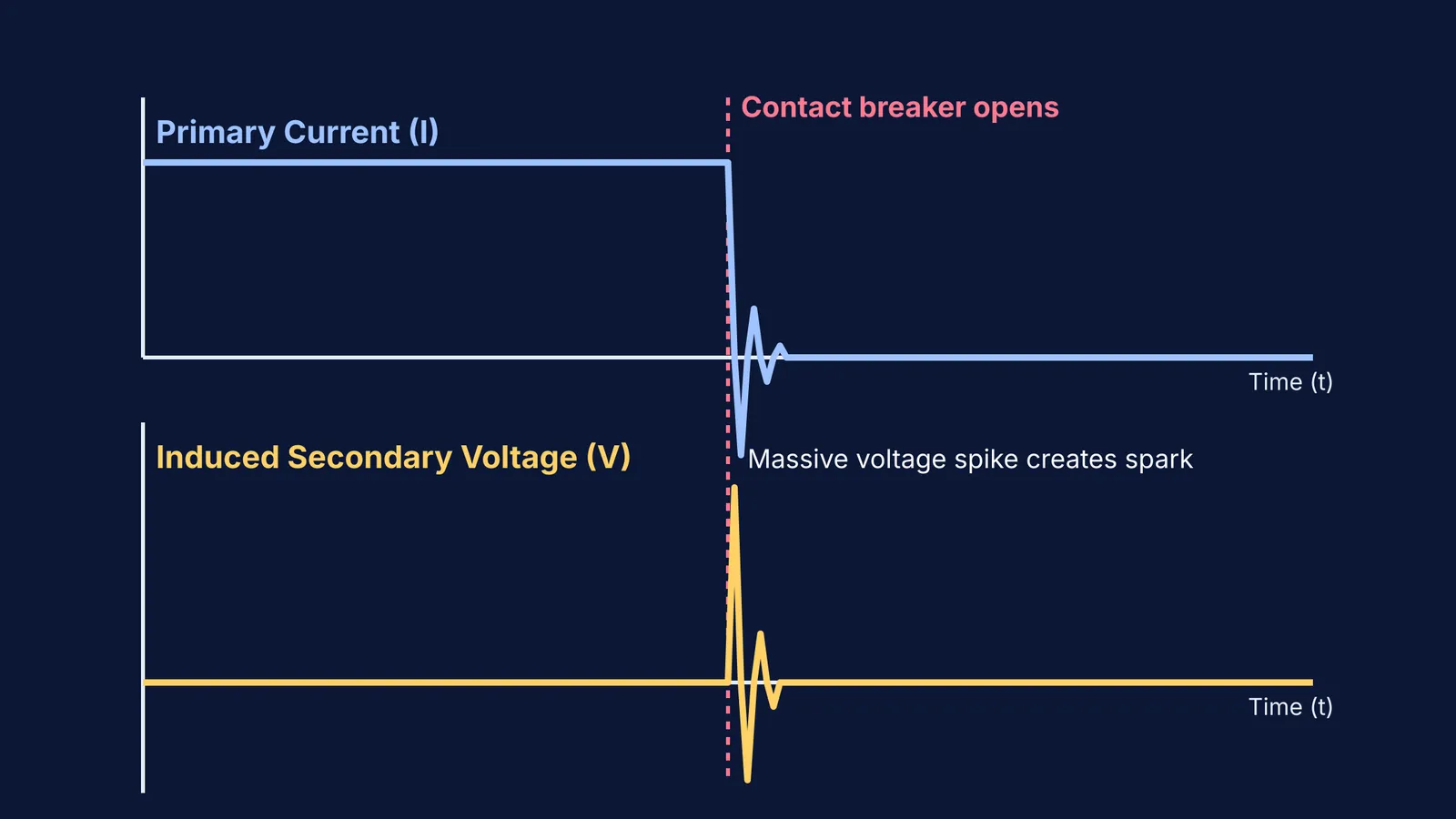
The Sudden Break: A mechanical contact breaker on the outside of the engine suddenly opened, interrupting the primary current.
The Massive Spike: Because the current dropped to zero almost instantly, the magnetic field collapsed rapidly. According to Faraday's law of induction, the induced voltage depends on the rate at which the magnetic flux changes.
The Secondary Winding: A secondary coil is built with roughly 100 times as many turns of wire as the primary coil. Sitting within the rapidly collapsing field, this coil induced an electromotive force (EMF) of several tens of thousands of volts, typically reaching between 12,000 and 25,000 volts.
The Fixed-Gap Spark Plug: This massive high-tension voltage was sent through an insulated wire to the spark plug. With enough voltage, the electricity could bridge the fixed gap between the nonmoving electrodes, creating a hot, reliable spark.
When studying electromagnetic induction, the idea that stopping a current creates a much larger voltage than starting one can be difficult to grasp. If you are struggling to picture how a rapidly collapsing magnetic field induces such a massive EMF, you can use the Fermi Simulation Lab to watch the magnetic flux change in real time as a circuit breaks.
Was the spark plug a breakthrough for the automotive industry?
Because the spark plug itself had no moving parts, it could easily withstand the high temperatures and pressures of combustion. This high-voltage magneto ignition system allowed engines to run at much higher compression ratios and faster speeds.
The system quickly proved its durability on the race track. On July 2, 1903, a German Mercedes equipped with the new Bosch ignition won the prestigious Gordon Bennett Cup in Athy, County Kildare, Ireland (Gordon Bennett Cup, Wikipedia)). Driven by Camille Jenatzy, this victory on a course marshalled by 7,000 police officers showcased the reliability of the high-tension magneto to the world. It proved that cars could be trusted for long-distance travel and high-speed racing without their engines failing.
While modern cars use battery-powered electronic ignition coils instead of magnetos, they still rely on the same fundamental principles of induction to fire fixed-gap spark plugs. The basic operating principle of the spark plug designed by Honold and Bosch in 1902 remains largely unchanged in gasoline engines today.
If you are exploring the physics behind magnetic induction and how transformers step up voltages, you can read more about Faraday's law for a changing B: the circulating E inside a solenoid. You can also see another early application of this principle by exploring Nicholas Callan and the induction coil that made big sparks, or practice predicting the direction of the current in Faraday's and Lenz's laws: finding the induced current direction.


