

On this page
When we look up at the night sky, we see visible light. But the universe is also blazing with X-rays—high-energy radiation produced by some of the most violent events in the cosmos. Because the Earth's atmosphere absorbs X-rays, protecting life on the ground, astronomers didn't know these cosmic sources existed until we could send detectors above the air.
In 1962, the Italian-American astrophysicist Riccardo Giacconi changed that. His team launched an Aerobee 150 sounding rocket above the atmosphere to look for X-rays bouncing off the Moon. Instead, the detector found Scorpius X-1, the first X-ray source discovered beyond the Solar System (Wikipedia).
Why did Riccardo Giacconi use a rocket for X-ray astronomy?
You cannot do X-ray astronomy from the ground. X-rays from space hit atoms in the Earth's upper atmosphere and are absorbed long before they reach sea level. To detect them, you have to go high. In the late 1950s and early 1960s, that meant using rockets.
On June 12, 1962, Giacconi's team at American Science and Engineering launched an Aerobee 150 rocket. It carried a soft X-ray detector designed by Frank Paolini. The flight was originally meant to check if the Moon emitted X-rays, under a contract with the United States Air Force to explore the lunar surface before astronauts were launched to the Moon (Wikipedia).
Instead of the Moon, the detector picked up a massive signal from a source deep in the Milky Way. Located in the constellation Scorpius, it became known as Scorpius X-1.
What is Scorpius X-1?
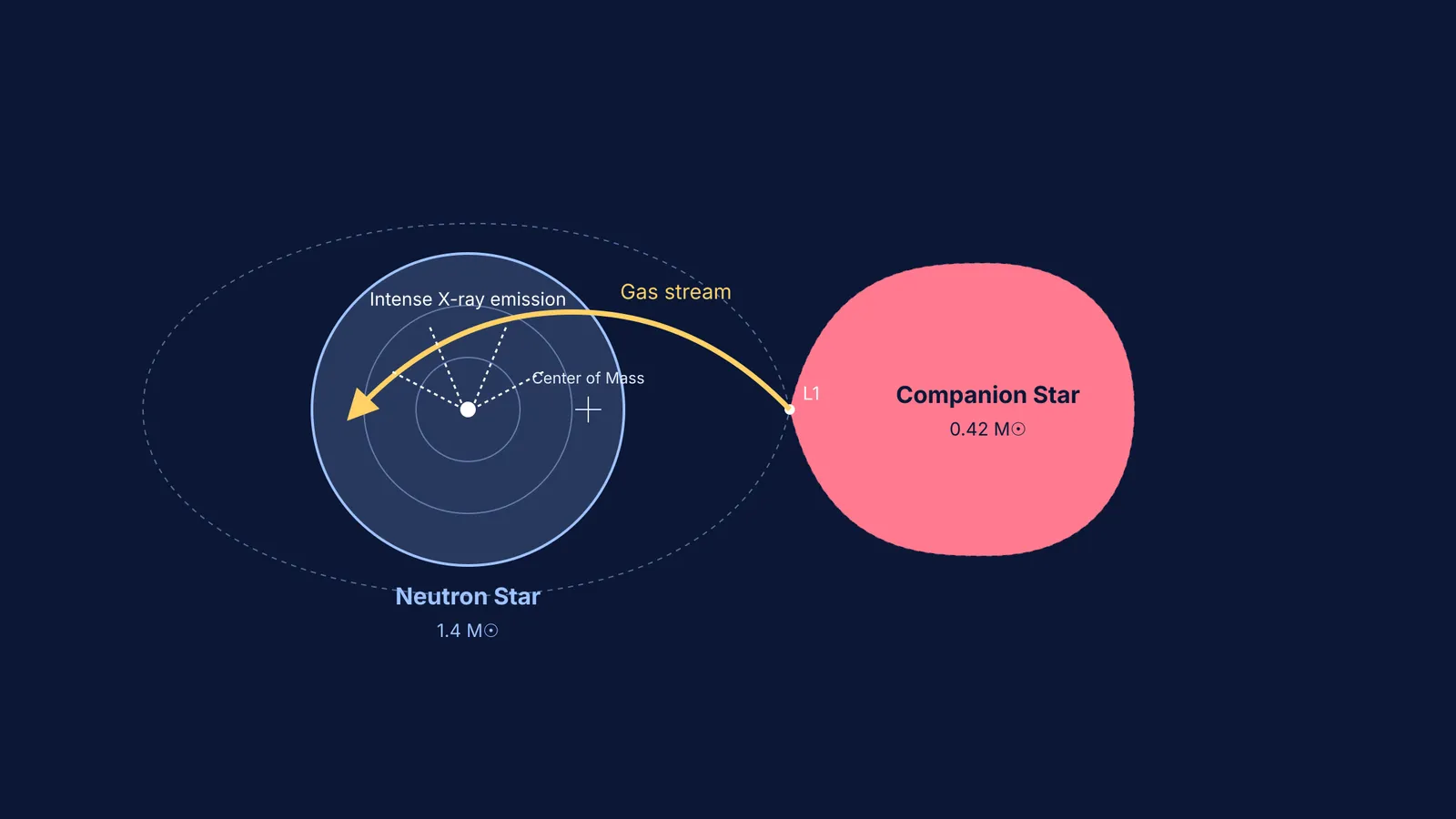
Today, we know Scorpius X-1 is an X-ray binary system located about 9,000 light years away. It consists of a dense neutron star, which is roughly 1.4 times the mass of the Sun, and a smaller companion star of about 0.42 solar masses (Wikipedia).
The intense gravity of the neutron star pulls gas off its companion. This gas spirals inwards, forming a hot accretion disk. As the material accelerates and compresses, it heats up to millions of degrees, releasing enormous amounts of energy. Scorpius X-1's X-ray output is 2.3 × 10³¹ watts, making it about 60,000 times brighter than the total luminosity of our Sun (Wikipedia).
If you are trying to picture how this works, the Fermi Simulation Lab provides interactive simulations for the ideas that are easier to see than to read. You can explore how mass transfers between stars in a binary system and watch the accretion disk form.
How did X-ray astronomy change how we see the universe?
Before 1962, astronomers mostly studied the universe in visible light and radio waves. Scorpius X-1 proved that the cosmos is full of incredibly energetic, high-temperature objects that are completely invisible to standard telescopes.
The discovery won Giacconi a share of the 2002 Nobel Prize in Physics "for pioneering contributions to astrophysics, which have led to the discovery of cosmic X-ray sources". He went on to lead the team that built Uhuru, the first orbiting X-ray satellite, and later the Chandra X-ray Observatory, which was launched in 1999 and is still in space today (Wikipedia).
When you are studying physics, topics like gravitation, angular momentum and the photoelectric effect can feel abstract. Fermi's AI tutor can help you connect these equations to real phenomena. The tutor teaches rather than just answering questions: it holds a line of reasoning across a session, working out what you already know and building a plan to take you forward.
How do X-ray binaries work?
If you are studying mechanics, Scorpius X-1 is a perfect example of conservation laws in action.
The Roche Lobe: Gravity and rotation create a teardrop-shaped zone of influence around each star, called a Roche lobe. When the companion star swells to fill its Roche lobe, its gas spills over the balance point (the L1 Lagrangian point).
Conservation of Angular Momentum: As the gas falls toward the neutron star, it cannot fall straight down because it is orbiting. Just like a skater pulling their arms in, the gas spins faster as it gets closer, forming a flat, rapidly rotating accretion disk.
Friction and Heat: The gas in the inner parts of the disk orbits faster than the gas on the outside. This friction generates immense heat, converting gravitational potential energy into the X-rays detected by Giacconi's rocket.


