

On this page
When your body encounters a new pathogen, it has to mount a defence. But how do the highly specific, targeted immune cells—the ones that remember a virus for decades—know exactly what to attack? The answer lies in a rare cell discovered by Ralph M. Steinman.
What was the Ralph Steinman dendritic cells discovery?
In 1973, Ralph M. Steinman and his colleague Zanvil A. Cohn were studying cell populations in peripheral lymphoid organs like the spleen and lymph nodes of mice at Rockefeller University. They noticed a small fraction of cells that looked completely different from known immune cells. In their preparations, these novel cells made up just 0.1 to 1.6% of the total nucleated cells (*The Journal of Experimental Medicine*).
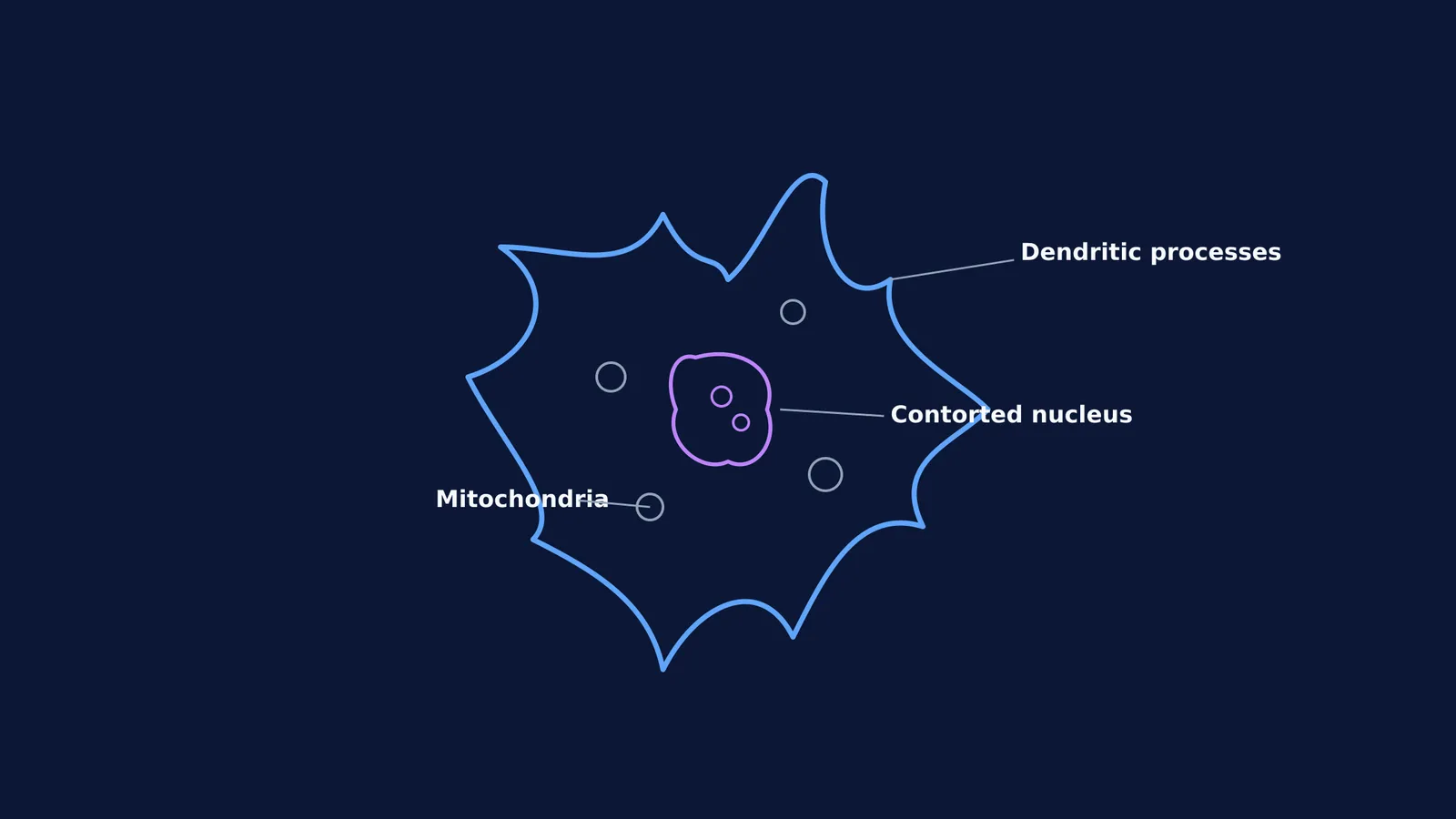
These cells had distinct morphological features, including large, contorted nuclei and processes of varying length and width that undergo characteristic movements. Steinman proposed the name "dendritic cells" for this novel cell type.
Unlike macrophages, which engage in active endocytosis to engulf cellular debris, dendritic cells did not appear to do so. Instead, Steinman spent the following decades meticulously showing that dendritic cells have a unique capacity to activate T cells.
How do dendritic cells link innate and adaptive immunity?
Your immune system operates in two main phases. The innate immune system is the rapid, first line of defence against pathogens. The adaptive immune system is the later stage of the immune response, where microorganisms are cleared and immunologic memory is formed for future protection.
Dendritic cells act as the vital messengers between these two systems. When an innate immune response is triggered, dendritic cells sense these signals and use them to control the activation of T cells, kickstarting the targeted adaptive immune response.
If you want to strengthen your understanding of how the body fights disease, the Fermi Concept Library maps out every concept in biology, including the detailed roles of innate and adaptive immunity.
How does the innate immune system sense pathogens?
While Steinman focused on the bridge to adaptive immunity, the other half of the 2011 Nobel Prize went to Bruce A. Beutler and Jules A. Hoffmann for their discoveries concerning the activation of innate immunity. The innate immune system needs a way to detect invading microorganisms immediately.
In 1996, Hoffmann discovered that a specific gene in fruit flies, called *Toll*, was essential for sensing pathogenic microorganisms and mounting a successful defence. Building on this, Beutler discovered in 1998 that mice use a similar receptor, known as a Toll-like receptor (TLR), to recognize bacterial products. These discoveries revealed that both mammals and fruit flies use similar mechanisms to trigger the body's first line of defence when pathogens are detected (NobelPrize.org).
Why did Ralph Steinman win the Nobel Prize?
For decades, Steinman faced skepticism but worked tirelessly to prove the significance of dendritic cells, showing they have a unique capacity to activate and regulate adaptive immunity. His persistence transformed our understanding of immunology, opening entirely new avenues for vaccine development and attempts to stimulate the immune system to attack tumours.
In recognition of his work, Ralph Steinman was awarded one half of the 2011 Nobel Prize in Physiology or Medicine (NobelPrize.org). The other half was awarded jointly to Bruce A. Beutler and Jules A. Hoffmann for their discoveries concerning the activation of innate immunity. Sadly, Steinman passed away before the news of his Nobel Prize reached him.
A framework for studying immune cells
When studying human health and disease for exams like NEET-UG, immune cells can easily blur together. Use this simple checklist to distinguish them in your notes:
Morphology: What does the cell look like? (e.g. dendritic cells have processes of varying length and width).
Function: What is its primary job? (e.g. dendritic cells present antigens to T cells; macrophages engulf and digest cellular debris).
Location: Where is it found before and after activation? (e.g. dendritic cells patrol tissues like the skin, then migrate to lymph nodes when activated).
System: Does it belong to the innate or adaptive immune system, or does it bridge both?
By categorising cells this way, you can easily map the sequence of events during an immune response.
More biology topics
If you are revising human physiology and health, explore our guides to Opioids, cannabinoids and coca alkaloids: NEET's drug-abuse facts and The human skeleton: counting axial and appendicular bones.


