

On this page
Why did Maxwell predict that light exerts pressure?
In 1873, James Clerk Maxwell proved that light is an electromagnetic wave governed by Maxwell's equations. He showed that electromagnetic waves carry momentum in oscillating electric and magnetic fields. In §792 of his treatise, Maxwell deduced that radiation striking a surface exerts a mechanical push equal to the wave's volume energy density [Lebedev, 1901, https://doi.org/10.1002/andp.19013111102].
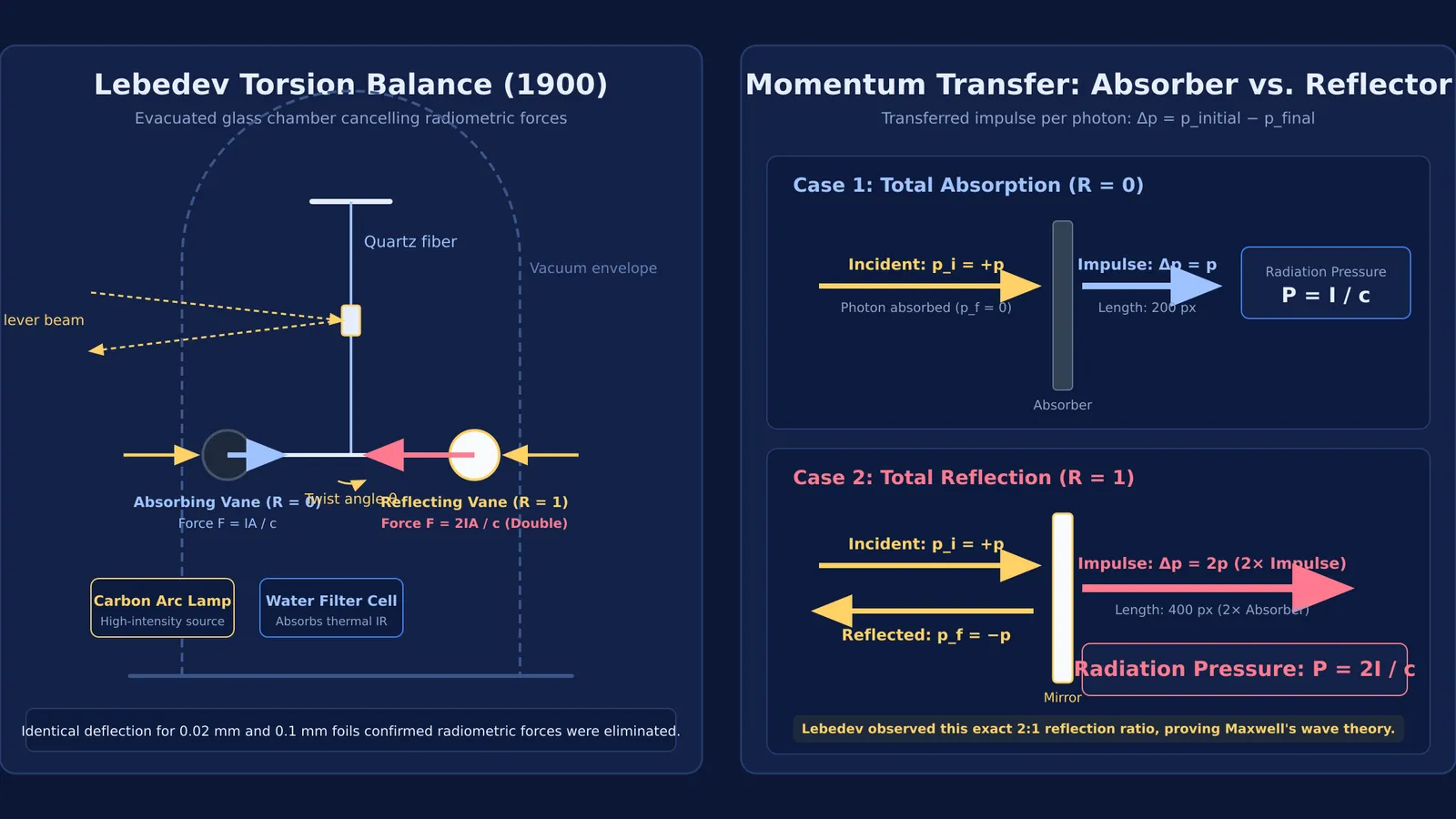
For beam intensity I and light speed c (3.0 × 10⁸ m/s), wave energy density is u = I / c. Striking an absorbing surface at normal incidence, incident momentum is absorbed, giving radiation pressure P = I / c. On a perfect reflector, radiation reverses direction; doubling the momentum change per unit time doubles radiation pressure to P = 2I / c.
Adolfo Bartoli reached the same conclusion in 1876 using thermodynamics. He proved that without radiation pressure, moving a mirror against radiation could transfer heat from cold to hot without external work, violating the second law of thermodynamics. Yet for three decades, Maxwell's prediction remained unconfirmed in the laboratory.
Why was radiation pressure so difficult to detect?
Radiation pressure is faint in everyday life. As documented in OpenStax University Physics, electromagnetic radiation imparts momentum proportional to wave intensity. In bright sunlight with intensity roughly 1,000 W/m², an absorbing surface experiences P = 1,000 / (3.0 × 10⁸) ≈ 3.33 × 10⁻⁶ N/m².
This is 3.33 micropascals—less than one thirty-billionth of standard atmospheric pressure (101,325 Pa). On a disc 5 mm across, total force is under 7.0 × 10⁻¹¹ newtons, roughly the weight of a microscopic dust grain.
In the 1870s, William Crookes observed spinning vanes in his radiometer and believed he had detected light pressure. However, the vanes rotated backward: blackened faces retreated, whereas Maxwell predicted reflective surfaces should experience twice the forward push.
The rotation was driven by the radiometric effect rather than radiation pressure [Lebedev, 1901, https://doi.org/10.1002/andp.19013111102]. In a partial vacuum, blackened faces absorb light and warm adjacent gas molecules. These molecules recoil with higher speeds, while convection and thermal transpiration around vane edges create forces thousands of times stronger than radiation pressure, swamping Maxwell's signal.
How did Pyotr Lebedev measure the pressure of light?
To isolate true light pressure from thermal gas forces, Russian physicist Pyotr Lebedev spent five years refining an apparatus at Moscow University. He reported preliminary findings in August 1900 at the International Congress of Physics in Paris and published his definitive results in Annalen der Physik in 1901 [Lebedev, 1901, https://doi.org/10.1002/andp.19013111102].
Lebedev eliminated thermal interference through three innovations:
Ultra-high vacuum: Mercury pumps evacuated the glass chamber to a fraction of a millitorr, removing gas molecules that exert radiometric forces.
Ultrathin foils: Circular vanes 5 mm across were cut from platinum, aluminium, nickel, and mica [Khramov, 1986, https://doi.org/10.1070/pu1986v029n12abeh003609]. Mica discs were under 0.01 mm thick, and platinum foils were tested at 0.02 mm and 0.1 mm, keeping front-to-back temperature differences negligible.
Rapid exposure and filtering: Water cells filtered infrared rays from an arc lamp, while rapid shutters and mirrors illuminated alternate faces before thermal gradients could form.
Suspended on a fine quartz fiber, the vanes formed a torsion balance. When the arc lamp illuminated a vane, light momentum twisted the fiber through an angle θ, tracked with a mirror and optical scale.
Crucially, deflection per unit radiant energy was identical for both 0.02 mm and 0.1 mm platinum foils [Lebedev, 1901, https://doi.org/10.1002/andp.19013111102]. Radiometric gas forces would have produced steeper thermal gradients and larger deflections on thicker foils. Reflective vanes showed twice the deflection of blackened vanes, matching Maxwell's ratio within 20% error. Ernest Fox Nichols and Gordon Ferrie Hull confirmed these findings in 1901, later reaching 1% precision [Nichols and Hull, 1901, https://doi.org/10.1103/PhysRevSeriesI.13.307].
What do radiation pressure calculations look like in practice?
Competitive examinations such as JEE Main, JEE Advanced, and NEET-UG regularly test radiation pressure and electromagnetic wave intensity. Standard textbooks like OpenStax University Physics formulate these relationships directly from wave momentum and intensity. Here is how to work through the mechanics.
Problem: An arc lamp beam of intensity I = 2,400 W/m² strikes a circular vane of radius r = 2.5 mm at normal incidence. Calculate the radiation force if the vane is totally absorbing (reflection coefficient R = 0) versus totally reflecting (R = 1).
Step 1: Vane area Area A = πr² = 3.1416 × (2.5 × 10⁻³ m)² ≈ 1.963 × 10⁻⁵ m².
Step 2: Total absorption P_abs = I / c = 2,400 / (3.0 × 10⁸) = 8.0 × 10⁻⁶ N/m². Force F_abs = P_abs × A = (8.0 × 10⁻⁶) × (1.963 × 10⁻⁵) ≈ 1.57 × 10⁻¹⁰ N.
Step 3: Total reflection P_ref = 2I / c = 2 × 2,400 / (3.0 × 10⁸) = 1.6 × 10⁻⁵ N/m². Force F_ref = P_ref × A = (1.6 × 10⁻⁵) × (1.963 × 10⁻⁵) ≈ 3.14 × 10⁻¹⁰ N.
For mixed surfaces with reflectance R, the general expression is P = (1 + R) I / c. To practice problems on photon momentum and radiation pressure, the Fermi Problem Library provides worked problems with a step-by-step solver that explains the reasoning rather than printing an answer.
To visualise how wave packets and fields transfer momentum, the Fermi Simulation Lab provides interactive simulations for the ideas that are easier to see than to read. To explore connections across optics, thermodynamics, and modern physics, the Fermi Concept Library includes every concept in physics, each with its own lesson and its place in the map.


