

On this page
What is Ptolemy's theorem for a cyclic quadrilateral?
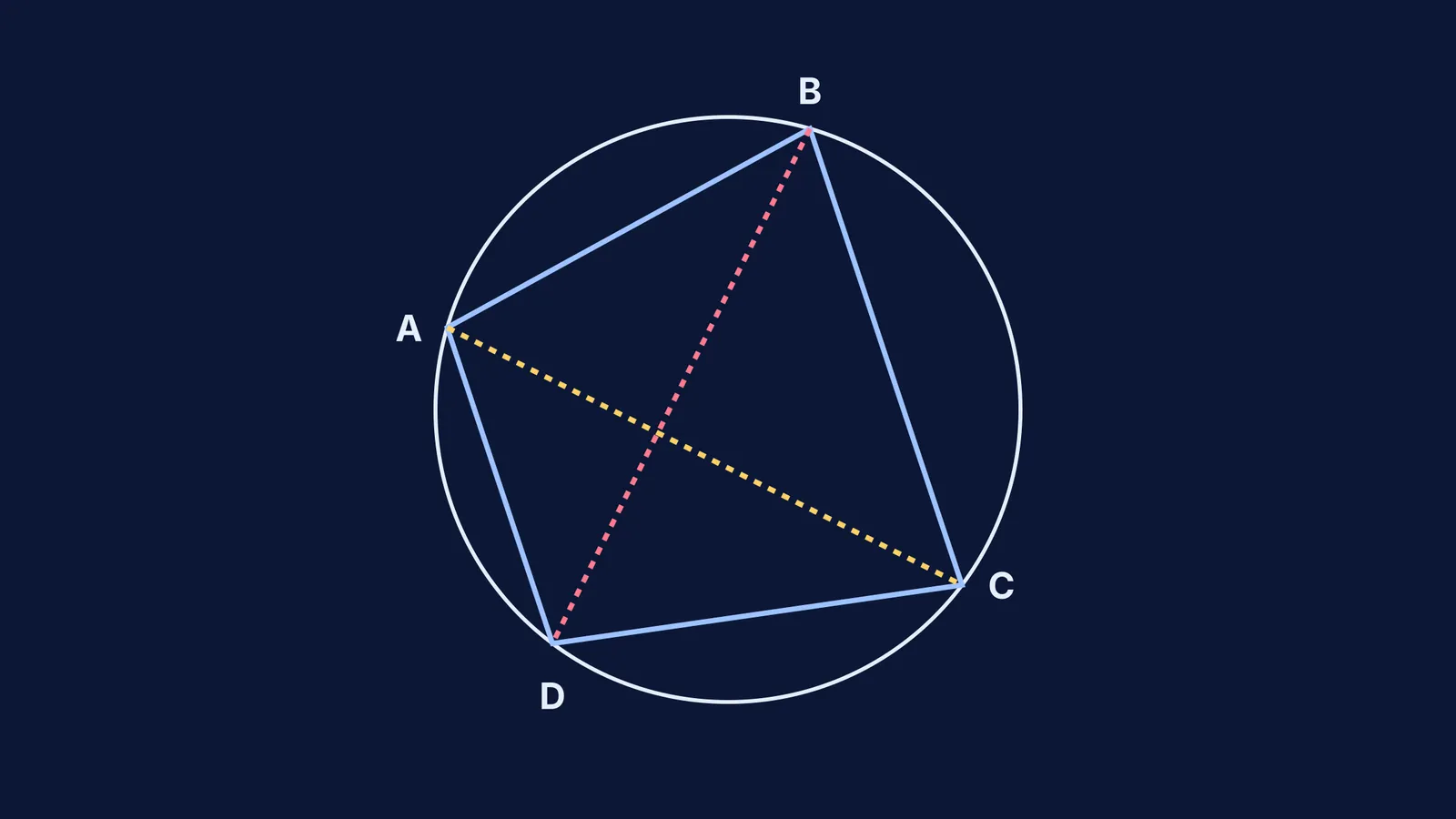
A cyclic quadrilateral is a four-sided shape whose vertices all lie on a single circle. For any such shape, Ptolemy's theorem states that the product of the lengths of the diagonals is equal to the sum of the products of the lengths of the pairs of opposite sides.
If the vertices are A, B, C, and D in order, the lengths of the diagonals are AC and BD, and the sides are AB, BC, CD, and DA. The theorem gives a direct equation: AC × BD = (AB × CD) + (BC × DA)
This result is named after the Greek astronomer and mathematician Claudius Ptolemy. He completed his influential treatise, the *Almagest*, around AD 150. While modern students see this theorem as a pure geometry problem, Ptolemy used this theorem as a primary tool to create his table of chords. His chord table was an early version of a sine table, used extensively for tracking celestial motions, predicting eclipses, and mapping the stars in the night sky.
How do you prove Ptolemy's theorem?
The standard proof of Ptolemy's theorem relies on the properties of similar triangles and angles subtended by the same arc. You start by drawing a line from one vertex to a diagonal to create equal angles. This single construction splits the cyclic quadrilateral into proportional shapes.
Locate a point E on the diagonal AC such that the angle ABE is exactly equal to the angle CBD.
Because angles subtended by the same arc (arc AD) are equal, the angle BAE equals the angle BDC. This makes the triangle ABE similar to the triangle DBC.
From these similar triangles, the ratio of their corresponding sides gives AB / BD = AE / CD. When you rearrange this fraction, you get AB × CD = AE × BD.
Following the same logic, because angle ABE equals angle CBD, adding angle EBD to both means angle ABD equals angle EBC. Since angles subtended by arc DC are equal, angle ADB equals angle ECB. Therefore, the triangle EBC is similar to the triangle ABD.
This second pair of similar triangles gives the relationship BC / BD = EC / DA, which becomes BC × DA = EC × BD.
Adding the two results together gives (AB × CD) + (BC × DA) = (AE + EC) × BD. Since the segments AE and EC together make up the full diagonal AC, the final equation becomes AC × BD = (AB × CD) + (BC × DA), and the proof is complete.
If you ever forget which side corresponds to which triangle while practising, the Fermi Problem Library has worked problems with a step-by-step solver that explains the reasoning rather than printing an answer.
Where is Ptolemy's theorem used in exams?
Ptolemy's theorem is a frequent tool in competitive exams because it turns complex geometry into straightforward algebra. It is particularly useful for finding the lengths of diagonals in regular polygons or when a circle through three given points has a fourth point added to form a cyclic quadrilateral.
Here is a worked example to show how it saves time on a test. Imagine a cyclic quadrilateral ABCD with side lengths AB = 3, BC = 4, CD = 5, and DA = 6. If you know the diagonal BD = 7, you can find the length of AC directly without calculating any interior angles or applying the cosine rule.
Multiply the opposite sides: (3 × 5) + (4 × 6) = 15 + 24 = 39.
Set this equal to the product of the diagonals: AC × 7 = 39.
Divide by 7 to get the final answer: AC = 39/7.
The theorem provides a direct way to prove the Pythagorean theorem. A rectangle is simply a cyclic quadrilateral where the opposite sides are equal (AB = CD and BC = DA) and the diagonals are equal (AC = BD). When you substitute these values into Ptolemy's equation, you get AC × AC = (AB × AB) + (BC × BC), which simplifies directly to the famous AC² = AB² + BC².
Another common application is finding the diagonals of regular polygons. For example, if you take four consecutive vertices of a regular pentagon to form a cyclic quadrilateral, applying Ptolemy's theorem yields the golden ratio when you divide the diagonal's length by the side's length. This avoids heavy trigonometric calculations.
Finally, the theorem can be used to derive angle sum and difference formulas in trigonometry. By setting the diameter of the circumcircle to 1, the lengths of the sides become the sines of the angles they subtend. This geometric approach was the original method Ptolemy used to calculate the exact values of sin 18° and cos 36°, derived step by step in early astronomy.
When geometry problems are hard to picture, tracing the shapes out visually helps. The Fermi Simulation Lab offers interactive simulations for the ideas that are easier to see than to read.


