

On this page
Sir Proby Thomas Cautley (1802–1871) was an English engineer and palaeontologist who conceived one of the greatest feats of 19th-century civil engineering (Wikipedia). At a time when modern heavy machinery did not exist, he designed an irrigation network that altered the geography of northern India.
Just as Blaise Pascal: pressure, a mountain barometer and probability laid the early groundwork for understanding fluid mechanics, 19th-century engineers had to apply these physical principles on a colossal scale to manage the flow of water across hundreds of miles.
Why was the Upper Ganges Canal built?
The Upper Ganges Canal was constructed primarily to "famine-proof" the Doab region, the fertile tract of land situated between the Ganges and Yamuna rivers (Wikipedia). Following the devastating Agra famine of 1837, Cautley proposed a massive, reliable irrigation system that could sustain agriculture through severe droughts.
Digging of the canal officially began in April 1842. Cautley faced stiff opposition from officials who thought the terrain was too difficult, and he lacked an established supply chain for materials. To solve this, he had to build his own brick kilns and make his own mortar on site. Despite the tremendous physical and financial hurdles, his vision prevailed. When the canal formally opened on 8 April 1854, its main channel was 348 miles (560 km) long, and the various distributaries spanned over 3,000 miles (4,800 km) in total length (Wikipedia).
If you are studying the principles of hydrodynamics that make such continuous fluid systems possible, Fermi's AI tutor can work out what you already know and build a plan for the session, so you sit down to a clear next step.
How does the Solani Aqueduct cross the river?
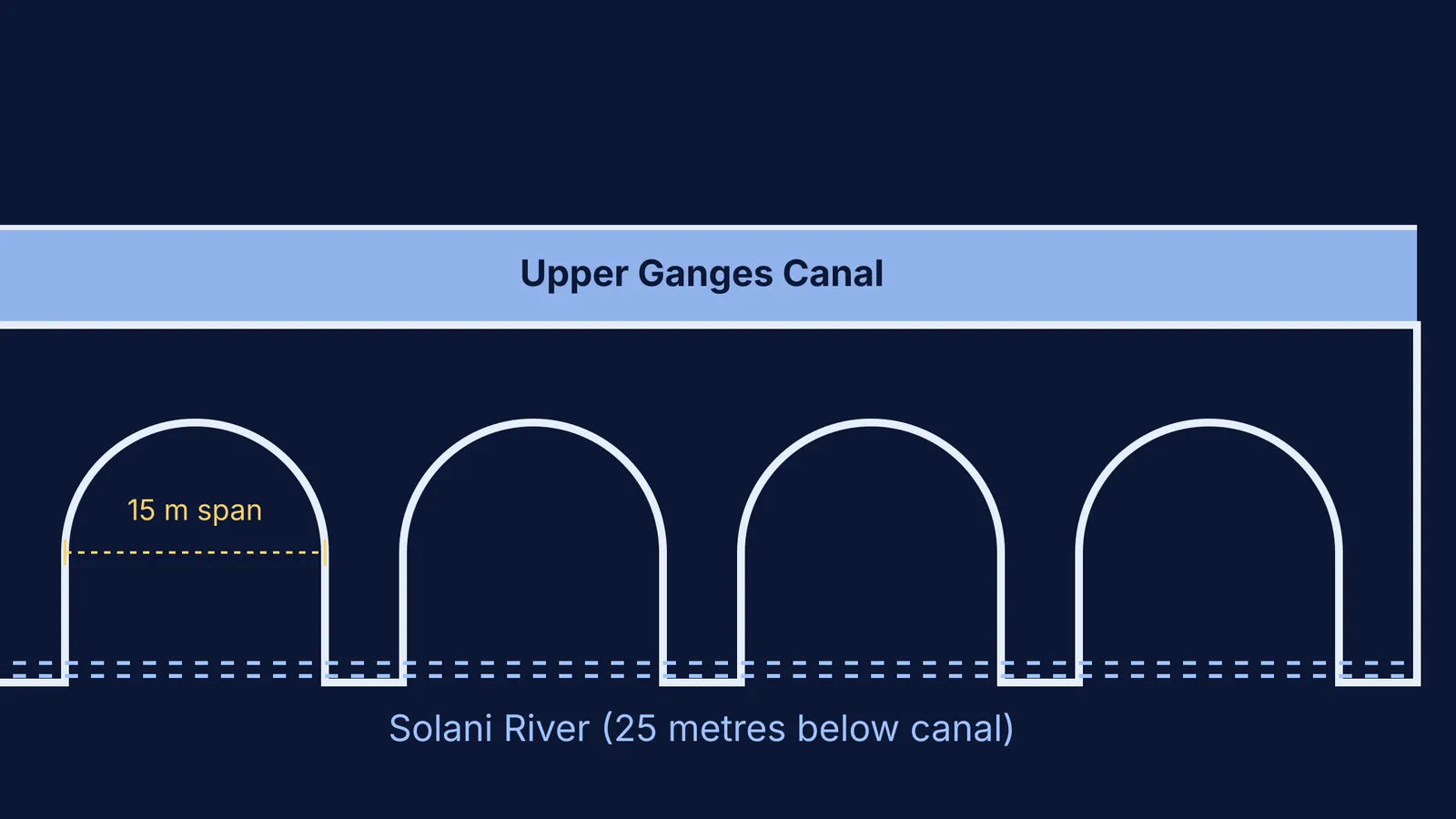
The most challenging obstacle of the entire canal project was the Solani River valley near Roorkee. Near Roorkee, the land fell away sharply, creating a massive topographical depression, and Cautley had to build an aqueduct to carry the canal for half a kilometre over the valley (Wikipedia). As a result of this elevation maintenance, at Roorkee the canal water is 25 metres higher than the original river flowing beneath it.
India's first aqueduct was constructed over the Solani river here as part of the Ganges Canal project, which itself was India's first irrigation work in North India (Wikipedia). The immense weight of the flowing water had to be supported by a massive bridge made of millions of locally fired bricks, resting on arches that allowed the seasonal river to pass underneath undisturbed.
When you tackle problems on fluid mechanics: pressure, buoyancy and Bernoulli mistakes to avoid, picturing these massive structures helps you understand the sheer force water exerts. For concepts that are hard to picture mentally, the Fermi Simulation Lab provides interactive simulations for ideas easier to see than read.
What is the legacy of Roorkee's canal?
Building this enormous canal system eventually led to the establishment of the first engineering college in India. The College of Civil Engineering at Roorkee was founded in 1847 to train the local engineers and surveyors needed for the project, and it is now known as the Indian Institute of Technology (IIT) Roorkee (Wikipedia).
To move the millions of tons of earth and bricks required for the aqueduct's embankments, Cautley built the Solani Aqueduct Railway. A steam engine named *Jenny Lind* pulled a freight train in Roorkee on 22 December 1851 (Wikipedia). This milestone occurred 14 years after the first freight trains ran in Chennai in 1837, marking one of the earliest uses of steam locomotion in northern India. In recognition of his extraordinary public service and engineering brilliance, Cautley was made a Knight Commander of the Order of the Bath in 1854 (Wikipedia).
The Cautley Framework for Exam Prep
When preparing for rigorous exams like JEE Main or NEET-UG, applying an "engineering mindset" can prevent you from feeling overwhelmed:
Make your own bricks: Cautley could not simply order millions of bricks; he had to build the kilns to manufacture them first. If your fundamentals are weak in a subject, stop rushing to practice advanced problems and take the time to rebuild your basic concepts.
Measure the drop: Cautley meticulously mapped the exact elevations before a single shovel hit the ground. Take diagnostic mock tests to find exactly where your knowledge drops off.
Build the aqueduct: When you hit a major gap in your understanding (like the Solani river valley), build a bridge. Use targeted, intensive study sessions to safely cross the gap instead of hoping it won't appear on the exam.
If you find yourself making wrong-method mistakes while building these mental bridges, the Fermi Problem Library offers a step-by-step solver that explains the reasoning rather than just printing an answer.


