

On this page
In the 19th century, chemists faced a practical problem: generating gases like hydrogen or hydrogen sulphide safely. The available tools, such as the Marsh apparatus, were difficult to control. Once a reaction started, it would run until the chemicals ran out, wasting materials and releasing toxic fumes into the laboratory.
Around 1844, the Dutch pharmacist and instrument maker Petrus Jacobus Kipp published a design for a three-globe glass device that could make gas on demand. The first functional glass versions were made by the German glassblower Heinrich Geißler, and the device became a standard fixture in laboratories and schools for over a century.
How does Kipp's apparatus work?
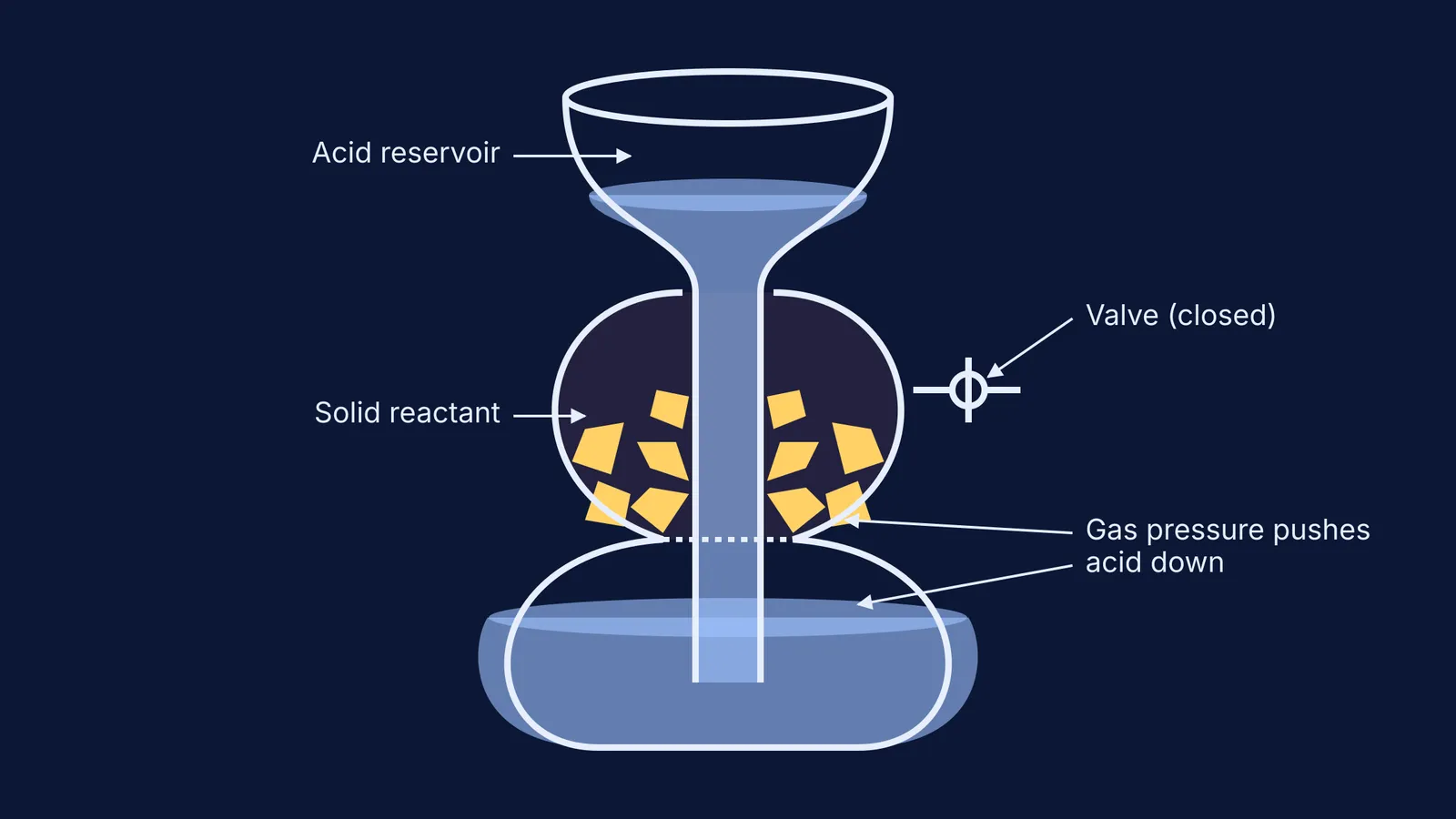
The apparatus looks like a glass snowman made of three stacked chambers. It relies on a feedback loop driven by gas pressure to automatically start and stop chemical reactions.
The chambers: The middle chamber holds a solid reactant, such as iron(II) sulphide lumps, resting on a porous plate. The top chamber acts as a funnel and is filled with a liquid acid, like dilute hydrochloric acid. A long tube connects the top chamber directly to the bottom chamber.
Starting the reaction: When the stopcock on the middle chamber is opened, air escapes. The acid flows down from the top, fills the bottom chamber, and rises into the middle chamber. When the acid touches the solid, the chemical reaction begins, and gas bubbles out through the stopcock.
Stopping the reaction: When the stopcock is closed, the gas has nowhere to go. It builds up pressure in the middle chamber, pushing the acid back down and up into the top funnel. Once the acid loses contact with the solid, the reaction stops automatically.
Before gas cylinders existed, this was a brilliant way to have gas "on tap." Much like Mikhail Lomonosov's sealed-flask experiments, it was a practical breakthrough in handling chemicals safely.
What else could the apparatus make?
While hydrogen sulphide was the most common application in qualitative analysis, Kipp's apparatus was a versatile tool. By changing the solid and the liquid, chemists could produce a wide variety of gases:
Carbon dioxide: By reacting marble chips (calcium carbonate) with hydrochloric acid, the apparatus provided a steady stream of CO₂.
Hydrogen: Zinc metal granules reacted with dilute hydrochloric acid to produce hydrogen gas.
Acetylene: Calcium carbide reacting with water generated acetylene gas.
The only strict requirement was that the solid chunks had to be large enough not to fall through the porous plate, and they had to be insoluble in the liquid. If the solid dissolved, it would wash down into the bottom chamber and continue reacting out of control.
Why was hydrogen sulphide so important?
For decades, Kipp's apparatus was most famous for generating hydrogen sulphide (H₂S), a gas infamous for smelling like rotten eggs. In qualitative inorganic analysis, students and chemists used H₂S to identify unknown metal ions in a solution.
Because hydrogen sulphide is highly toxic, having a generator that could instantly shut off the gas flow was a major safety improvement for schools and laboratories. If you left a basic flask bubbling, it would quickly fill the room with dangerous fumes. Kipp's device ensured that gas was only produced exactly when it was needed.
What are the sulphide precipitate colours?
In qualitative analysis, bubbling H₂S through a solution was the standard way to separate metal ions. If you are preparing for a practical exam, here are the key colour changes to remember:
Black precipitates: Copper (CuS), lead (PbS), and bismuth (Bi₂S₃).
Yellow precipitates: Cadmium (CdS) and arsenic (As₂S₃).
White precipitates: Zinc (ZnS), which only precipitates in basic conditions.
Pink or flesh-coloured precipitates: Manganese (MnS).
Visualising gas pressure, equilibria, or chemical reactions can be hard to grasp from a textbook alone. If you are learning how solids and pure liquids drop out of equilibrium expressions, or trying to convert PV, PT and VT graphs for ideal gases, the Fermi Concept Library has a lesson for every concept in physics, chemistry, biology, mathematics and computing, each with its place in the map, helping you connect the theory to the reaction.
Where is Kipp's apparatus used today?
Today, the classic glass Kipp's apparatus has largely vanished from working laboratories. Industrial gases are now widely available in high-pressure cylinders, which provide purer and drier gas than a benchtop generator.
For educational demonstrations, modern chemistry classes often use safer organic compounds like thioacetamide. When heated in water, thioacetamide slowly releases hydrogen sulphide directly into the solution, avoiding the need to bubble toxic gas through the room.
However, the legacy of Petrus Jacobus Kipp lives on. He started his pharmacy in Delft in 1830. Today, the business he founded to sell scientific instruments, Kipp & Zonen, still exists over 160 years after his death in 1864. His clever use of gas pressure remains one of the most elegant examples of 19th-century laboratory design.


