

On this page
Every Class 12 student who writes "aniline, NaNO2 + HCl, 0-5 °C" is repeating an experiment from 1858. The chemist behind it, Peter Griess, was a German researcher who later spent most of his career at an English brewery. His discovery gave chemists the intermediate behind azo dyes, and gave you a chapter of conversions.
Who discovered diazonium salts?
Peter Griess described the reaction in a short note in Justus Liebigs Annalen der Chemie in 1858, volume 106, pages 123-125, as listed in the Crossref record of the paper. The note's title calls it a preliminary report on the action of nitrous acid on two amino-nitro derivatives of phenol.
According to a 2015 history of Griess in Notes and Records of the Royal Society, he was trying to make derivatives of picramic acid for his mentor, Hermann Kolbe. Kolbe suggested warm aqueous nitrous acid. Griess switched to a cold solution of nitrous acid in ethanol, and later said this was why he could recover the products. What formed was a derivative with unexpected properties.
The result led August Wilhelm Hofmann to invite Griess to the Royal College of Chemistry in London. In 1862 Griess joined the Allsopp brewery in Burton upon Trent, where he stayed until his death in 1888, and he was elected a Fellow of the Royal Society in 1868 (Yates and Yates, 2015).
What exactly is diazotisation?
Diazotisation is the reaction of a primary aromatic amine with nitrous acid and a mineral acid. It gives a diazonium salt, ArN2+ X-. The nitrous acid is made in the flask from sodium nitrite and an acid such as HCl (overview of diazonium compounds).
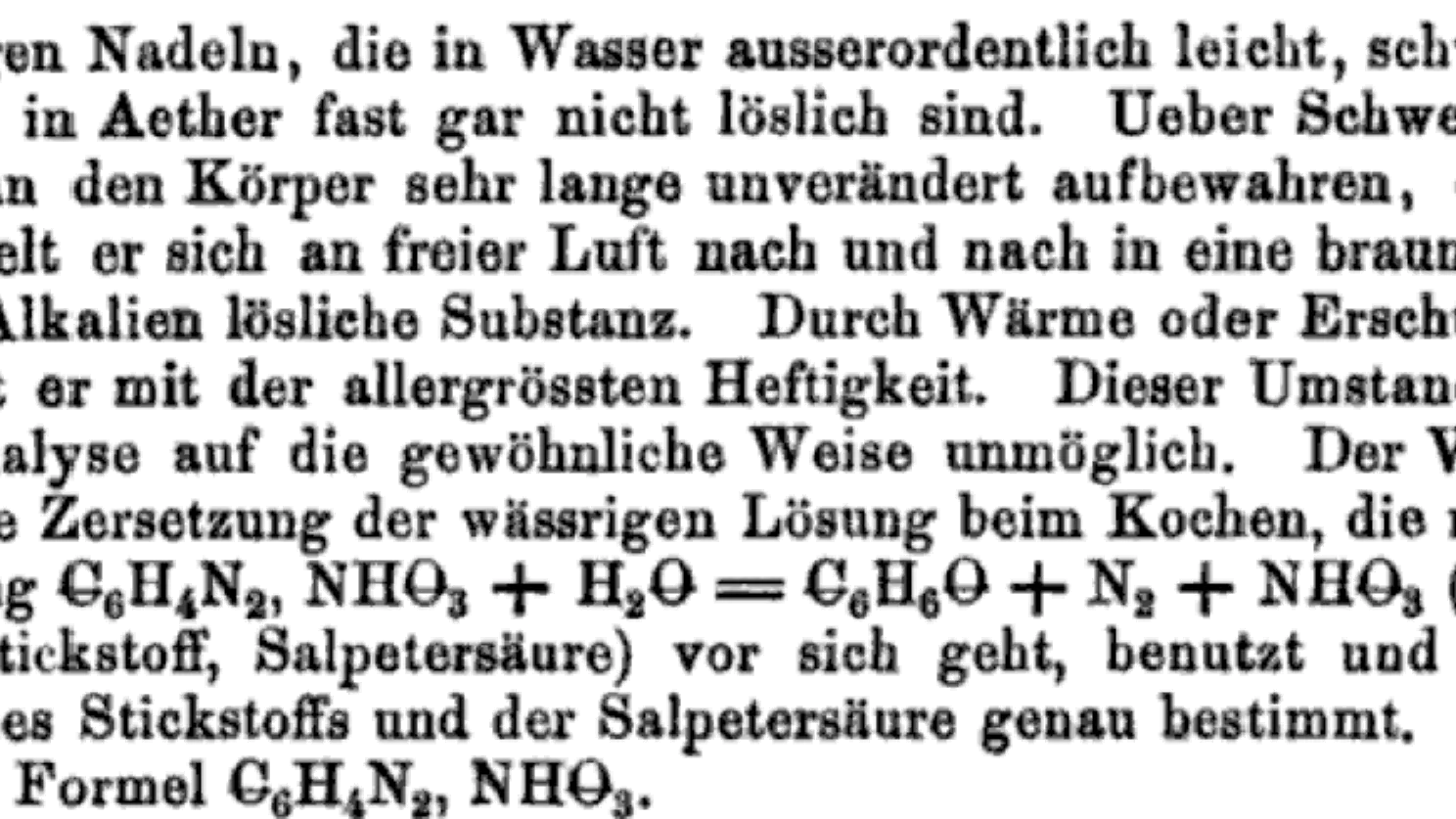
The cold matters. That overview notes that diazonium chlorides are unstable at room temperature, are classically prepared at 0-5 °C, and that benzenediazonium chloride is dangerously explosive. Griess met this problem early. The image above is from an 1866 report of his work in Chemisches Zentralblatt on a diazobenzene salt that, it says, explodes "mit der allergrössten Heftigkeit" (with the very greatest violence) when heated or jarred. So the salt was analysed another way: it was boiled in water, and the nitrogen and nitric acid released as it turned into phenol were measured.
How did diazonium salts lead to azo dyes?
A diazonium ion can also keep both nitrogens and bridge to another aromatic ring, giving an azo compound, Ar-N=N-Ar. Chemguide's page on diazonium reactions describes the classroom versions. With cold alkaline phenol you get a yellow-orange product. With naphthalen-2-ol you get an intense orange-red precipitate. With phenylamine (aniline) you get a yellow solid called aniline yellow.
Industry moved quickly. The Royal Society history notes that Martius and Caro prepared aniline yellow and Bismarck brown in 1863-64, and that Bismarck brown was the first marketed azo colour. Today, a 2020 review in Heliyon states that azo dyes account for more than 60% of total dyes.
Griess's chemistry also became a test. In the Griess test, nitrite turns an aromatic amine into a diazonium salt, which then couples to form a pink-red azo dye (Griess test overview). It is still used to detect nitrite in water.
How do diazonium salts appear in Class 12 chemistry?
The CBSE Chemistry syllabus for 2025-26 lists diazonium salts, their preparation, reactions and importance in synthesis, under Unit 9, Amines. Many questions are conversions, and one question decides them: does the nitrogen leave, or stay?
Here is a worked example starting from aniline:
Diazotise first: aniline with NaNO2 and HCl in an ice bath gives benzenediazonium chloride.
Nitrogen leaves (substitution): warm with water to get phenol, or use CuCl/HCl, CuBr/HBr or CuCN to get chlorobenzene, bromobenzene or benzonitrile.
Nitrogen stays (coupling): add cold alkaline phenol to get a yellow-orange azo compound, or add aniline to get aniline yellow.
A quick self-check before you write any conversion:
Is the starting amine primary and aromatic? If not, it will not give a stable diazonium salt.
Is the target missing nitrogen? Then N2 has left, so think of substitution.
Does the target contain -N=N-? Then think of coupling, done cold.
The copper-salt steps are covered in our guide to Sandmeyer and Gattermann reactions, and basicity order in amines and diazonium salts. Griess's London host has his own profile: August Wilhelm Hofmann and amine chemistry.
If you get the reagents right but keep choosing the wrong route, the Fermi Problem Library has worked problems with a step-by-step solver that explains the reasoning rather than printing an answer. If the gap is earlier, for example why an aryl amine reacts differently from an alkyl amine, the Fermi Concept Library gives each chemistry concept its own lesson.


