

On this page
In 1827, French inventor Joseph Nicéphore Niépce pointed a camera obscura out of his window at Le Gras and captured history (Harry Ransom Center). This image is the oldest surviving camera photograph. If you look at the original plate today, you have to tilt it at just the right angle to catch the reflection and make out the scene: a pigeon house to the left, a sloped barn roof in the centre, and another wing of the estate on the right.
But Niépce did not use film or a digital sensor. Instead, he relied on a naturally occurring asphalt and the slow, invisible physics of crosslinking molecules, requiring an exposure time that lasted for several days.
How was the first photograph made?
Niépce called his process *heliography*, meaning "sun writing". He started with a polished pewter plate measuring 16.7 by 20.3 centimetres (Harry Ransom Center). Over this, he spread a thin layer of Bitumen of Judea, a dark, viscous tar dissolved in oil of lavender.
In its normal state, the bitumen could easily be washed away by solvents. But when exposed to sunlight, it underwent a photochemical change. The ultraviolet rays in the light caused the hydrocarbon chains in the bitumen to bond together in a three-dimensional network, a process known as crosslinking (Wikipedia). This hardening made the exposed areas completely insoluble.
This mechanism—where light alters a polymer's structure, making it resistant to chemicals—was the world's first photoresist. This exact principle of using light to harden a chemical layer so unprotected areas can be washed away is how modern microchips are etched today.
After leaving the plate in his camera for several days, Niépce rinsed it with a mixture of lavender oil and white petroleum. The solvent washed away the unexposed, soft bitumen, revealing the bare metal. The hardened bitumen remained, forming a permanent image of the bright areas.
How does a camera obscura work?
The device Niépce used to project the view onto his plate was a camera obscura—a darkened box with a small aperture on one side. The physics of this device is elegantly simple and relies on the rectilinear propagation of light (Wikipedia).
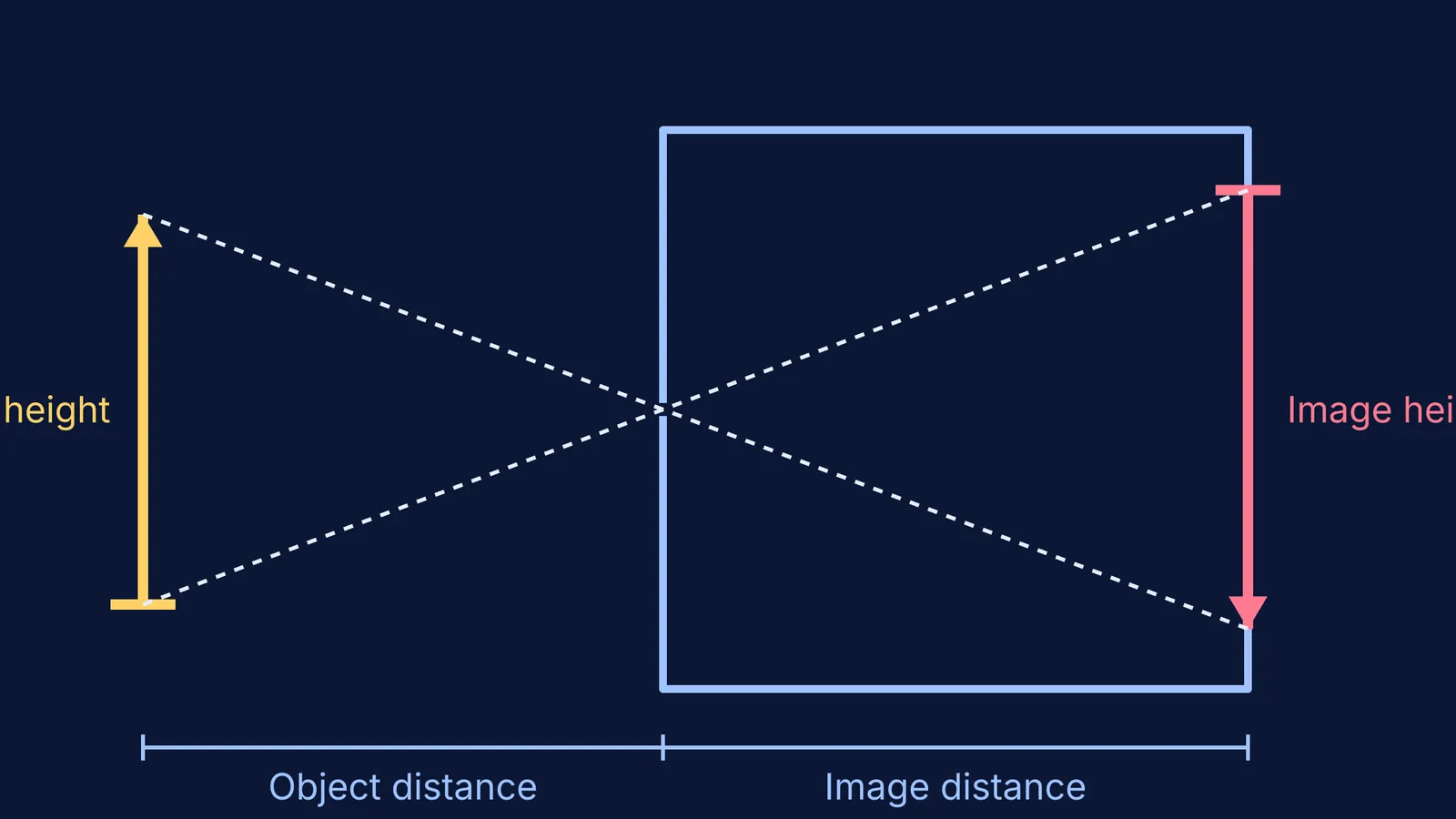
Because light travels in straight lines, rays from the top of an object pass through the pinhole and hit the bottom of the back wall. Rays from the bottom of the object hit the top. This is why the projected image is always inverted (upside down) and reversed.
If the pinhole is too large, rays from a single point on the object spread out and hit multiple spots on the plate, making the image blurry. If it is too small, the wave nature of light causes diffraction, which also blurs the edges. Niépce had to balance these physical constraints perfectly to achieve his result.
The size of this projected image is governed by similar triangles. The magnification formula is:
Magnification = h_i / h_o = d_i / d_o
Where h_i is image height, h_o is object height, d_i is the distance from the pinhole to the plate (the camera's depth), and d_o is the distance to the object.
Imagine Niépce was photographing a 6-metre tall pigeon house standing 15 metres away. If his camera obscura had a depth of 30 centimetres (0.3 metres), how tall would the image be on his plate?
Using the formula, we find the magnification is 0.3 m / 15 m, which simplifies to 0.02. Multiplying the object's height (6 m) by 0.02 gives 0.12 metres, or 12 centimetres.
This meant the entire height of the pigeon house fit comfortably on his pewter plate. If you are studying optics and get stuck on magnification or ray diagrams, the Fermi Problem Library has worked problems with a step-by-step solver that explains the reasoning rather than printing an answer.
What can we learn from Niépce's slow progress?
Niépce's experiment was a triumph of patience. Because the Bitumen of Judea reacted so slowly, the sun moved across the sky during the multi-day exposure, illuminating the buildings in the photograph from both sides.
Today, you do not have to wait days to test an idea in optics or chemistry. For concepts that are easier to see than to read, such as how light paths cross through an aperture or how molecules bond, the Fermi Simulation Lab provides interactive simulations.
The original pewter plate was lost for decades before being rediscovered in 1952. Today, it rests in the permanent collection at the Harry Ransom Center in Austin, Texas, a reminder of the quiet, persistent work that happens before a breakthrough. If you find yourself frustrated by slow progress in your own studies, remember Niépce's window. True understanding, like the crosslinking of his bitumen, takes time to solidify.
For more on the physics of light, read about the Dispersion of white light by a glass prism or explore Why a lens's object and real image are at least 4f apart.


