

On this page
In short In 2010, Ngô Bảo Châu became the first Vietnamese mathematician to win the Fields Medal. He proved the fundamental lemma of the Langlands programme, a conjecture connecting number theory and geometry, which Time magazine ranked among the top ten scientific discoveries of 2009.
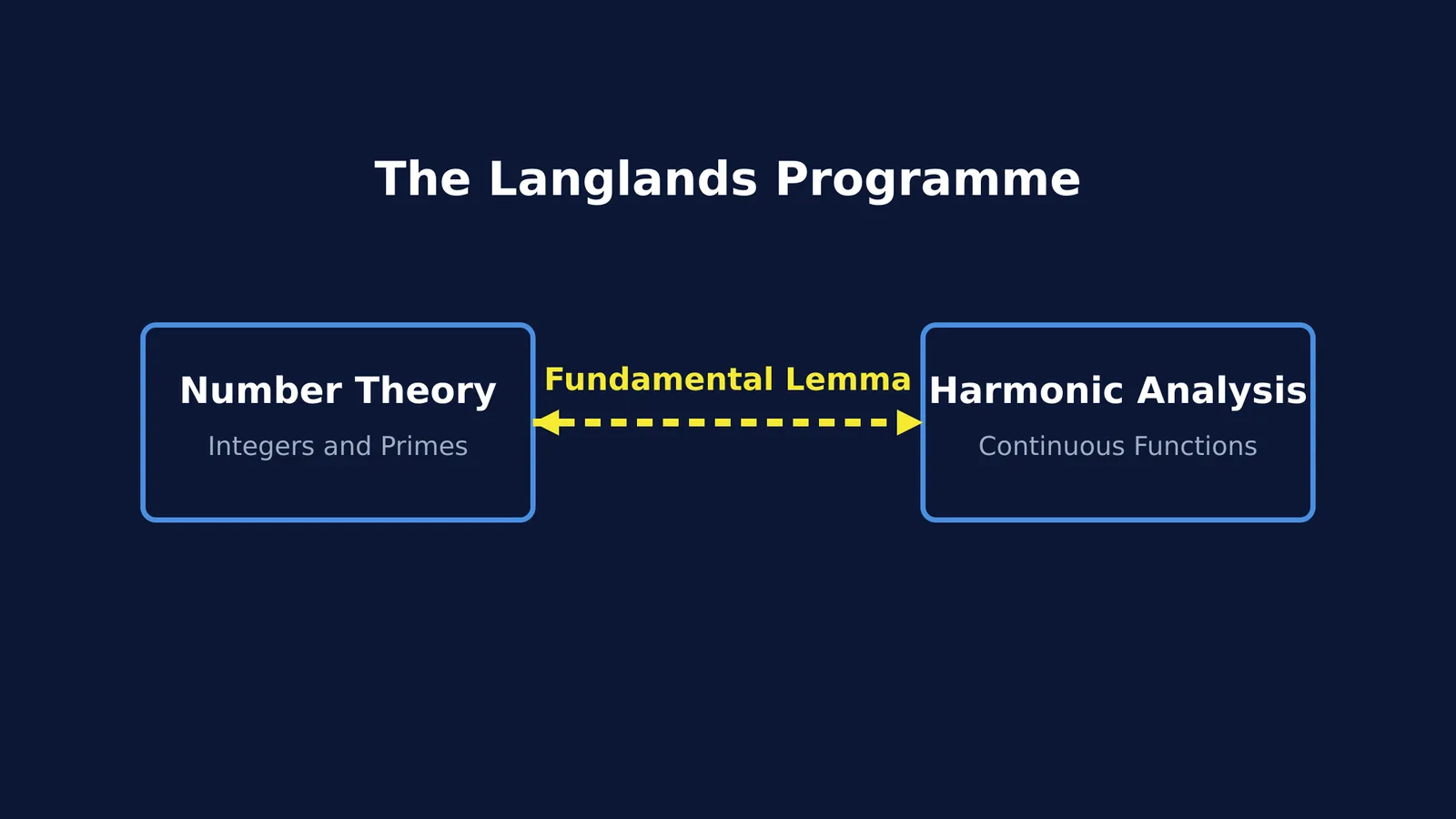
The Langlands programme, proposed by Canadian mathematician Robert Langlands in 1967, is often described as the grand unifying theory of mathematics. It is a vast web of conjectures that suggests deep, hidden connections between two seemingly unrelated branches of mathematics: number theory, which is the study of integers and prime numbers, and harmonic analysis, which deals with periodic waves, continuous functions and symmetry.
A central piece of this puzzle was the fundamental lemma, a technical conjecture formulated by Langlands and Diana Shelstad in 1987. Langlands initially believed it would be straightforward to prove—hence the term "lemma", which usually denotes a minor stepping stone toward a larger theorem. Instead, the fundamental lemma proved to be incredibly resistant to traditional mathematical techniques. For decades, it remained an unsolved bottleneck, preventing researchers from fully exploring the connections across the Langlands programme.
How did Ngô Bảo Châu prove the fundamental lemma?
Ngô Bảo Châu approached the fundamental lemma by translating the problem from the realm of numbers into the language of geometry. Working alongside his former PhD supervisor Gérard Laumon, and building upon crucial earlier reductions made by Jean-Loup Waldspurger, he formulated an ingenious geometric approach.
His breakthrough was to study the local orbital integrals that appear in the fundamental lemma by examining affine Springer fibres, which are complex geometric objects that arise in the Hitchin fibration. By turning a combinatorial problem of a number-theoretic nature into a question of geometric representation theory, he was able to complete the proof. He published the complete solution for Lie algebras in 2010.
The impact of this proof was immediate and profound. It provided the solid ground that number theorists had been waiting decades to cross. Time magazine recognised the magnitude of his achievement by ranking it as the seventh most important scientific discovery of 2009. For university students exploring abstract spaces like these, the Fermi Concept Library contains every concept in physics, chemistry, biology, mathematics and computing, each with its own lesson and its place in the map.
What was his road to the Fields Medal?
Born in Hanoi, Vietnam, in 1972, Ngô Bảo Châu demonstrated extraordinary mathematical talent from a very young age. He attended special mathematics classes for gifted students, and his abilities quickly became apparent on the world stage. At 16 years old, he became the first Vietnamese student to win a gold medal at the International Mathematical Olympiad (IMO) with a perfect score of 42/42. He returned to the IMO the following year to win a second gold medal.
After completing high school, he moved to France on a scholarship, eventually earning his PhD from Université Paris-Sud in 1997. His academic rise was swift. In 2005, at age 33, he was named a full professor in Vietnam, becoming the youngest person ever to hold the title in his home country.
His ultimate recognition came at the 2010 International Congress of Mathematicians, where he was awarded the Fields Medal. Awarded only once every four years to mathematicians under the age of 40, it is widely considered the highest honour in mathematics. His journey mirrors the diverse paths of other legendary mathematicians, from the prolific networking seen in Paul Erdős and the problems that linked mathematicians to the solitary focus required by Grigori Perelman and the proof of the Poincaré conjecture.
What can students learn from his approach?
Ngô Bảo Châu's work provides a valuable framework for tackling impossibly hard problems, whether you are preparing for a difficult exam, facing a challenging university course, or pursuing a research career.
Change your perspective: When number theory failed to yield an answer, he shifted the entire problem into geometry. If an algebraic equation seems impossible to untangle, try graphing it. A new representation often reveals the solution.
Build on existing tools: He did not invent every part of his proof from scratch. He relied on the foundational work of his predecessors, much like how Karl Weierstrass and the epsilon-delta definition built the rigorous basis for modern calculus. Use the theorems and methods available to you.
Persist through the bottlenecks: The fundamental lemma was considered a minor technical hurdle when it was first proposed, yet it took decades for the mathematics community to crack. Deep understanding requires patience and a willingness to stay with a problem.
When you are stuck on a difficult proof or physics problem and need to see the logic, Fermi's AI tutor can work out what you already know and build a plan for the session. The Fermi Problem Library has worked problems with a step-by-step solver that explains the reasoning rather than printing an answer.


