

On this page
In 1955, Allen Newell, Herbert A. Simon, and computer programmer Cliff Shaw began working on a program that would teach machines to reason. Completed in 1956, the Logic Theorist is widely described as the first artificial intelligence program.
Rather than just performing numerical calculations, the program was designed to simulate human problem-solving and decision-making.
What was the first AI program?
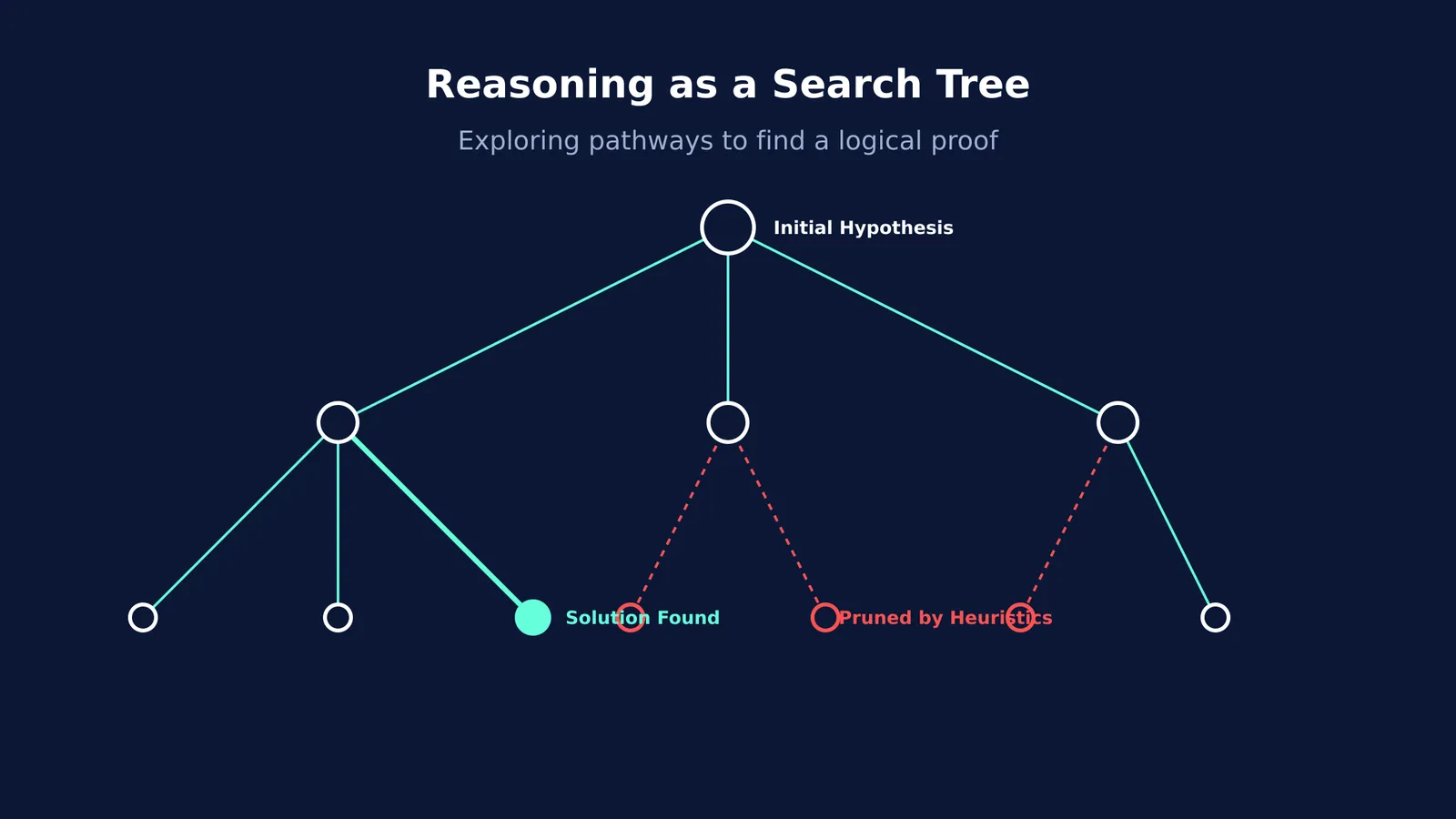
The Logic Theorist was the first program deliberately engineered to perform automated reasoning. It introduced the concept of reasoning as a search process, exploring a tree of possibilities where the root was an initial hypothesis and the branches were logical deductions. At each step, the program would apply logical rules to generate new branches, aiming to reach the desired conclusion.
To manage the exponential growth of this search tree, Newell and Simon introduced "heuristics"—rules of thumb used to trim pathways that were unlikely to lead to a solution. Instead of checking every possible logical path, which would be impossible even for modern computers, the program used these heuristics to focus only on the most promising routes.
Because existing software was inadequate, the team had to invent a new programming language called Information Processing Language (IPL). It introduced list processing, a concept where data is stored in lists that can contain pointers to other lists. This allowed for the flexible memory structures needed to represent complex logical proofs and dynamically changing search trees. IPL directly paved the way for John McCarthy's Lisp, which would become the standard language for AI research for decades due to its simpler syntax and automatic memory management.
The program was executed on the JOHNNIAC, a vacuum-tube computer located at the RAND Corporation in Santa Monica. Named after John von Neumann, the machine was large but had a limited memory. It initially relied on Selectron tubes before upgrading to magnetic-core memory. Running the program required meticulous optimisation to fit within the machine's constraints while performing the search through possible deductions.
What did the Logic Theorist prove?
The creators chose to test their program on the complex mathematical proofs found in *Principia Mathematica*, the monumental work by Alfred North Whitehead and Bertrand Russell. This three-volume book attempted to derive all mathematical truths from a well-defined set of axioms and inference rules in symbolic logic.
The Logic Theorist successfully proved 38 of the first 52 theorems in chapter two of the book. For Theorem 2.85, the program's automated methods actually produced a proof that was more elegant and shorter than the one produced by hand by Russell and Whitehead. When Simon shared this new proof with Russell, the philosopher reportedly responded with delight.
However, the academic establishment was less enthusiastic. When the team attempted to publish the program's new proof of Theorem 2.85 in *The Journal of Symbolic Logic*, the paper was rejected. The editors argued that a new proof of an elementary theorem was not notable, missing the fact that the author was a machine.
How was the first AI program tested?
Before the program could run on a computer at the RAND Corporation, it had to be tested. Newell, Simon, and Shaw wrote the program's logic and sub-routines onto 3x5 index cards.
In January 1956, Simon assembled his wife, his three children, and some graduate students for a hand-simulation. As Simon recalled, "To each member of the group, we gave one of the cards, so that each one became, in effect, a component of the computer program." The human processors successfully executed the instructions, proving the logic worked before a machine ever ran it.
Later that summer, Newell and Simon presented the Logic Theorist at the Dartmouth conference organised by John McCarthy, where the term artificial intelligence was born. The conference brought together researchers to explore how machines could simulate human intelligence. Expecting a triumphant reception, Newell and Simon were instead met with a lukewarm response. While other attendees were still theorising about what machines might do in the future, Newell and Simon had already built a working system that was actively proving theorems.
Simon was so confident in the program's significance that he told a graduate class in January 1956 that over Christmas, he and Newell had invented a thinking machine. He later argued that they had solved the venerable mind-body problem by demonstrating how a physical system could possess the properties of a mind.
What does step-by-step reasoning mean for learning?
Just as George Boole formalised logic into algebra, the Logic Theorist formalised reasoning into code. It showed that a computer could trace a logical path from a problem to a solution.
This step-by-step approach is the foundation of how modern educational tools explain concepts to students. If you are stuck on a difficult maths or physics problem, the Fermi Problem Library has worked problems with a step-by-step solver that explains the reasoning rather than printing an answer.
Instead of jumping straight to the final result, you can follow the exact logical steps to see where a method went wrong, much like the Logic Theorist laid out its elegant mathematical proofs.


