

On this page
How do rocks record the magnetic field?
When a volcano erupts, the molten lava contains iron-rich minerals such as magnetite. At high temperatures, thermal agitation prevents the magnetic domains in these minerals from aligning. It is only when the lava cools below a critical threshold, known as its Curie temperature, that the alignment becomes permanent. As the lava solidifies, these minerals lock into alignment with the Earth's magnetic field, acting like millions of tiny compass needles frozen in stone.
In 1926, Motonori Matuyama set out to read these ancient compasses. He visited the Genbudo Cave in Japan's Hyogo Prefecture, a site famous for its striking hexagonal basalt columns formed by cooling lava in the early Pleistocene epoch. Matuyama collected samples there and from other sites, totalling 36 different localities across Japan, Korea, and Manchuria.
Back in his laboratory at Kyoto Imperial University, he used a sensitive Gauss-type magnetometer to measure the residual magnetisation of his 38 samples.
How did Motonori Matuyama discover magnetic reversal?
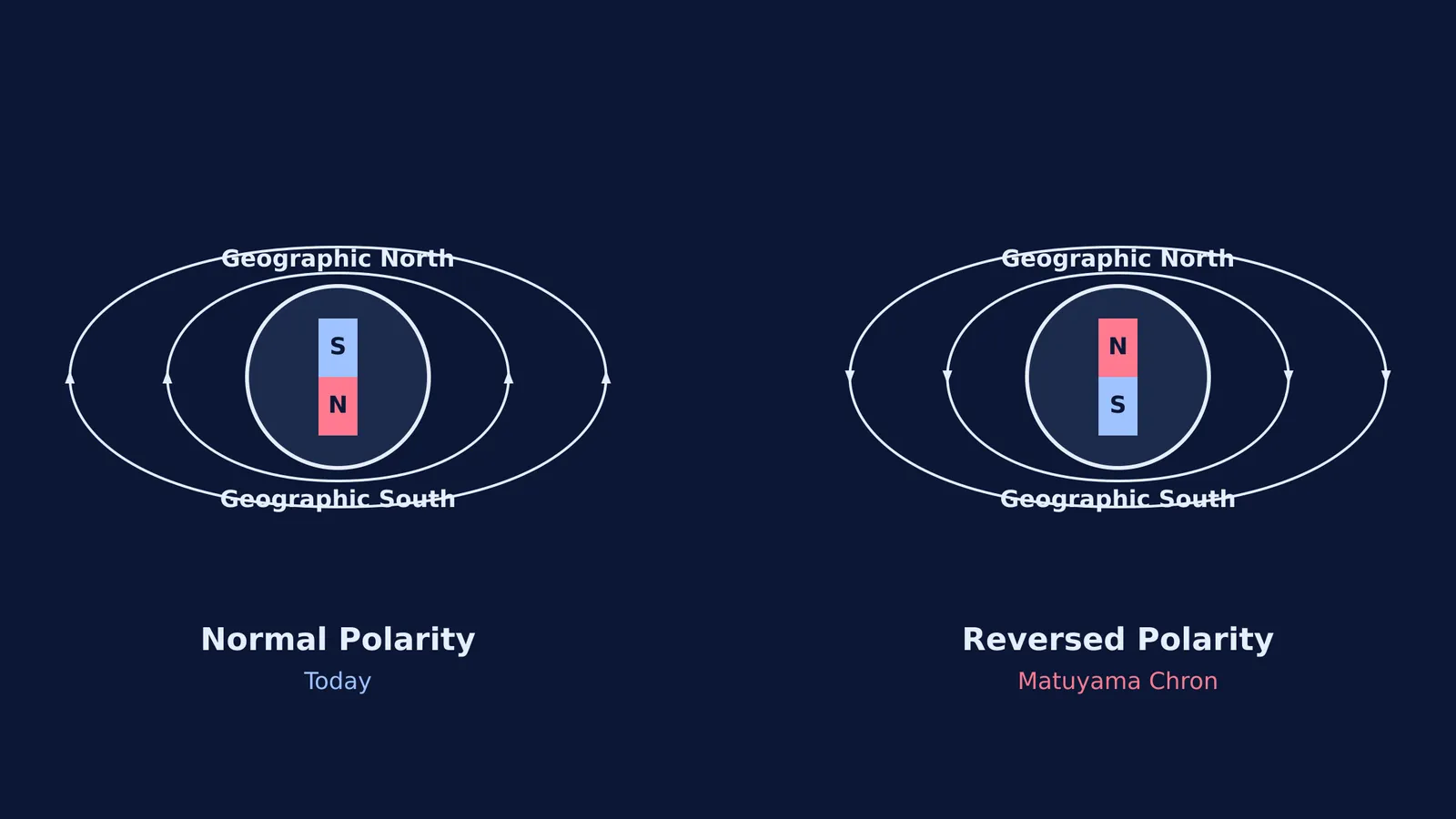
When Matuyama analysed his data, he noticed a clear pattern. Some rocks pointed north, just like a modern compass. However, other rocks were magnetised in the exact opposite direction—pointing south and upward.
His breakthrough, published in 1929 in his paper *On the Direction of Magnetisation of Basalt in Japan, Tyôsen and Manchuria*, was linking these magnetic directions to the geological age of the rocks. He found that all the rocks with "normal" polarity were relatively young. The rocks with "reversed" polarity, including those from Genbudo Cave, were consistently older, dating to the early Pleistocene epoch.
Matuyama proposed that these reversed rocks were not local anomalies or errors in measurement. Instead, the Earth's entire magnetic field must have flipped its polarity in the past. Today, the long period of reversed polarity that he discovered is named the Matuyama Reversed Chron in his honour.
What causes Earth's magnetic field to reverse?
Earth's magnetic field is not a static bar magnet. It is a geodynamo generated by the churning of liquid iron and nickel in the planet's outer core.
As the Earth rotates, convection currents in the molten metal twist and shear, generating electric currents that in turn create the magnetic field. This turbulent flow is chaotic. Periodically, the flow patterns become unstable, causing the main dipole field to weaken, splinter into multiple poles, and eventually rebuild itself in the opposite direction.
If you are studying electromagnetism for exams, mastering the physical principles of magnetic fields is crucial. The Fermi Concept Library contains every concept in physics, chemistry, biology, mathematics and computing, each with its own lesson and its place in the map.
How did paleomagnetism prove plate tectonics?
Matuyama's discovery was decades ahead of its time, but it became a cornerstone for the greatest geological theory of the 20th century.
In the 1960s, oceanographers measuring the magnetic properties of the seafloor discovered a zebra-stripe pattern of alternating normal and reversed polarity. Because new oceanic crust is continuously forming at mid-ocean ridges and cooling, it records the Earth's magnetic field at the time it forms. As the seafloor spreads outward, it creates a symmetrical tape recording of Earth's magnetic history.
This discovery, built directly on Matuyama's foundation, provided the definitive proof for Harry Hess and the idea of seafloor spreading, confirming that the continents indeed drift.
To solve problems on this topic efficiently, remember these key principles of the Earth's field:
Magnetic dipole: The Earth's field behaves roughly like a bar magnet placed at its centre, tilted by about 11.3° from the rotation axis.
Magnetic declination: This is the angle between geographic north and the direction a compass needle points. It varies depending on your location.
Magnetic dip (inclination): This is the angle the magnetic field makes with the horizontal plane. At the magnetic equator, the dip is 0°; at the magnetic poles, it is 90°.
Rather than just memorising these angles, Fermi's AI tutor can work out what you already know, build a plan for the session, and teach through it — writing on a board, drawing the figure, running the simulation, and checking understanding as it goes. You can explore how these magnetic records were read by the pioneers of plate tectonics in our piece on Vine, Matthews and the magnetic stripes on the seafloor.


