

On this page
Mitchell Feigenbaum (1944–2019) was a mathematical physicist who changed how we understand chaotic systems. In the 1970s, scientists knew that simple equations could produce wild, unpredictable results, a phenomenon known as chaos. But Feigenbaum discovered that the path a system takes to become chaotic is strictly ordered and governed by a universal number.
What is period doubling on the road to chaos?
Imagine a dripping tap. If you turn it on slightly, it drips at a steady, regular rate. This is a system with a period of 1.
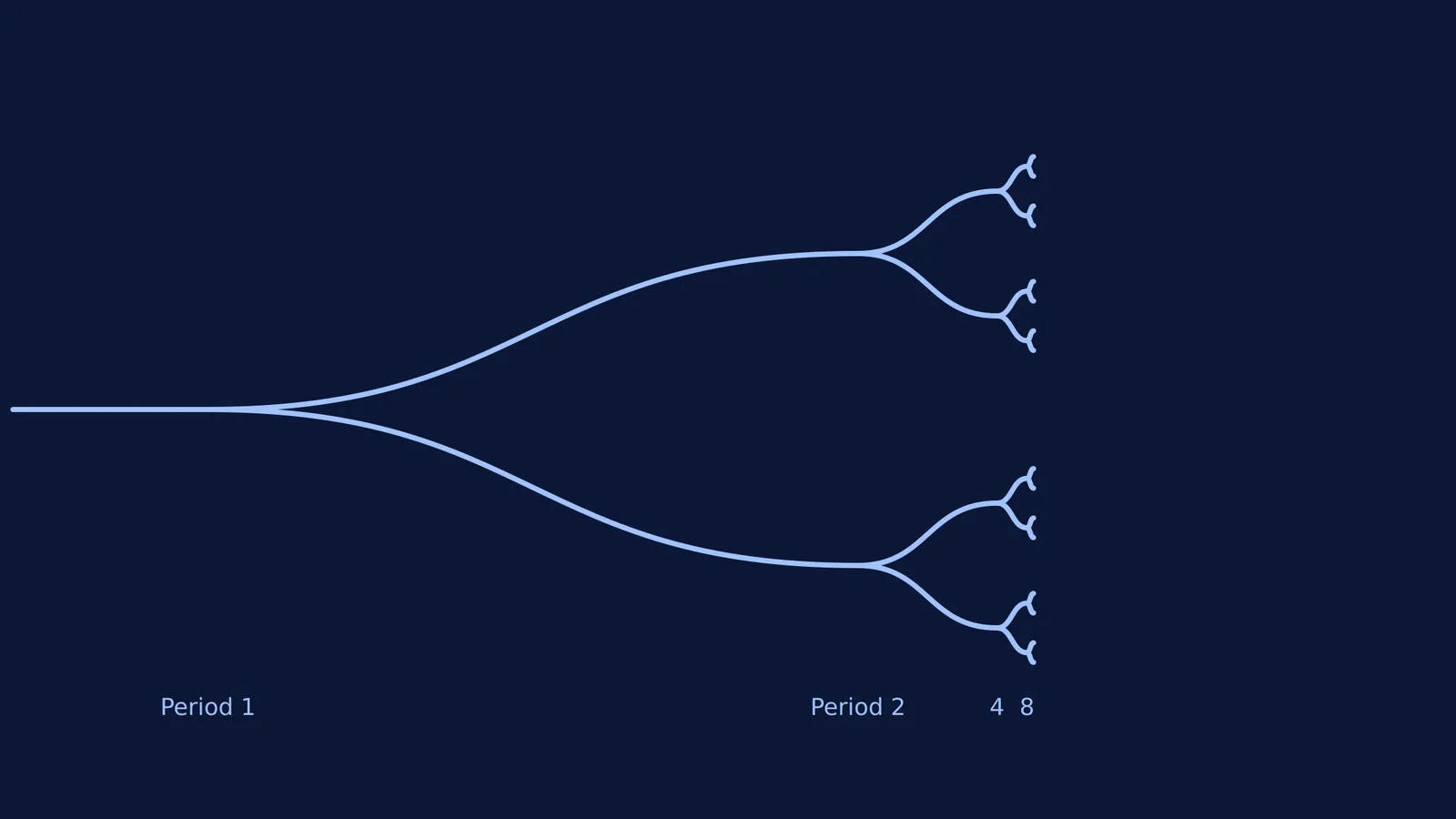
If you open the tap a bit more, the pattern changes. Instead of equal drops, you might get a large drop followed by a small drop, over and over. The system now takes two drips to repeat its pattern. This split is called a bifurcation, and the system has undergone period doubling to a period of 2.
Turn the tap further, and the pattern repeats every four drips, then eight, then sixteen. The parameter at which the system changes period gets smaller with each step. Eventually, the bifurcations happen so closely together that the period becomes infinite, which is the threshold where the system becomes chaotic (https://en.wikipedia.org/wiki/Feigenbaum_constants).
To find the fixed points where a simple equation stays at period 1, mathematicians often set the output equal to the input and count the roots by curve intersections.
How did Mitchell Feigenbaum find his constant?
In 1975, while working at the Los Alamos National Laboratory, Feigenbaum was studying the logistic map. This is a simple formula often used to model population growth and exponential models when resources are limited.
Using a programmable HP-65 pocket calculator, Feigenbaum calculated the exact points where the period doubled. He noticed a striking pattern in the shrinking intervals between bifurcations. He divided the width of the first interval by the width of the second, then the second by the third.
The ratio was always the same: approximately 4.669 (https://en.wikipedia.org/wiki/Mitchell_Feigenbaum). As the periods double toward infinity, the distance between bifurcations shrinks by this exact factor every time.
What is the second Feigenbaum constant?
While the first constant describes the distance between bifurcations along the parameter axis, Feigenbaum also found a second universal number. This second constant, denoted by alpha, has a value of approximately 2.502 (https://en.wikipedia.org/wiki/Feigenbaum_constants).
This second value describes the scaling of the width of the branches in the bifurcation diagram. As a system's period doubles, the new branches shrink in size. The ratio of the width of a branch to the width of its sub-branches converges to 2.502. Together, these two constants completely map out the geometry of the transition to chaos.
Why does the number 4.669 matter?
Feigenbaum published his findings in 1978 in a paper titled "Quantitative Universality for a Class of Nonlinear Transformations" (https://doi.org/10.1007/BF01020332). The number 4.669, now known as the first Feigenbaum constant, was not just a quirk of the logistic map.
He proved that this constant applies to any one-dimensional map with a single quadratic maximum, meaning a single hump in its graph. Completely different physical systems—fluid turbulence, chemical reactions, and electronic circuits—all transition from order to chaos at exactly the same relative rate.
How can you study nonlinear systems?
When you study mathematics and physics, visualising how systems bifurcate and become chaotic requires stepping beyond static textbook diagrams. In the Simulation Lab, you can interact with non-linear models directly, changing the parameters to watch period doubling happen in real time.
If the mathematics of sequences and limits seem daunting, Fermi's AI tutor can help break down the underlying equations. The tutor teaches rather than answers: it holds a line of reasoning across a session, checks your understanding as it goes, and builds a plan for the session so you sit down to a clear next step.
For those tracking oscillatory systems, understanding the natural frequencies is the first step. You can practice calculating the standard period of a system, like the SHM through a tunnel across the Earth, before adding the non-linear forces that lead to chaos.


