

On this page
In short
The Ottoman architect-engineer Mimar Sinan built the Selimiye Mosque dome in the 16th century with a massive diameter of 31.5 meters. He solved the structural challenge by using an octagonal system of eight piers with concealed buttresses to safely redirect the dome's lateral thrust into the ground.
In the mid-16th century, the great Ottoman architect Mimar Sinan set out to achieve what many considered impossible: to build a single, unified interior space covered by a dome that could rival the ancient Hagia Sophia. The result was the Selimiye Mosque in Edirne, built in the 16th century (UNESCO World Heritage). Sinan himself considered this complex to be his "most important architectural work."
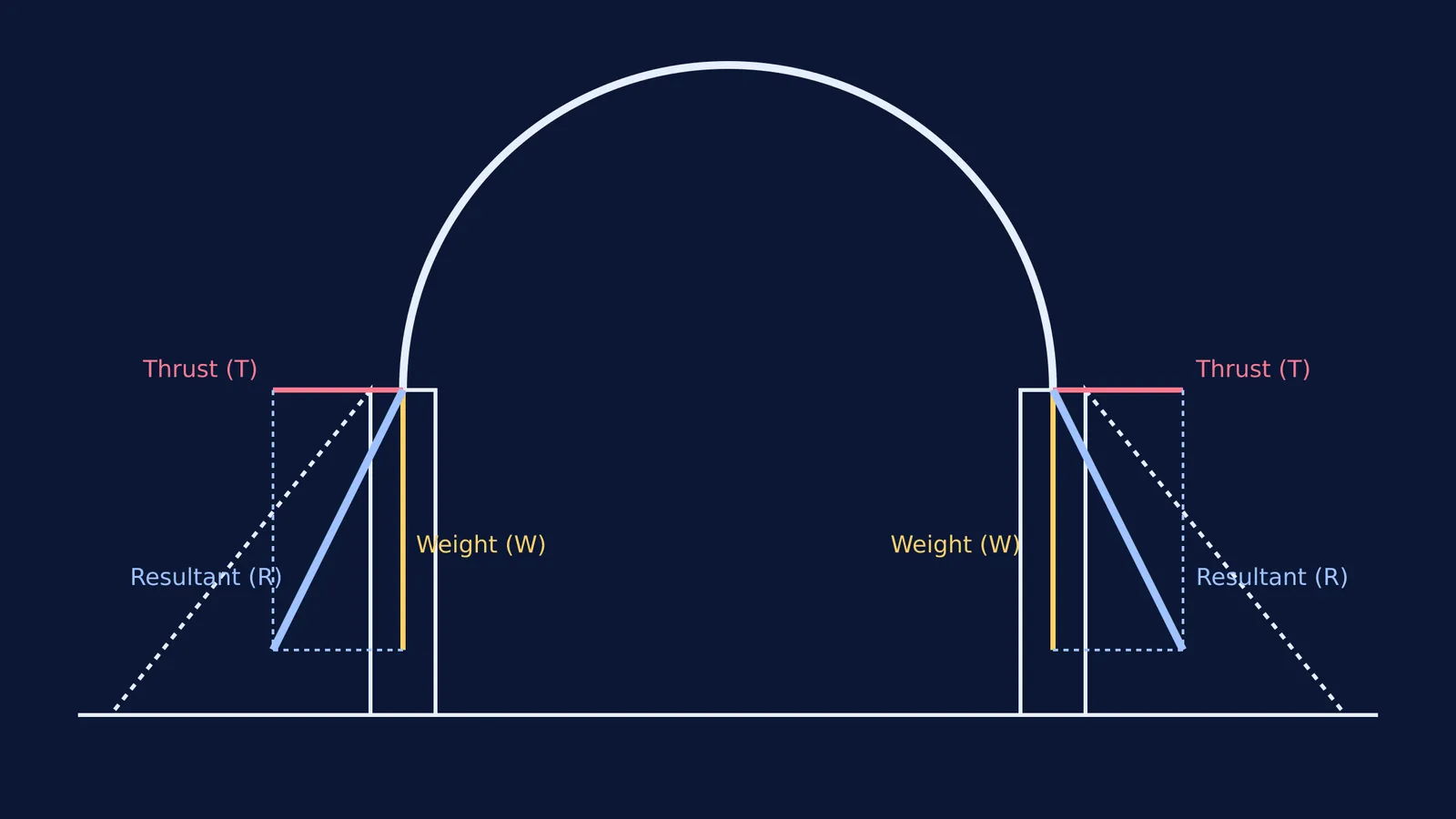
To build it, Sinan had to solve a fundamental physics problem. A massive masonry dome generates enormous downward weight (gravity), but its curved shape also pushes outwards, creating lateral thrust. If that outward force is not contained, the walls will burst and the dome will collapse.
What makes the Selimiye dome engineering unique?
The central dome of the Selimiye Mosque spans a diameter of 31.5 meters (UNESCO). In older, traditional designs, architects typically distributed a dome's weight across four massive "elephant leg" columns in a square formation. However, these giant columns often obstructed sightlines and broke the interior space into smaller, compartmentalized sections.
When looking at the mimar sinan selimiye mosque dome engineering, the most radical shift was moving from four supports to eight. Sinan designed an octagonal baldaquin—a canopy-like structure where the dome rests on eight pillars. By multiplying the points of support from four to eight, he could push the load-bearing elements closer to the exterior walls.
This brilliant piece of structural geometry allowed Sinan to create a vast, unobstructed prayer hall measuring 45 by 36 meters (UNESCO). From any point inside the mosque, a visitor can see the entire space and the central mihrab, achieving a level of spatial unity unseen in earlier monumental architecture.
How do the eight piers and buttresses work?
Even with eight piers, the outward push of the massive stone dome has to go somewhere. In Gothic cathedrals, architects used visible "flying buttresses" on the outside to push back against the walls. Sinan, however, wanted the exterior of the Selimiye Mosque to look elegant and stepped, rather than looking like a heavy scaffold.
He solved this by artfully concealing the buttresses. Sinan integrated heavy external buttresses behind exterior galleries and porticoes. In physics terms, the eight piers absorb the direct downward weight, while the concealed buttresses absorb the horizontal lateral thrust. Together, they form a perfect vector addition system. The resultant force vector points diagonally downward, safely channeled through the heavy masonry into the deep foundations.
To anchor the corners, Sinan placed four slender minarets (UNESCO) at the edges of the prayer hall. While they are visually stunning, their massive vertical weight acts as a structural counterweight, further stabilizing the central building against outward forces. Sinan's genius was recognizing that structural engineering is largely a battle against gravity and geometry. By refining the octagonal baldaquin, he arrived at a mathematically elegant resolution of space.
How to solve physics problems like an architect?
Sinan did not use modern calculus, but his approach to forces and equilibrium is exactly what you are expected to master in high-school statics and mechanics. When you are stuck on a physics numerical, try breaking it down the way an architect approaches a building:
Isolate the system: Draw a free-body diagram of the object in question.
Identify the invisible forces: A dome is not just heavy; it actively pushes sideways. Always account for normal forces, friction, and lateral components.
Resolve the vectors: Break diagonal forces into their horizontal and vertical components, just as Sinan broke the dome's thrust into the vertical piers and horizontal buttresses.
If you are struggling to picture how vectors add up, the Fermi Simulation Lab provides interactive simulations for the ideas that are easier to see than to read. You can adjust the magnitude and direction of forces to see how the resultant vector shifts in real time, making it much easier to understand why a structure stands or falls.
When you know the theory but get stuck setting up the equations, Fermi's AI tutor can help. The Fermi Problem Library offers worked problems with a step-by-step solver that explains the reasoning rather than printing an answer. It notices where you are stuck and helps you build a plan to find the solution—teaching you how to think from first principles.


