

On this page
In 1861, at the Royal Institution in London, the Scottish physicist James Clerk Maxwell projected an image of a tartan ribbon onto a screen 1. It was the world's first durable colour photograph.
Maxwell was not primarily a photographer; his goal was to prove a physical theory about how the human eye sees colour. He built upon the work of Thomas Young, who first proposed that the eye contains three types of colour receptors. To demonstrate this additive colour theory physically, he teamed up with Thomas Sutton, the inventor of the single-lens reflex camera 1. Together, they relied on a brilliant insight that still governs how every digital screen works today.
How did Maxwell take the first colour photograph?
Maxwell believed that all colours could be created by mixing red, green, and blue light. To prove this, he asked Sutton to photograph a tartan ribbon three times 1.
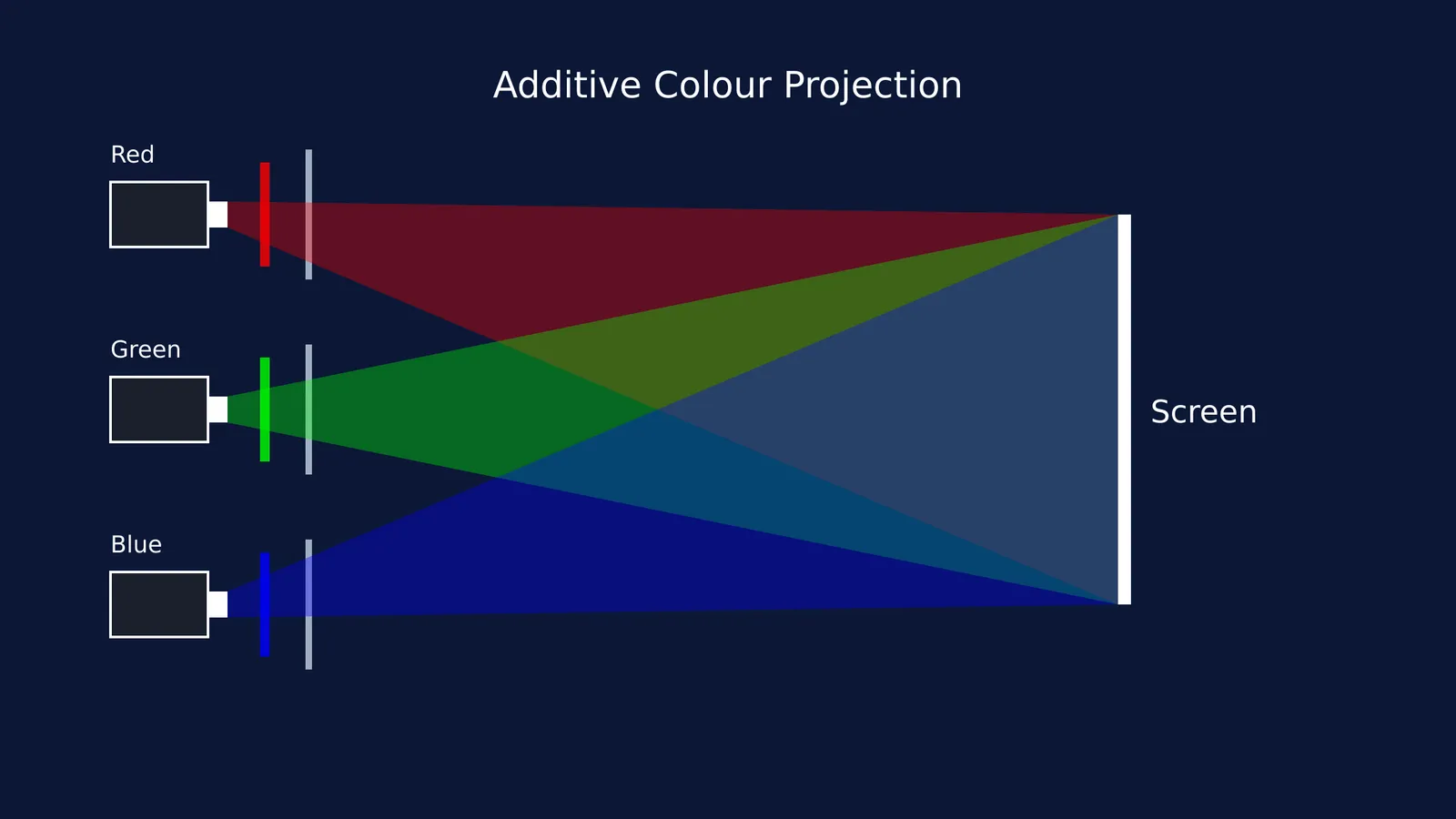
For each exposure, Sutton placed a different glass filter in front of the lens. One filter was red, the second was green, and the third was blue 1. This process resulted in three black-and-white photographic plates, each recording the intensity of one specific colour bouncing off the ribbon.
During his lecture, "On the Theory of the Three Primary Colours", Maxwell placed these three monochrome plates into three separate projectors 1. He then shone light through each plate using the same red, green, and blue filters that Sutton had used for the original exposures. When the three projected beams overlapped on the screen, they merged to recreate the vibrant, full-colour image of the original tartan ribbon. The audience saw a complete image built purely from three base colours of light.
The ultraviolet accident: why did the photograph work?
While Maxwell's theory of three-colour separation was perfectly correct, his 1861 demonstration succeeded partly by accident.
In the 1860s, photographic plates were coated with wet collodion, a chemical mixture that was sensitive to blue light and ultraviolet light but practically blind to red and green light 2. In theory, Sutton's red-filtered plate should have captured nothing at all, because the plate could not "see" the red wavelengths.
However, research conducted a century later in 1961 revealed two lucky coincidences 2. First, the specific red dye in the tartan ribbon strongly reflected ultraviolet (UV) light. Second, the red filter Sutton used allowed ultraviolet light to pass through 2. Because the photographic plate was highly sensitive to UV rays, the "red" separation was actually a photograph of ultraviolet light. This unexpected sensitivity allowed the final image to display a complete colour range, covering for the chemical limitations of the era.
If you are studying optics and the electromagnetic spectrum, understanding these wavelength interactions is essential. You can explore how different wavelengths of light behave in the Fermi Concept Library, which maps out every core idea in the physics of waves.
How does the three-colour theory apply today?
Maxwell's tartan ribbon proved that full-colour images do not require infinite shades of dye; they only require three primary colours mixed in the correct proportions.
This additive colour principle is the foundation of modern technology. Every pixel on your phone, television, or computer monitor contains tiny red, green, and blue sub-pixels. By adjusting the brightness of these three colours, the screen tricks your eye into seeing the entire spectrum, exactly as Maxwell demonstrated in 1861.
If you struggle to visualise how light, lenses, and filters interact to form images, reading about it is often not enough. You can experiment with these principles directly in the Fermi Simulation Lab, where interactive models make hard-to-picture physics ideas easy to see.
A quick guide: Additive vs. subtractive colours
Students often confuse the physics of light with the rules of mixing paint. If you are preparing for exams, use this checklist to keep the principles straight:
Additive colour (Light): The primary colours are Red, Green, and Blue (RGB). Mixing all three together creates pure white light. This is how screens, projectors, and Maxwell's experiment work.
Subtractive colour (Pigment): The primary colours are Cyan, Magenta, and Yellow (CMY). Mixing all three together creates black (or very dark brown). This is how printers, dyes, and paint work, because pigments absorb (subtract) light.
The golden rule of thumb: If the source emits its own light, it uses additive colour. If the source merely reflects ambient light, it uses subtractive colour.
For more on the history of optics, read how dispersion in a glass prism separates white light into its spectrum, or explore the invention of the polarising filter by Edwin Land.


