

On this page
Mary the Jewess (also known as Maria Prophetissima) lived in Alexandria, Egypt, between the 1st and 3rd centuries CE. Most of her writings are lost, but her legacy survives in the texts of later alchemists like Zosimos of Panopolis, who revered her as a sage. In a 1982 historical analysis, she is described as the "founding mother of alchemy" (Patai, 1982).
She bridged the gap between mystical philosophy and practical laboratory work. While earlier Greek figures speculated about the abstract nature of matter, Mary built the physical tools to actually test it.
What is a bain-marie in alchemy?
Before the bain-marie, alchemists struggled with direct fire. Wood or charcoal fires are notoriously difficult to control; a sudden draft can spike the temperature, ruining days of careful preparation.
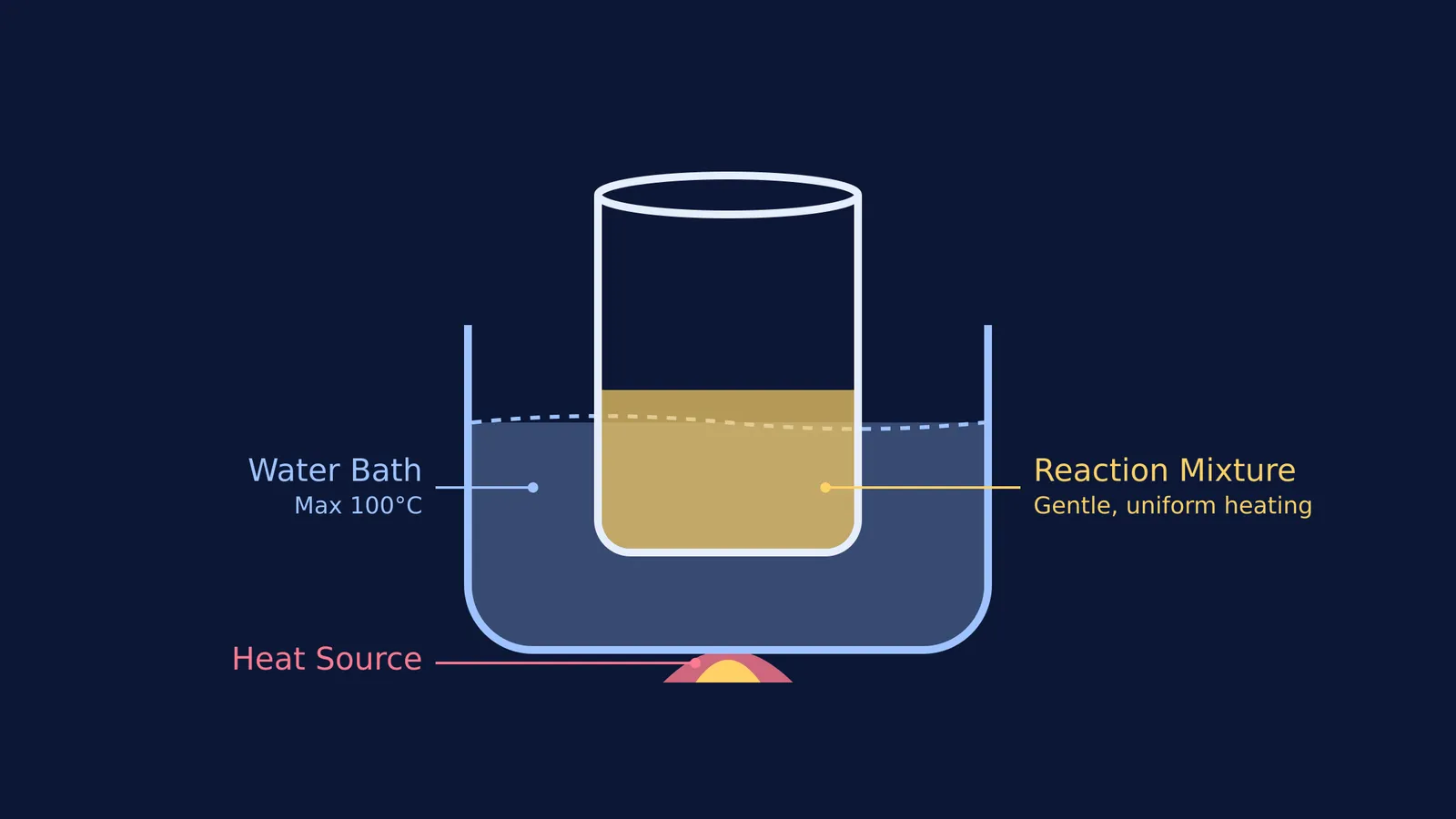
Mary solved this with the *balneum Mariae*, or Mary's bath—what we now call a bain-marie. It is a double boiler: an outer vessel holds water over a fire, and an inner vessel holds the reaction mixture. Because liquid water cannot exceed its boiling point (100°C at sea level) without turning into steam, the inner vessel is bathed in a gentle, uniform heat that never crosses 100°C.
This temperature ceiling was crucial for the slow, controlled reactions of early chemistry. It prevented delicate mixtures from burning or decomposing prematurely. Today, you find the bain-marie everywhere from school chemistry labs to restaurant kitchens melting chocolate. If you are studying for exams and need to visualise how temperature limits affect phase changes, the Fermi Simulation Lab has interactive simulations for the ideas that are easier to see than to read.
What else did Mary the Jewess invent?
Mary's practical genius went beyond the water bath. She designed airtight seals using flour paste and recommended glass over clay or metal so she could watch the reactions happen.
Two of her other major inventions became standard equipment (Wikipedia):
The tribikos: A three-armed distillation apparatus. It was an early alembic that used an earthen pot for the boiling liquid and three copper tubes to channel the condensed vapour into distinct glass receivers. Mary provided precise instructions for making the copper tubes, specifying they should be the thickness of a frying pan. Distillation remains a primary way to purify liquids, alongside chemical methods like separating 1°, 2° and 3° amines.
The kerotakis: An airtight heating device used to treat metals with vapours. Metals like copper were placed on a palette inside the cylinder, while sulphur was heated below. As the sulphur vaporised and condensed, it reacted with the metal to create a superficial alloy that looked like gold. Her work was so influential that the hermetic seal—the airtight closure she achieved here—is named in honour of Hermes Trismegistus, the mythical founder of the tradition she followed.
This continuous refluxing (where a vapour condenses and drips back down) is a process still used when a reaction needs prolonged heating without losing solvent, such as when you need to push the equilibrium in a Fischer esterification.
If you get stuck on vapour pressure or distillation problems, Fermi's AI tutor can work out what you already know and build a plan for the session, guiding you through the reasoning step by step.
Why is her work important today?
Mary the Jewess did not just write about theories; she built the apparatus to test them. She understood that chemistry requires observing changes firsthand. Her attention to the physical construction of equipment transformed alchemy from a purely philosophical pursuit into a rigorous laboratory practice.
This hands-on approach is the heart of active learning. Reading about how a tribikos separates liquids is one thing, but calculating the vapour pressures, understanding Dalton's law, and working out why separation happens takes practice. When you use the Fermi Problem Library, you get worked problems with a step-by-step solver that explains the reasoning rather than printing an answer, helping you master the mechanics behind the observations.
Mary's tools laid the foundation for the next two thousand years of chemical engineering. Every time you set up a water bath in a practical exam, you are using a piece of technology designed by an alchemist in Roman Egypt.


