

On this page
Before the 20th century, transporting perishable food into cities was a gamble with public health. It took the work of Mary Engle Pennington (1872–1952), a pioneering bacteriological chemist, to turn refrigeration from a luxury into a precise science. Despite being denied a formal bachelor's degree by the University of Pennsylvania due to her gender, she earned her Ph.D. in chemistry from the institution in 1895. Often called the "Ice Woman," Pennington developed the rigorous temperature standards that keep our eggs, milk, and poultry safe today.
How did Mary Engle Pennington change food safety?
Following the passage of the Pure Food and Drug Act of 1906, Harvey W. Wiley (the "Father of the FDA") sought an expert to lead the newly created Food Research Laboratory to enforce the new safety laws. Knowing that a woman might face discrimination for such a senior role in government, Wiley had Pennington take the Civil Service exam and submitted her application under the name "M.E. Pennington." She earned the highest score and, in 1907, became the first female lab chief in the history of the USDA (Science History Institute).
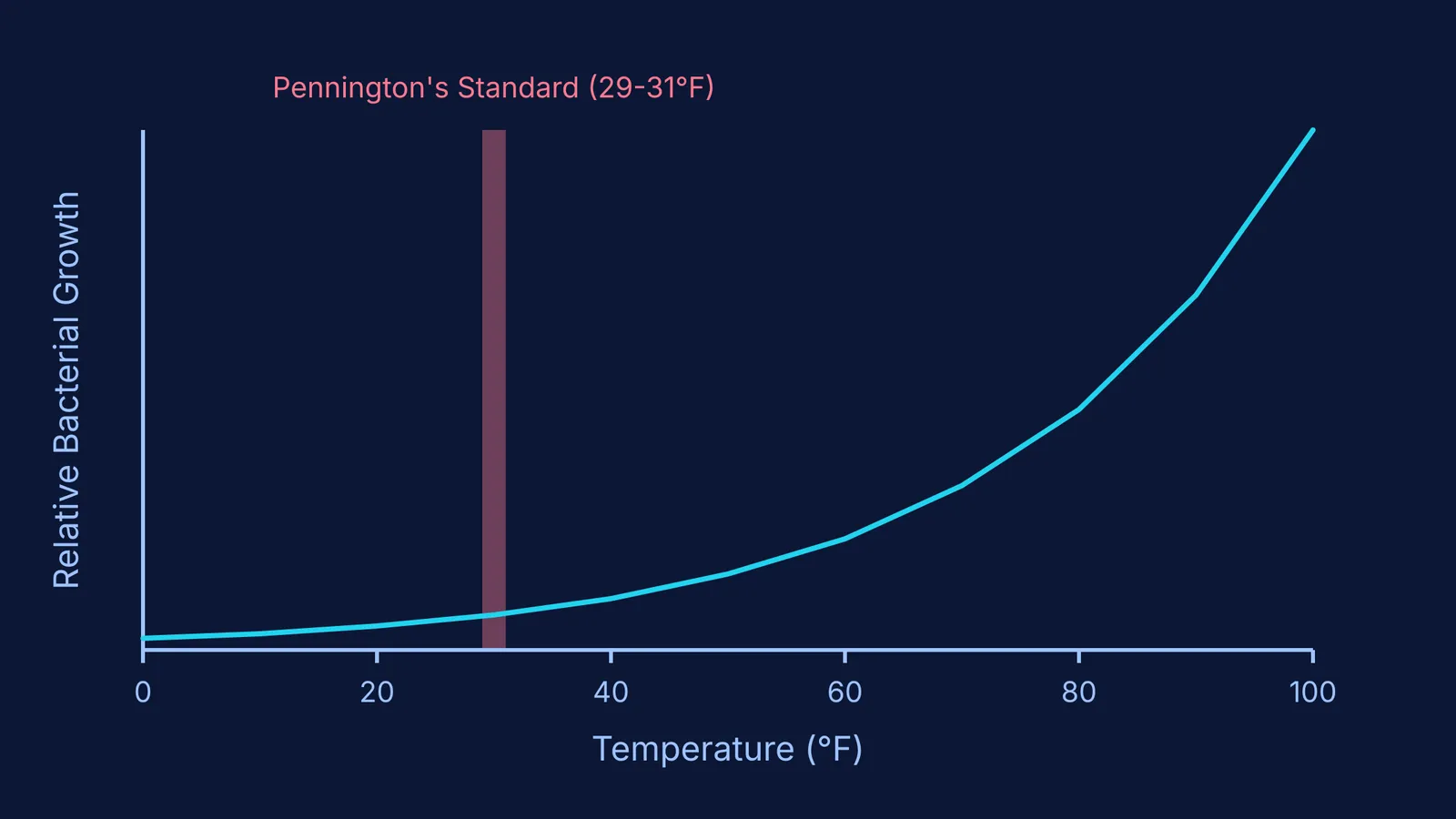
Pennington's mandate was to eliminate food that was "filthy, putrid, or decomposed." She quickly realised that the problem was not just on the farms, but in the transportation. Bacteria multiply rapidly at room temperature. If you study reaction rates, you know that heat accelerates chemical and biological processes—a concept explored in our guide on the Temperature coefficient of rate: why rates double every 10 °C. Pennington solved this by establishing the "cold chain": an unbroken system of constant refrigeration from the farm to the urban consumer.
What were the temperature standards for eggs and milk?
Pennington's work on milk safety began even before her federal career, when she investigated the contaminated milk supply for the Philadelphia Bureau of Health. She educated farmers on sanitary practices and proved that keeping bacterial counts low through constant refrigeration was the only way to ensure milk remained safe to drink.
She brought this same rigorous approach to eggs. Pennington spent years riding in refrigerated railroad boxcars (known as reefers) across the country to test insulation and measure temperature fluctuations. Through extensive bacterial testing, she discovered that the optimal temperature for shipping eggs was exactly 29–31°F (National Inventors Hall of Fame). Despite initial pushback from the agricultural industry over the cost of upgrading equipment, this narrow range proved essential to stop bacterial growth and became the national standard.
She also found that when liquid eggs are removed from their shells, they lose natural carbon dioxide, which accelerates spoilage. To solve this, she patented a "Method of Treating Eggs" (U.S. Patent 1,996,171, issued in 1935), which involved restoring CO₂ to the liquid eggs to maintain their internal chemistry and freshness. Students using the Fermi Concept Library to study cellular respiration and gas exchange can see exactly how controlling carbon dioxide alters a biological environment.
Why did Pennington invent "dry chilling" for poultry?
Pennington fundamentally transformed how poultry was processed and transported. Before her research, chickens were typically "ice-packed" in barrels of water. As the ice melted during long journeys, the waterlogged meat became a breeding ground for bacteria.
Pennington advocated for a completely new "dry-chilling" and "dry-packing" method. To achieve this on a large scale, she and Howard Castner Pierce designed an all-metal poultry-cooling rack, which was issued U.S. Patent 1,020,575 in 1912 (ChemistryViews). This rack allowed cold air to circulate evenly around the carcasses without moisture, keeping the skin dry and significantly extending shelf life.
Her work on thermal properties transformed transport logistics. Much like the early pioneers of thermal physics—such as Jean Peltier and cooling at a junction of two metals—Pennington applied thermodynamic principles to solve real-world problems. Today, students can use the Fermi Simulation Lab to interactively model heat transfer and see why specific insulating materials are more effective at trapping cold air.
How can you apply cold-chain principles in your own kitchen?
Pennington's research on dry packing and temperature control is just as useful at home as it is on a train. Here is a modern checklist to keep your food safe, based on her early findings:
Keep it dry: Moisture breeds bacteria. Wash your leafy greens and vegetables, but dry them completely before storing them in the refrigerator, mimicking Pennington's dry-packing method.
Check your fridge temperature: Pennington insisted on exact numbers. Ensure your home refrigerator is set to a strictly cold setting to stall bacterial growth.
Do not break the chain: When you buy perishables like milk and poultry, make them the last items in your shopping basket and the first items you put away when you get home.


