

On this page
On April 3, 1973, standing on Sixth Avenue in New York City, Motorola engineer Martin Cooper held a heavy device, extended its antenna, and pressed a series of buttons. He was about to make a call that would permanently change how humans communicate.
The recipient was Joel S. Engel, the head of the cellular program at Bell Labs (AT&T). Engel's team was working on mobile technology, but their focus was entirely on car-bound phones. Cooper's team at Motorola had a different vision: they wanted people to talk to people, no matter where they were standing.
When Engel answered, Cooper delivered the historic line: "Joel, this is Marty. I'm calling you from a cell phone, a real handheld portable cell phone" (Wikipedia)). There was silence on the other end of the line.
Who made the first handheld mobile phone call?
The first handheld mobile phone call was made by Martin Cooper, a visionary engineer at Motorola who believed that personal communication was the future.
Prior to 1973, mobile phones did exist, but they were heavy transceivers bolted into the trunks of cars, drawing power directly from the vehicle's battery. Cooper championed the idea that a phone should belong to an individual (Wikipedia)). This motivation drove Motorola to invest heavily in the technology, racing to build a working prototype before regulators handed monopoly control of the cellular spectrum to AT&T.
What was the first mobile phone in 1973?
The device Cooper used was a prototype of the Motorola DynaTAC (Dynamic Adaptive Total Area Coverage).
It was far from the sleek glass slabs we use today. The 1973 DynaTAC prototype weighed 2.5 pounds (1.1 kg) and was 10 inches (25 cm) long (Wikipedia). Its battery technology severely limited its utility. It required 10 hours to recharge and provided a maximum of 30 minutes of talk time. As Cooper later joked, the short battery life was not a problem because nobody could hold the heavy phone up to their ear for that long anyway.
It took ten more years of refinement before the first commercial version, the DynaTAC 8000X, went on sale in 1983 for nearly $4,000 (Wikipedia).
How did the first cellular network work?
The brilliance of the 1973 call was not just the phone, but the physics of the cellular network behind it. To make the call, Motorola installed a single experimental base station on the roof of the nearby Burlington House, which patched the radio signal directly into the AT&T landline telephone network.
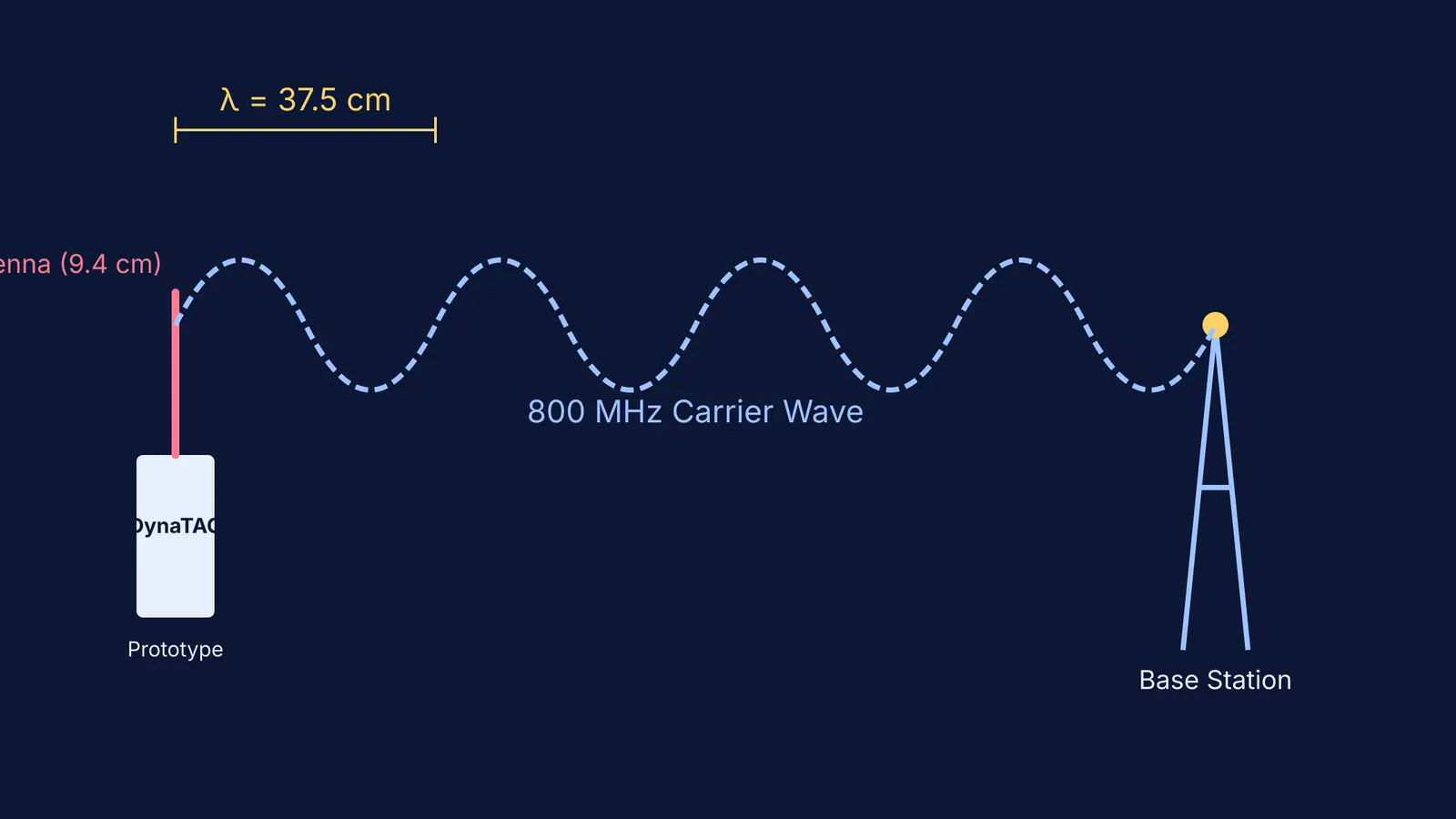
The call operated in the 800 MHz frequency region within the Ultra High Frequency (UHF) spectrum (Britannica). In physics, we know that all electromagnetic waves travel at the speed of light (c = 3 × 10⁸ m/s). Using the wave equation c = fλ, a frequency (f) of 800 MHz gives a wavelength (λ) of 37.5 cm.
This specific wavelength was crucial for the phone's design. For an antenna to efficiently transmit and receive radio waves, its physical length must be a fraction of the wavelength, typically a quarter-wave (λ/4). A quarter of 37.5 cm is about 9.4 cm. The DynaTAC's prominent whip antenna was built to match this physical reality perfectly.
If you are studying radio waves or calculating wavelengths for your own physics numericals, having a clear method is essential. Fermi's AI tutor can work out what you already know and build a plan for the session, so you sit down to a clear next step when tackling these concepts. For more on how electromagnetic energy propagates, see our guide on the Energy density and intensity of an EM wave, with worked numbers.
What can students learn from Cooper's prototype?
The cellular network also relied on a concept called "frequency reuse." Instead of one massive radio tower trying to cover a whole city on one frequency, a city is divided into small cells, each with its own low-power base station. Because the power is low, the same frequencies can be reused in non-adjacent cells without interfering with each other. This builds on foundational communication principles explored in Alexander Graham Bell and the physics of the telephone.
For students, Cooper's approach to the first mobile phone is a powerful lesson in active learning and prototyping. You do not need to wait until your knowledge is perfect to test it.
A framework for testing your understanding:
Build a prototype answer: Write down your best attempt at solving a problem without looking at the textbook.
Find your base station: Compare your answer against a trusted source, such as the worked problems in the Fermi Problem Library, which has a step-by-step solver that explains the reasoning rather than just printing an answer.
Iterate quickly: The DynaTAC took ten years to go from prototype to product. When studying, spot where your reasoning broke down and immediately try a similar problem.
Martin Cooper's 1973 call proved that a bold idea, grounded in solid physics and tested in the real world, can shift the course of history.


