

On this page
On 5 April 1859, the US Patent Office granted patent 23,536 for "Pyrotechnic Night-Signals" (the patent on Google Patents). The inventor named on it was B. Franklin Coston, who had died eleven years earlier. His widow Martha, who made the idea work, appears only as administratrix.
Who was Martha Coston?
Martha Coston was born Martha Hunt in Baltimore on 12 December 1826 and died on 9 July 1904, according to the National Inventors Hall of Fame, which inducted her in 2006. Her husband, an inventor, died in 1848 after chemical exposure at work. The Lemelson-MIT Program notes that she was widowed at 21 with children to support.
Among her husband's papers she found drawings for a signal that ships could use to communicate at night. Lemelson-MIT says his system did not work. She had no knowledge of chemistry, according to The Henry Ford, so she relied on others and spent years directing a team of chemists. The Hall of Fame puts the effort at more than ten years.
How did Coston's signal flares work?
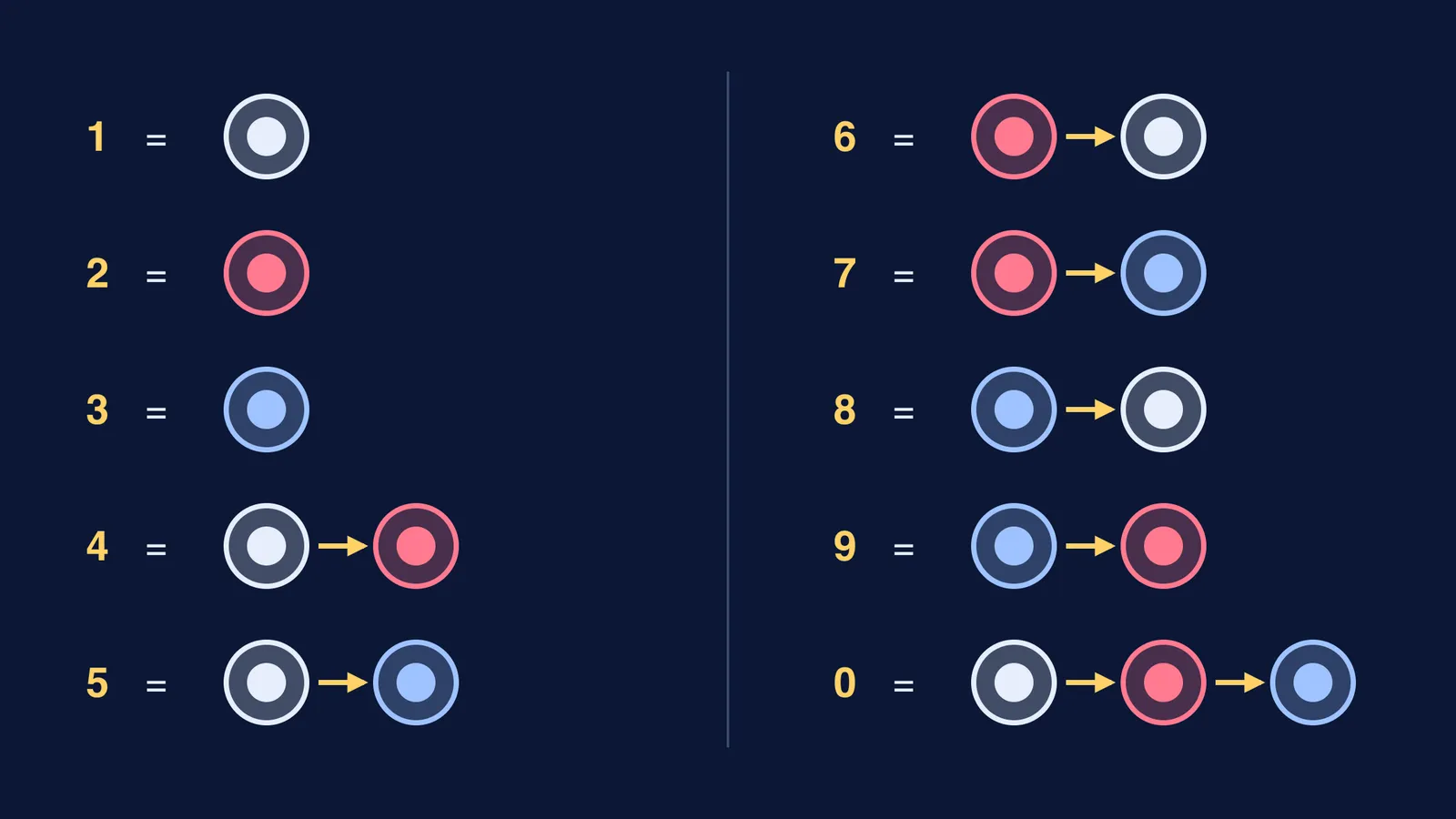
The patent says signal books "could only be used during the hours of the day" (US Patent 23,536). Her answer was a code made of coloured fire. The patent names three colours and builds all ten digits from them:
White = 1, red = 2, blue = 3
White running into red = 4, white into blue = 5
Red into white = 6, red into blue = 7
Blue into white = 8, blue into red = 9
White, then red, then blue = 0
The same patent adds two handshake signals: a long white fire means a ship wants to communicate, and a long red fire means the other ship is ready to answer.
Worked example: send the number 470
Your ship burns a long white fire. The other ship replies with a long red fire.
You burn white running into red. That is 4.
You burn red running into blue. That is 7.
You burn white, red and blue in turn. That is 0.
Why did the flares end up green instead of blue?
She had recipes for red and white, but blue remained elusive, according to The Henry Ford. In 1858 she watched New York's fireworks celebrating the first transatlantic telegraph cable. Inspired, she wrote to New York pyrotechnists looking for a strong blue, using a man's name for fear she would be ignored. In the end she found a recipe for a brilliant green instead. The Hall of Fame lists the finished flares as red, white and green.
The chemistry explains her trouble. In fireworks, strontium compounds give red, barium gives green and copper chlorides give blue, as PBS NewsHour reports. PBS adds that copper's narrow temperature range makes blue the hardest colour for pyrotechnic experts to create. John Conkling, former executive director of the American Pyrotechnics Association, told PBS where the colour comes from: a heated electron jumps to a higher energy level, drops back, and gives out a photon at "a very distinct wavelength for the different chemical elements". That is the same idea behind the flame tests in your school chemistry lab.
How did the US Navy use Coston flares?
On 5 August 1861, Congress authorised the navy to buy the patent for $20,000, half the $40,000 she had asked for (Wikipedia). During the Civil War, Union ships used the flares on the blockade and to pursue Confederate blockade-runners, and her company sold them at cost (The Henry Ford). Admiral David Porter wrote, as The Henry Ford quotes him, that "at night the signals can be so plainly read that mistakes are impossible".
After the war she added a twist-ignition device patented in 1871 (Lemelson-MIT), and her later patents carried her own name. Every station of the US Life-Saving Service came to be equipped with Coston flares (Wikipedia).
What can students learn from Coston's method?
Coston fixed someone else's broken design piece by piece. You can use the same four steps when a problem, or an old set of notes, stops making sense:
Keep what works. She kept red and white. Write down the steps you are sure of.
Name the exact gap. For her it was one colour. For you, it might be one step.
Look outside your chapter. She found her answer in fireworks, not naval manuals. Check a related topic, another textbook or a friend's notes.
Accept a substitute that does the job. Green worked in place of blue for the code. A different method that reaches a correct answer still counts.
If the gap is an idea that is hard to picture, like electrons jumping between energy levels, the Fermi Simulation Lab has interactive simulations for ideas that are easier to see than to read. If it is a missing concept, the Fermi Concept Library gives each concept in physics, chemistry, biology, mathematics and computing its own lesson.
Next time you do a flame test, remember that the same colours once carried messages between warships.


