

On this page
For much of the early 20th century, scientists studied bacteria primarily to understand the diseases they caused. The focus was on identifying them, killing them, or preventing their spread. Marjory Stephenson took a different approach: she wanted to know how they worked on the inside.
By treating bacteria as complex chemical factories, Stephenson laid the groundwork for modern microbial biochemistry.
Who was Marjory Stephenson?
Marjory Stephenson (1885–1948) was a pioneering British biochemist who fundamentally changed how scientists viewed microorganisms. After her early research was interrupted by service during the First World War, she returned to Cambridge and dedicated herself to exploring the chemical lives of microbes. Rather than just looking at what a bacterium looked like under a microscope or what disease it caused in a patient, she investigated the specific chemical reactions that kept it alive.
In 1945, her monumental contributions were recognised when she became one of the first two women elected as a Fellow of the Royal Society, alongside Kathleen Lonsdale (Royal Society, 1949). By that point, her decades of meticulous research had already established chemical microbiology as a distinct and rigorous scientific discipline.
How did she study bacterial metabolism and enzymes?
To understand a factory, you have to look at its machines. In a living cell, those machines are enzymes. Before Stephenson's work, studying the chemistry of bacteria was incredibly difficult because the cells were constantly reproducing, dying, and changing the chemical makeup of their environment.
To solve this, she helped pioneer the washed suspension technique. By washing the bacteria and placing them in a buffer solution without nutrients, the cells entered a "resting" state. They were alive, but they were not growing or dividing. This allowed researchers to introduce a specific chemical and precisely measure what the bacteria did to it, bringing a new level of mathematical precision to microbiology.
In 1928, using these careful techniques, Stephenson became the first person to successfully isolate a bacterial enzyme from a cell—lactic dehydrogenase from *E. coli* (Wikipedia).
This was a major breakthrough. It proved that bacterial enzymes could be extracted and studied in isolation, just like the enzymes from plants and animals. This work sits alongside other great biochemical discoveries, such as James Sumner and the proof that enzymes are proteins and the development of Michaelis, Menten and the equation for enzyme speed.
Why do adaptive enzymes matter?
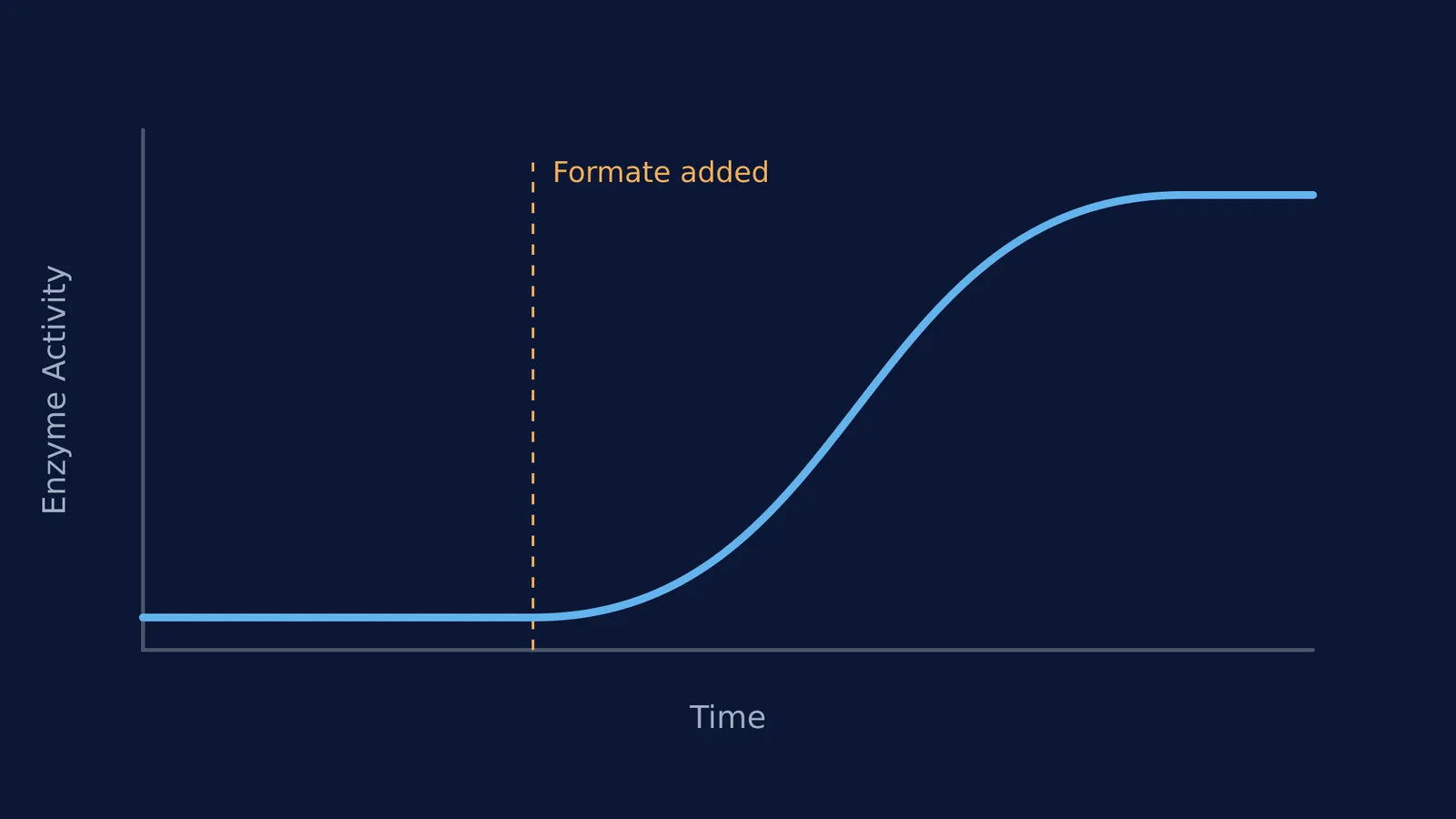
Stephenson did not just catalogue static enzymes; she discovered that bacteria are highly responsive to their environment. In the early 1930s, she demonstrated that *E. coli* only produced the enzyme formate hydrogenlyase when it was actively grown in the presence of formate.
This was one of the first clear scientific examples of what she termed an "adaptive enzyme". Today, biologists refer to this as an inducible enzyme, controlled by a process called transcriptional activation. She showed that a bacterium is highly efficient and does not waste energy building chemical machines it does not need. Instead, it adapts its internal chemistry to match whatever food source or environment it finds itself in. This foundational idea paved the way for later breakthroughs in genetics and molecular biology, showing how genes can be switched on or off.
How should you study biological systems?
Stephenson's approach to bacteria—breaking a living system down into isolated, understandable chemical reactions—is an excellent model for how to study complex biological systems. When facing a massive topic, you have to find a way to make it manageable.
Isolate the mechanism: Do not try to memorise an entire metabolic pathway (like cellular respiration, glycolysis, or photosynthesis) in one giant block. Study one individual step and its specific enzyme at a time, just as Stephenson first isolated lactic dehydrogenase from the rest of the cell.
Identify the inputs and outputs: For every chemical step you study, write down exactly what goes in and what comes out. In Stephenson's terms, what is the substrate being consumed, and what is the final product being made?
Understand the trigger: Remember her work on adaptive enzymes and how bacteria respond to their environment. Ask yourself: what specific conditions cause this enzyme to be produced or activated? Understanding the "why" behind a reaction makes the "what" much easier to remember than rote memorisation.
If you are struggling to break down these complex topics on your own, Fermi's AI tutor can guide you. When you bring a difficult concept or a problem set to the platform, the tutor works out what you already know, builds a plan for the session, and teaches through it—drawing the figure, running the simulation, and checking understanding as it goes. It helps you see the underlying mechanism rather than just memorising the final answer.


