

On this page
At the start of the 19th century, London faced a problem. They needed to move cargo across the River Thames, but a conventional bridge would block the tall sailing ships that filled the docks. Digging beneath the river seemed to be the only option, but early attempts ended in disaster when the soft, silty riverbed caved in. It took Marc Isambard Brunel and an unlikely biological inspiration to solve the problem and build the world's first underwater tunnel through soft ground.
How did a shipworm inspire the design?
Brunel is said to have found his answer while observing the shipworm (*Teredo navalis*) in a shipyard. The shipworm is a mollusc that bores efficiently through submerged timber. As it digs, its head is protected by two hard calcareous shells. While it scrapes away the wood, the shipworm simultaneously secretes a lime-like lining behind itself to prevent the tunnel from collapsing or swelling shut, according to historical accounts of his work.
Brunel realised that to dig through the unstable mud of the Thames, human miners needed a similar mechanical "shell". They needed a structure to protect them from cave-ins at the digging face, followed immediately by a permanent lining to secure the tunnel behind them.
Who invented the tunnelling shield?
In January 1818, Marc Isambard Brunel patented the tunnelling shield along with Lord Cochrane. By February 1825, Brunel and his son, Isambard Kingdom Brunel, began using the invention to excavate the Thames Tunnel connecting Rotherhithe and Wapping.
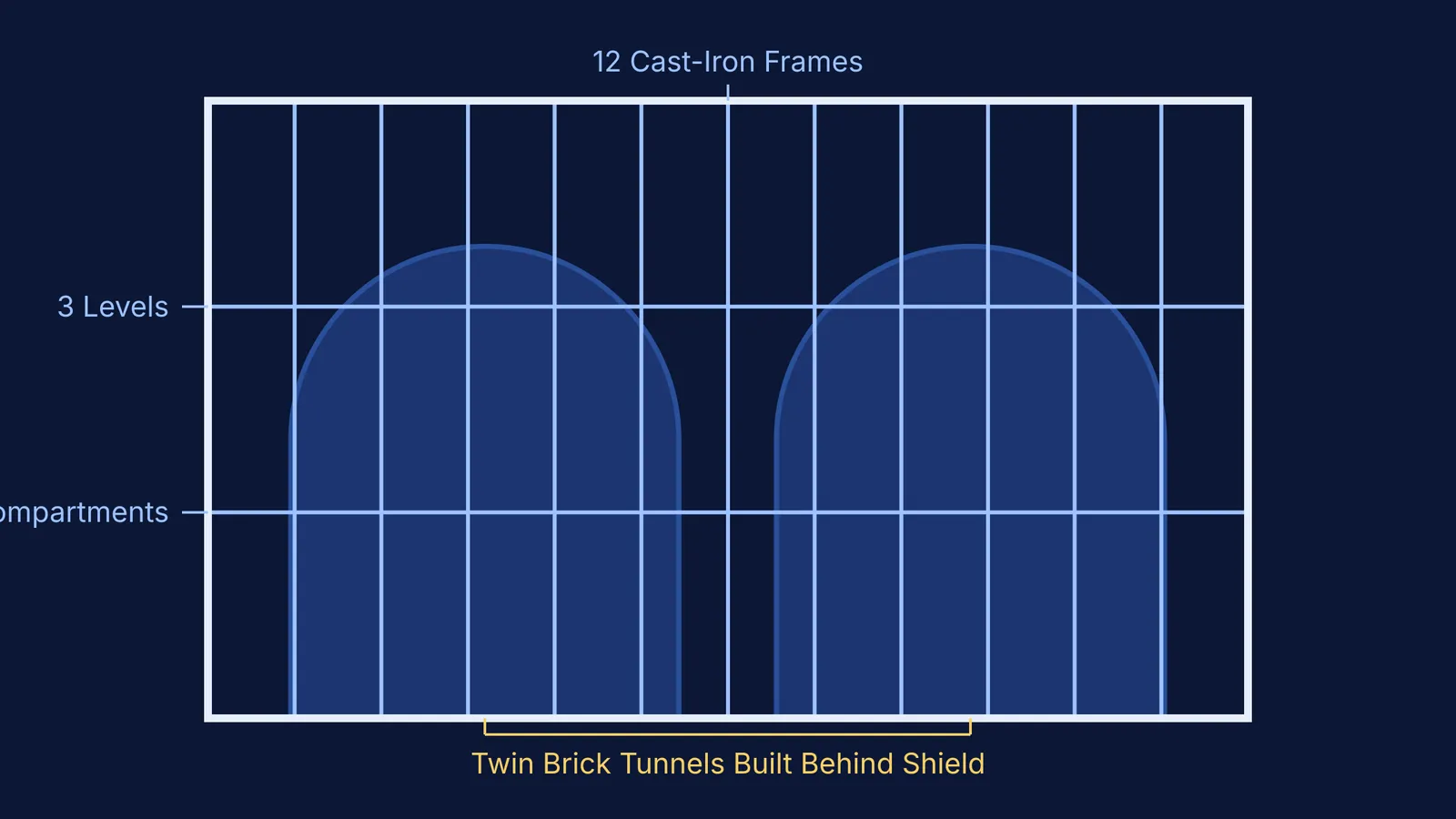
The original shield was a massive rectangular scaffold-like cast-iron structure. It measured 37 feet 6 inches wide and 22 feet 3 inches high, weighing approximately 80 tons. Inside, it was divided into 12 vertical frames, each containing three horizontal levels. This created 36 individual compartments, allowing 36 miners to work safely at the same time.
When you study for rigorous exams, tackling massive topics can feel overwhelming. Much like how Brunel broke an impossible task into 36 small, supported sections, the Fermi Problem Library provides a step-by-step solver that explains the reasoning rather than just printing an answer. Breaking the problem down helps you learn the method without getting buried in the complexity.
How did the tunnelling shield work?
Here is how the shield operated during the excavation:
Excavation: Miners stood in their individual compartments, removing small wooden "poling boards" one by one to dig out a few inches of earth at the face.
Advancement: Once enough earth was removed, independent jackscrews pushed the iron frames forward against the completed brickwork behind them.
Lining: As the shield inched forward, bricklayers worked immediately behind the structure to install the permanent twin-arch tunnel lining. The Thames Tunnel eventually required over 7.5 million bricks.
The work was incredibly difficult and dangerous. The project suffered major floods in 1827 and 1828, and the tunnel was sealed for seven years due to a lack of funds. When work resumed in 1835, a new, heavier shield weighing 140 tons with 9,000 parts was installed to finish the job.
What is the legacy of the Thames Tunnel?
Despite the setbacks, the Thames Tunnel reached the opposite shore in 1841 and officially opened on 25 March 1843. Although originally designed for horse-drawn carriages, it opened as a pedestrian tunnel and became a major tourist attraction.
If you ride the London Overground between Rotherhithe and Wapping today, you are travelling through the very same brick arches. Brunel's shipworm-inspired shield proved that humans could dig safely through soft ground, laying the foundation for modern tunnelling machines.
Whenever you face a massive learning challenge, remember that taking it one step at a time with the right framework makes it possible. Fermi's AI tutor can work out what you already know and build a plan for the session, so you sit down to a clear next step.


