

On this page
In January 2001, a magnitude 7.7 earthquake struck Gujarat, destroying thousands of hand-thrown earthenware storage pots across rural settlements. Soon after, Gujarati newspaper Sandesh published a photograph of a shattered pot beside a ruined kitchen with the caption *Garibo nu fridge tutyu*—the poor man's fridge is broken.
That headline caught the eye of Mansukhbhai Prajapati, a traditional potter in Wankaner in Gujarat's Morbi district. Having spent years producing earthenware cookware, Prajapati decided to take the metaphor literally. Instead of watching perishable food spoil without electricity, he set out to build an earthenware refrigerator.
Between 2001 and 2004, Prajapati tested clay blends, firing temperatures, and wall porosities. With support from the National Innovation Foundation, he developed a double-walled terracotta cooling cabinet named Mitticool. In June 2022, the Bureau of Indian Standards published Indian Standard IS 17693:2022 for non-electric clay cooling cabinets, formalising his grassroots design into India's first national standard for an informal innovation.
How does evaporative cooling work in a clay refrigerator?
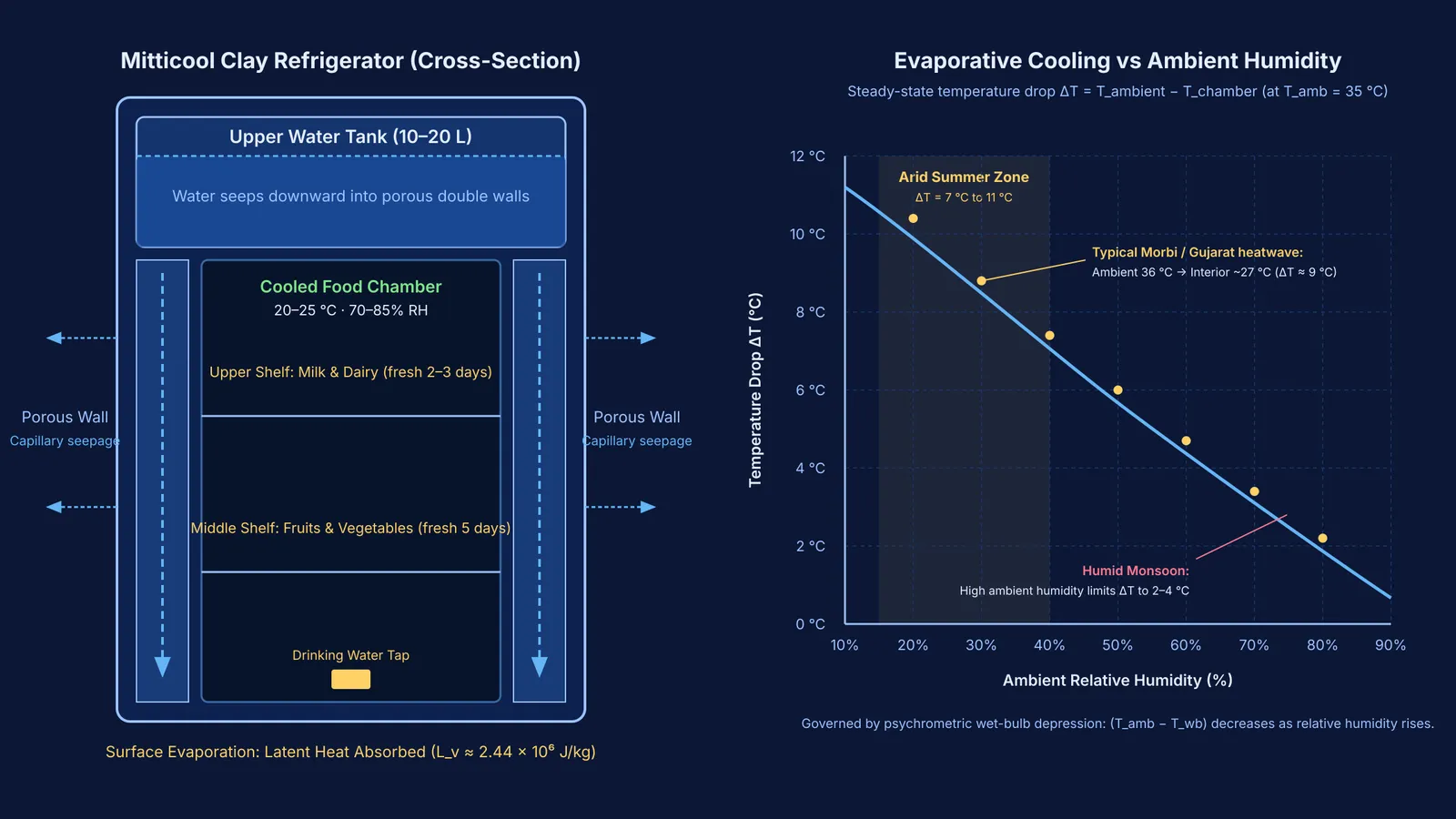
Unlike modern domestic appliances that compress and expand halogenated gases—a cycle detailed in our guide to vapour-compression refrigerators and heat pumps—Mitticool relies entirely on phase change. As documented by the National Innovation Foundation, an upper reservoir holds 10 to 20 litres of water, which seeps into hollow chambers between the porous double terracotta walls.
Water molecules migrate through microscopic capillaries in the terracotta to the exterior surface. Every gram of water that evaporates draws heat directly from the surrounding clay and food chamber, lowering internal air temperature. A thermodynamic discovery first quantified in the 1700s during Joseph Black's discovery of latent heat, this phase change provides sustained cooling. Experimental measurements by Patel and colleagues in Techno-Societal 2020 confirm that this evaporative flux maintains an interior temperature 5 °C to 8 °C cooler than ambient air under typical conditions, with internal relative humidity between 70% and 85%.
What does the thermodynamics of latent heat look like in practice?
Evaporative cooling works because water has a high latent heat of vaporisation. At 25 °C, evaporating water absorbs approximately 2.44 × 10⁶ J/kg, as analysed by A.W. Date in the International Journal of Heat and Mass Transfer. In contrast, warming liquid water by 1 °C takes just 4.18 × 10³ J/kg. Evaporating one drop absorbs nearly 600 times as much heat as warming that same drop by one degree.
Consider cooling 5 kg of fresh vegetables (c ≈ 4.18 kJ/(kg·°C)) from 35 °C to 27 °C, an 8 °C drop:
Q = m × c × ΔT = 5 kg × 4.18 kJ/(kg·°C) × 8 °C = 167.2 kJ
With latent heat at 28 °C around 2435 kJ/kg, the required evaporated water is:
m_water = Q / L_v = 167.2 kJ / 2435 kJ/kg ≈ 0.0687 kg ≈ 69 g
Less than 70 millilitres of evaporated water removes this heat. In practice, heat steadily conducts inward through the walls from the room; evaporating 1 to 2 litres of water over 24 hours comfortably balances this infiltration.
Working through energy balances and phase transitions builds strong physical intuition. The Fermi Problem Library offers worked problems with a step-by-step solver that explains the reasoning rather than printing an answer.
Why does relative humidity decide how well Mitticool cools?
Evaporative cooling depends on ambient weather. In thermodynamic analyses published in the International Journal of Heat and Mass Transfer, cooling is driven by the difference between dry-bulb and wet-bulb temperatures. In arid regions like Gujarat and Rajasthan where relative humidity drops below 25%, evaporation is brisk and yields temperature drops of 8 °C or more.
In humid coastal monsoons, where relative humidity approaches 90%, ambient vapour pressure nears saturation and evaporation slows. This relationship between vapour pressure, surface area, and cooling rate is detailed in our guide to the Class 9 physics of evaporation and latent heat.
Yet Mitticool retains an advantage over electric refrigerators: humidity. Electric compressors dehumidify storage air, wilting vegetables within two days. Because Mitticool's porous clay maintains high humidity, vegetables remain fresh for up to 5 days and milk stays fresh for up to 3 days, as tested by the National Innovation Foundation and noted by PIB Delhi.
Visualising how airflow, humidity, and pore structure control cooling rates is often easier through dynamic modelling. The Fermi Simulation Lab provides interactive simulations for ideas that are easier to see than to read.
What can students learn from Mansukh Prajapati's frugal engineering?
Mansukh Prajapati did not begin with a laboratory or research grant. He started with close observation of everyday materials and traditional pottery. His journey shows how foundational physics—capillary action, latent heat, and vapour pressure—can solve real-world problems when paired with structured testing.
For STEM students, Mitticool proves that physical laws are practical tools rather than abstract formulas. When studying thermodynamic cycles, look for where heat transfer and phase change operate around you.


