On this page
Number theory asks questions a Class 8 student can understand, such as which numbers can be written as a sum of squares, and some of them take centuries to answer. Manjul Bhargava has a habit of returning to such questions and finding a simpler way in. This post covers who he is, three of his results explained without heavy notation, a worked example on sums of squares you can check by hand, and what his way of working suggests for olympiad and JEE preparation.
Who is Manjul Bhargava?
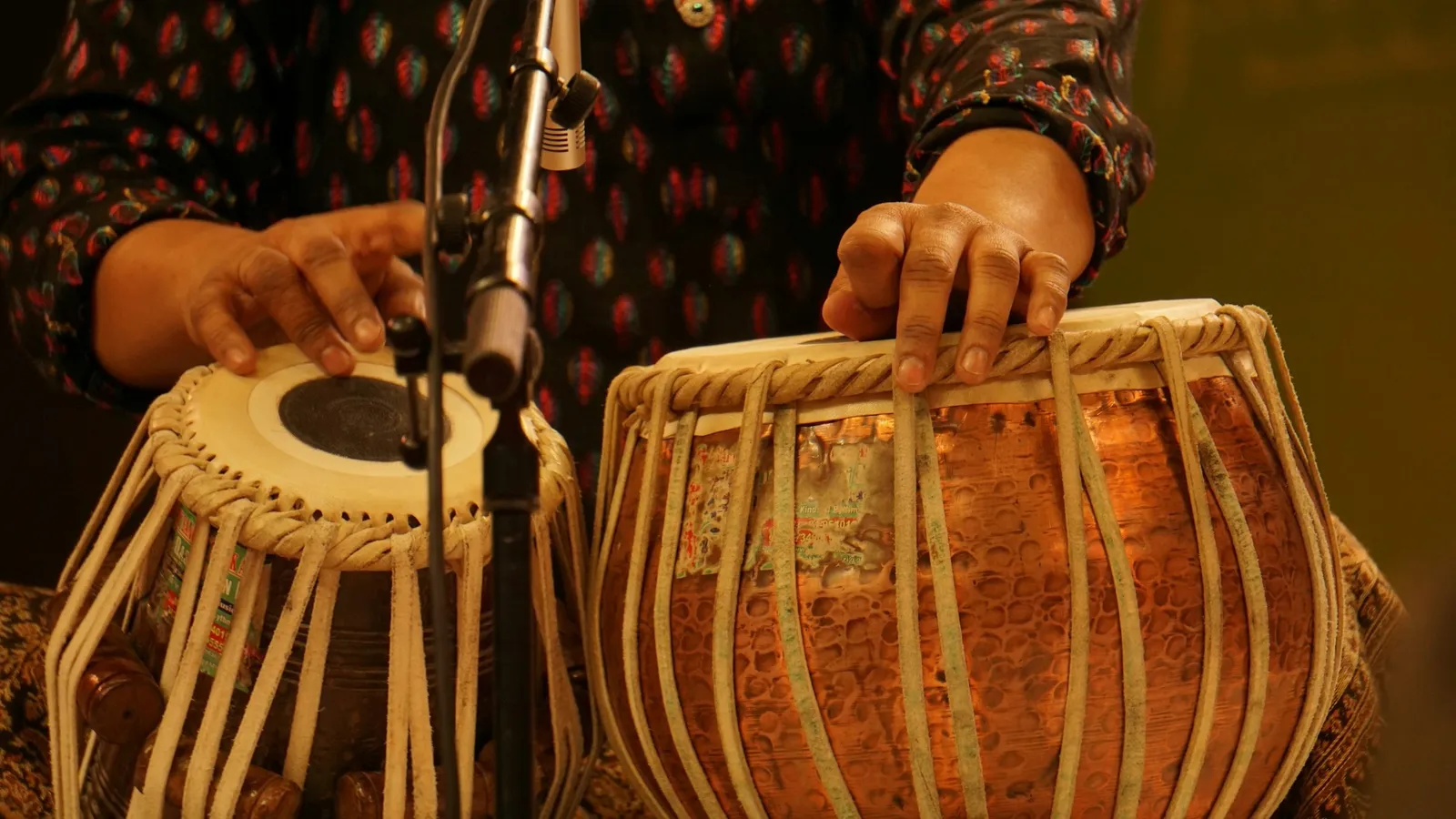
The International Mathematical Union's account of his work says he was born in 1974 in Canada, grew up mainly in the USA and also spent much time in India. He took his PhD at Princeton in 2001 under Andrew Wiles, the mathematician who proved Fermat's last theorem, and became a professor at Princeton in 2003. His honours before the Fields Medal included the SASTRA Ramanujan Prize in 2005 and the Infosys Prize in 2012. The IMU also notes that he plays the tabla at a professional level and has won several teaching awards.
His Fields Medal citation, on the IMU's 2014 Fields Medals page, is for "developing powerful new methods in the geometry of numbers, which he applied to count rings of small rank and to bound the average rank of elliptic curves."
How did a Rubik's cube lead to new mathematics?
As a graduate student, the IMU explains, Bhargava read Carl Friedrich Gauss's Disquisitiones Arithmeticae, a book many mathematicians know of but few read. Gauss studied binary quadratic forms, expressions ax² + bxy + cy² with whole-number a, b and c, and found a composition law: a way to combine two such forms into a third. The calculation runs to about 20 pages.
Bhargava felt there had to be a simpler way, and found it while playing with a Rubik's cube. He labelled the eight corners of a cube with numbers and sliced the cube in three ways. Each slicing gave two sets of four numbers, which formed matrices, and a short calculation gave a quadratic form. The three forms had the same discriminant, b² − 4ac, just as Gauss's law requires. The same idea extended to higher degrees, and he discovered 13 new composition laws that no one had known existed. You can read more about Gauss himself in our post on Carl Friedrich Gauss.
The discriminant is the same b² − 4ac you meet in the quadratic formula. For the form x² + xy + y², it is 1 − 4 = −3. For x² + y², it is 0 − 4 = −4.
What is the 290 theorem?
Which quadratic forms produce every positive whole number? The IMU release traces the question back to Fermat. The form x² + y² does not: it never gives 3, 6 or 7. Neither does x² + y² + z². But Lagrange proved that four squares, x² + y² + z² + w², give every positive integer. In 1916 Srinivasa Ramanujan found 54 more forms in four variables that do the same; our post on Ramanujan's notebooks covers his work.
In the early 1990s John Conway and his students guessed that a form needs to be checked only on numbers up to 290. Bhargava and Jonathan Hanke proved it. They found 29 integers, the largest being 290, such that any quadratic form, in any number of variables, that produces all 29 produces every positive integer. The proof combined clever ideas with extensive computer calculation.
A worked example: why 7 is not a sum of three squares
You can see part of this story with remainders.
Squares mod 8. Square every remainder from 0 to 7: 0, 1, 4, 9, 16, 25, 36, 49. Their remainders on division by 8 are 0, 1, 4, 1, 0, 1, 4, 1. So every square leaves 0, 1 or 4.
Sums of three. Add any three values from {0, 1, 4}: you can get 0, 1, 2, 3, 4, 5, 6, 8 and 9 (which leave 0 and 1), and 12 (which leaves 4). You never get a remainder of 7.
Conclusion. No number that leaves remainder 7 on division by 8, such as 7, 15 or 23, is a sum of three squares. That is why three squares are not enough.
Four squares work. 7 = 4 + 1 + 1 + 1 = 2² + 1² + 1² + 1², and 15 = 9 + 4 + 1 + 1.
The common mistake is to test a few numbers, find they work, and conclude the pattern holds. Remainders give a proof that covers all numbers at once.
What else did Bhargava find?
With Arul Shankar, he showed that the average rank of elliptic curves is bounded, and that a positive proportion of elliptic curves have only one rational point while a positive proportion have infinitely many. He also showed that a typical polynomial of degree at least 5 with rational coefficients never takes a square value. For a typical degree 10 polynomial, the IMU reports, there is a greater than 99% chance that the curve y² = f(x) has no rational points. Elliptic curves are the same objects his supervisor used in the proof of Fermat's last theorem.
What can a student take from Bhargava's way of working?
Read the original. He read Gauss when most people only read about Gauss. Read your NCERT derivation in full before reaching for a summary.
Look for a picture. A cube turned 20 pages of algebra into something he could see. Draw a figure before grinding through algebra.
Ask "what is the general pattern?" One composition law became 14. After solving a problem, change one condition and solve again.
Use remainders. Modular arithmetic, as in the worked example, is one of the most useful tools in olympiad number theory.
If remainders or quadratic forms are new to you, the Fermi Concept Library covers every concept in physics, chemistry, biology, mathematics and computing, so you can learn the background one idea at a time.
Try it now: use squares mod 4 to show that no number of the form 4k + 3 is a sum of two squares.