

On this page
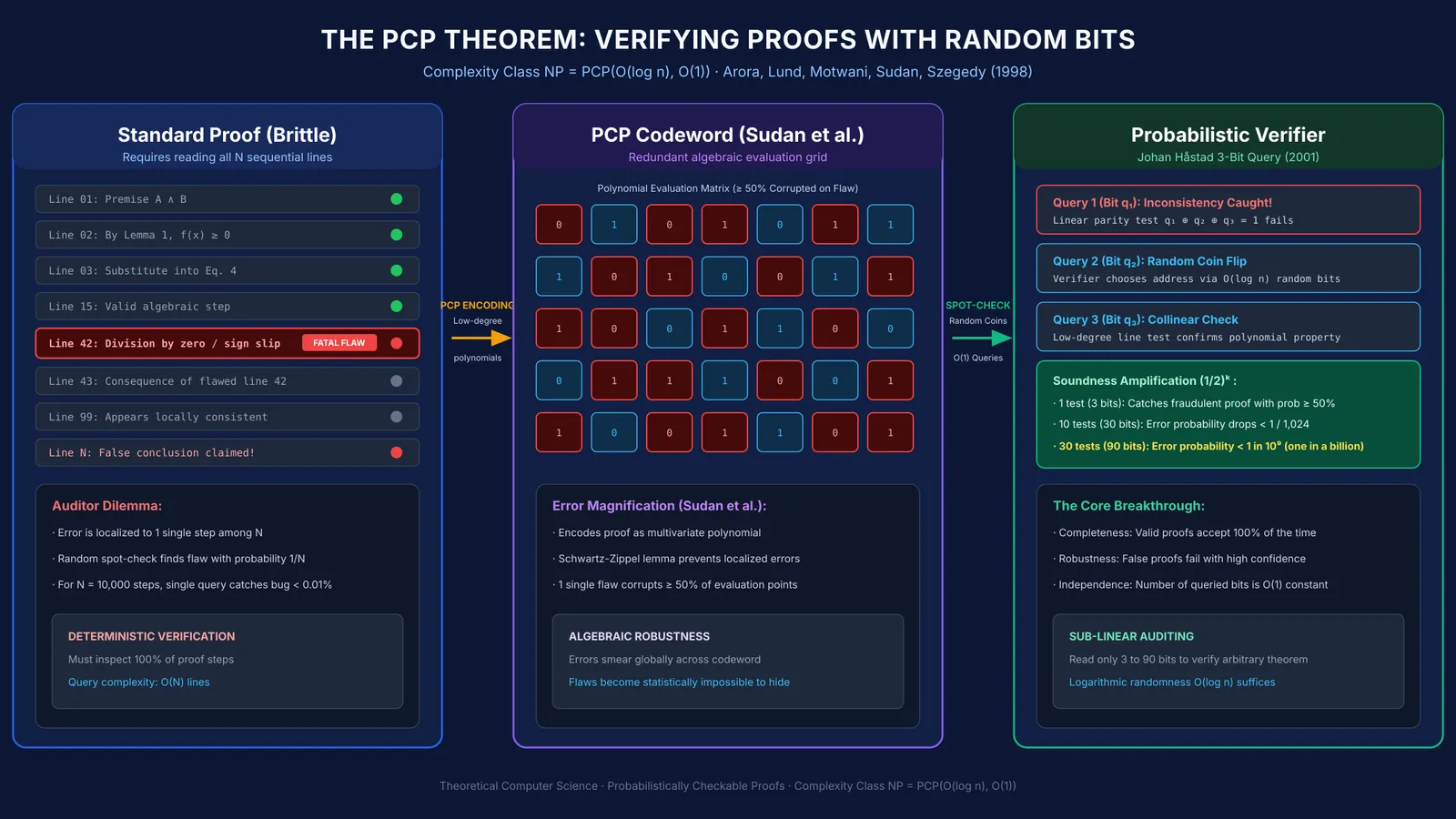
If someone hands you a 100-page mathematical proof, how many pages must you read to confirm that it is valid? In traditional mathematics, you must read all 100 pages. Mathematical deduction is brittle: a single arithmetic mistake on line 42 can render the conclusion completely false, even if every subsequent line follows logically.
In theoretical computer science, that assumption was overturned in the 1990s. Researchers proved that any mathematical proof can be rewritten so an auditor reads only a handful of randomly chosen bits to detect whether the proof is valid.
What is the PCP theorem?
The Probabilistically Checkable Proofs (PCP) theorem was established in two landmark 1998 papers in the *Journal of the ACM*. Sanjeev Arora and Shmuel Safra (DOI: 10.1145/273865.273901) showed that NP proofs can be verified probabilistically using logarithmic random bits and sublogarithmic proof queries. Sanjeev Arora, Carsten Lund, Rajeev Motwani, Madhu Sudan, and Mario Szegedy (DOI: 10.1145/278298.278306) pushed this to the limit: the verifier needs to read only a constant number of bits.
In complexity notation, NP = PCP(O(log n), O(1)). This statement contains two surprising properties:
Perfect completeness: If the theorem is true, a valid encoded proof is accepted 100% of the time, regardless of the random bits queried.
Robust soundness: If the theorem is false, every submitted proof is rejected with probability at least 1/2 (50%), no matter how the flaw is concealed.
Johan Håstad later proved that checking just 3 randomly selected bits suffices for linear systems (DOI: 10.1145/502090.502098). If a verifier reads 3 bits and accepts, a false proof still slips through with up to 50% probability. But repeating this test 30 times with independent coin flips queries 90 bits in total, dropping the chance of accepting a false proof below 1 in 10⁹ (one in a billion).
Why did Madhu Sudan treat proofs as error-correcting codes?
Madhu Sudan finished his bachelor's degree at IIT Delhi in 1987 and his Ph.D. at UC Berkeley in 1992 (Harvard Faculty Bio). Sudan shared the 2001 Gödel Prize for the PCP theorem (ACM SIGACT) and received the Rolf Nevanlinna Prize at the 2002 International Congress of Mathematicians (IMU Nevanlinna Prize).
Sudan treated proofs not as text, but as codewords in algebraic error-correcting codes. In classical computing, Richard Hamming's error-correcting codes introduced redundancy so corrupted data could be recovered.
Sudan applied this principle in reverse. In a standard proof, an error is localized to one line. To make checking efficient, Sudan and his colleagues converted proofs into evaluations of multivariate polynomials over finite fields, as reviewed in Shafi Goldwasser's Nevanlinna Prize survey. By the Schwartz-Zippel lemma, two distinct low-degree polynomials agree on only a tiny fraction of inputs. If a theorem is false, the polynomial violates algebraic constraints, smearing the error across 50% or more of the codeword. Low-degree tests sample points along random lines, exposing invalid proofs immediately.
How can students spot-check proofs without re-reading every line?
When solving multi-step problems in competitive physics or higher mathematics, students face the exact challenge the PCP theorem solves. Most students check work by re-reading line by line. But re-reading confirms expectations: the mind reads what it intended to write rather than what is on paper.
Instead of line-by-line reading, apply Sudan's principle: check global invariants that magnify errors.
A four-step invariant spot-check framework
Dimensional check: Verify units across each additive term. If an equation for speed is written as v = √(2gh + at), checking dimensions reveals an immediate contradiction: 2gh has units of m²/s², while at has units of m/s. Adding incompatible dimensions exposes an error without re-solving algebra.
Boundary and extreme values: Evaluate formulas at known physical limits. For a block sliding down an incline under acceleration a = g sin θ, setting θ = 0° on flat ground yields a = 0, while θ = 90° recovers free fall a = g. If your derivation gave a = g cos θ, boundary values catch the mistake instantly.
Parity and modular testing: In algebra and discrete maths proofs, such as those practiced when writing proofs for INMO, evaluate expressions modulo 2. If the initial equation is odd for all integers while your derived expression gives an even value for n = 1, a sign error exists.
Numerical spot-sampling: Substitute simple numbers (like x = 2 and y = 3) into both the initial problem and your final expression. If the outputs differ, you know an error occurred without reviewing intermediate steps.
How does deliberate practice build error-resilient problem solving?
When practicing derivations, the Fermi Problem Library provides worked problems with a step-by-step solver that explains the reasoning rather than printing an answer. To master underlying foundations, the Fermi Concept Library covers every concept in physics, chemistry, biology, mathematics and computing, each with its own lesson and its place in the map. When you are stuck on a step, Fermi's AI tutor holds a line of reasoning across the session, notices where you hesitate, and decides whether to explain, ask or show to check understanding as you go.
Understanding error propagation also explains why AI chatbots get maths wrong: language models generate tokens sequentially without evaluating global invariants. Madhu Sudan's work demonstrated that mathematical truth does not need to be fragile. By structuring verification around global invariants and error-amplifying checks, you can verify complex work with speed and confidence.


