

On this page
If you leave a newly formed volcanic island alone for a few hundred years, how many species of birds or insects will eventually settle there? For a long time, ecologists thought the answer was just a random accumulation of whatever happened to blow in on the wind or wash ashore on driftwood.
Ecologists Robert H. MacArthur and E. O. Wilson changed this when they published their seminal work, *The Theory of Island Biogeography*, in 1967 1. They proved that the number of species on an island is actually highly predictable and follows specific mathematical rules. The equilibrium is defined as the point where the countervailing forces of extinction and immigration result in a stable level of species richness 1.
Their model did not just explain literal islands in the ocean. Today, it is the primary framework that conservation biologists use to save species stranded in "islands" of native forest surrounded by human development, such as cities, highways and farms.
What decides how many species an island holds?
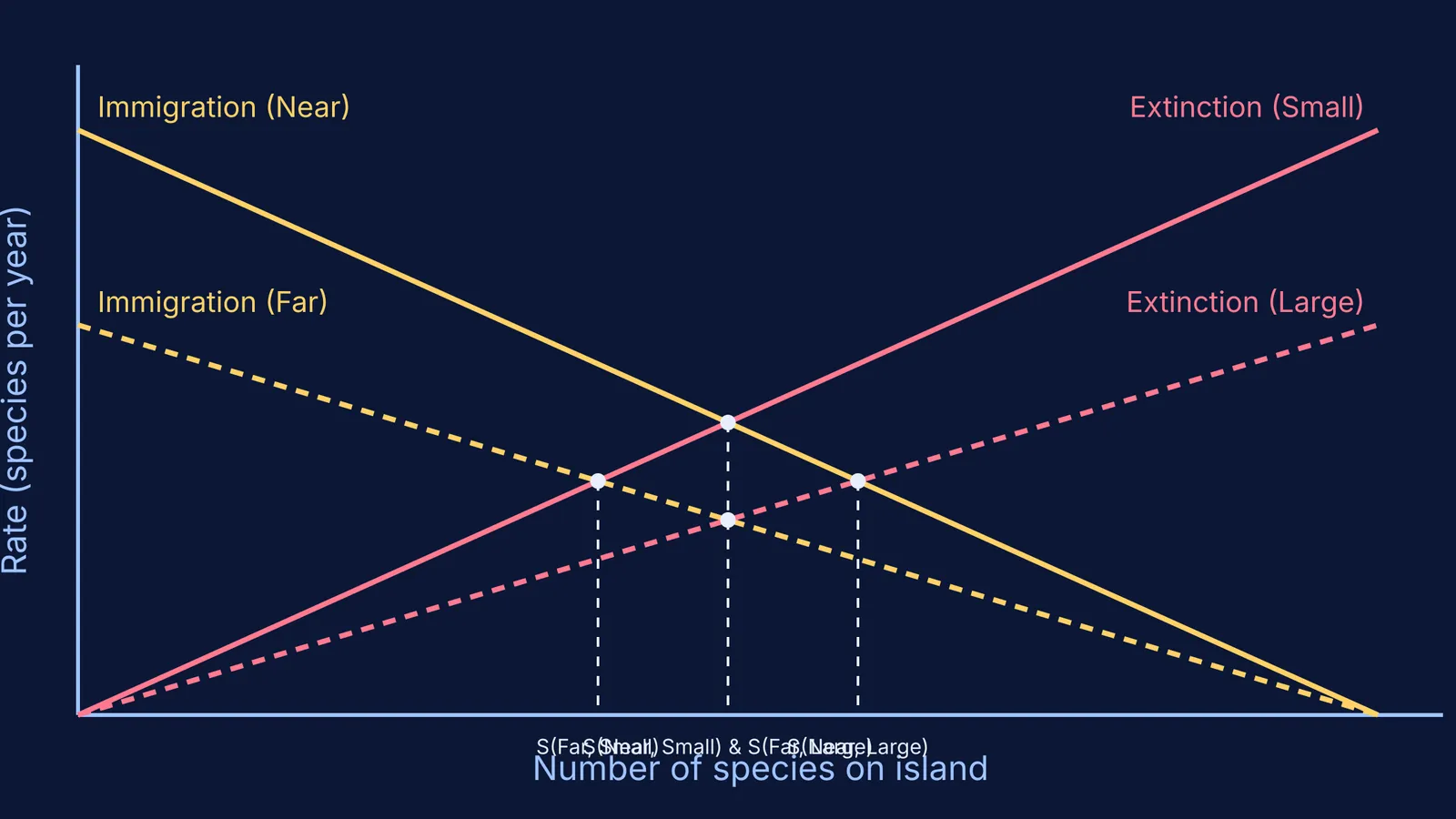
The theory suggests that an island's biodiversity is a constant tug-of-war between two opposing rates.
Immigration rate: How often new species arrive from the mainland.
Extinction rate: How often species already on the island die out.
These rates depend heavily on the island's physical geography. A larger island has more food resources and a wider variety of habitats, so its extinction rate is naturally lower than a small island's. An island close to the mainland is easier for travelling animals and wind-blown seeds to reach, meaning its immigration rate is much higher than an isolated island's.
Because the immigration curve falls as the island fills up, and the extinction curve rises as species compete for space, these curves always cross. This means every isolated habitat eventually reaches a dynamic equilibrium. The total number of species stays roughly the same over time, even though the exact list of species constantly changes as new arrivals replace those that die out.
If you find it hard to picture how two changing rates balance out over time, the Fermi Simulation Lab lets you adjust variables like area and distance to see how the equilibrium shifts in real time.
How did this theory change conservation biology?
When humans cut down a continuous forest to build roads and farms, they leave behind small, isolated patches of trees. These patches are effectively habitat islands.
Because these new fragments are smaller than the original continuous forest, their extinction rate spikes. Because they are isolated by dangerous roads and open fields, their immigration rate drops. The habitat enters a period of ecosystem decay, losing species until it hits a new, much lower equilibrium point.
This observation triggered a famous argument in ecology. The acronym SLOSS stands for "Single Large Or Several Small", referring to a major debate in conservation biology over the best way to protect land 2. In 1975, Jared Diamond proposed geometric principles for reserve design based on the island biogeography theory 2.
Diamond argued that a single large reserve is generally preferable to several smaller reserves of the same total area because it supports more species and has lower extinction rates 2.
How can we design better nature reserves?
Conservationists use Diamond's geometric rules to design parks that keep species alive. If you are studying ecology for an exam like NEET, or looking at how your local green spaces are laid out, you can evaluate a habitat's survival chances using this checklist.
Size: Is it one large block instead of several small fragments? Large areas support top predators that need space to hunt.
Proximity: If the habitat must be split, are the patches close together?
Shape: Is the boundary compact and circular? Long, thin shapes expose too much of the reserve to outside noise, wind and invasive species (known as the edge effect).
Corridors: Are the patches connected by trees or wildlife bridges?
Building wildlife corridors is the modern answer to the SLOSS debate. By linking several small reserves together, animals can migrate safely, effectively turning many small islands into one large, stable mainland.
Understanding how populations change in confined spaces is a core part of population ecology, which you can explore further in our guide to population growth models. Similarly, the way pollutants build up in these isolated food webs is explained in our breakdown of biological magnification.


