

On this page
How did Luther Burbank breed the Russet Burbank potato?
Burbank's journey into plant breeding began with a small piece of land and a keen eye. Using his inheritance, he purchased a 17-acre plot of land near Lunenburg, Massachusetts, to start his horticultural experiments.
In 1871, he noticed a rare seed ball on an "Early Rose" potato plant in his mother's garden. Potatoes typically reproduce vegetatively through tubers, so finding seeds was a unique opportunity to grow genetically distinct offspring. He planted its 23 seeds and found that one seedling, which he called the "Burbank Seedling", produced large, white-fleshed potatoes. Crucially, this new variety was slightly resistant to late blight, a highly desirable trait for farmers. He sold the rights to this potato for $150 to fund his eventual move to Santa Rosa, California, in 1875.
The potato we know today came a few decades later. A natural vegetative mutation—known as a sport—of the original Burbank potato with russeted skin was selected. It became known as the Russet Burbank, which is now the most widely cultivated potato in the United States and the standard cultivar used for commercial french fries.
Learning the mechanics of genetics and mutations is a core part of modern biology. If you are studying how traits are passed down, the Fermi Concept Library has a lesson for every concept in biology, each with its place in the map.
What were Luther Burbank's methods of plant breeding?
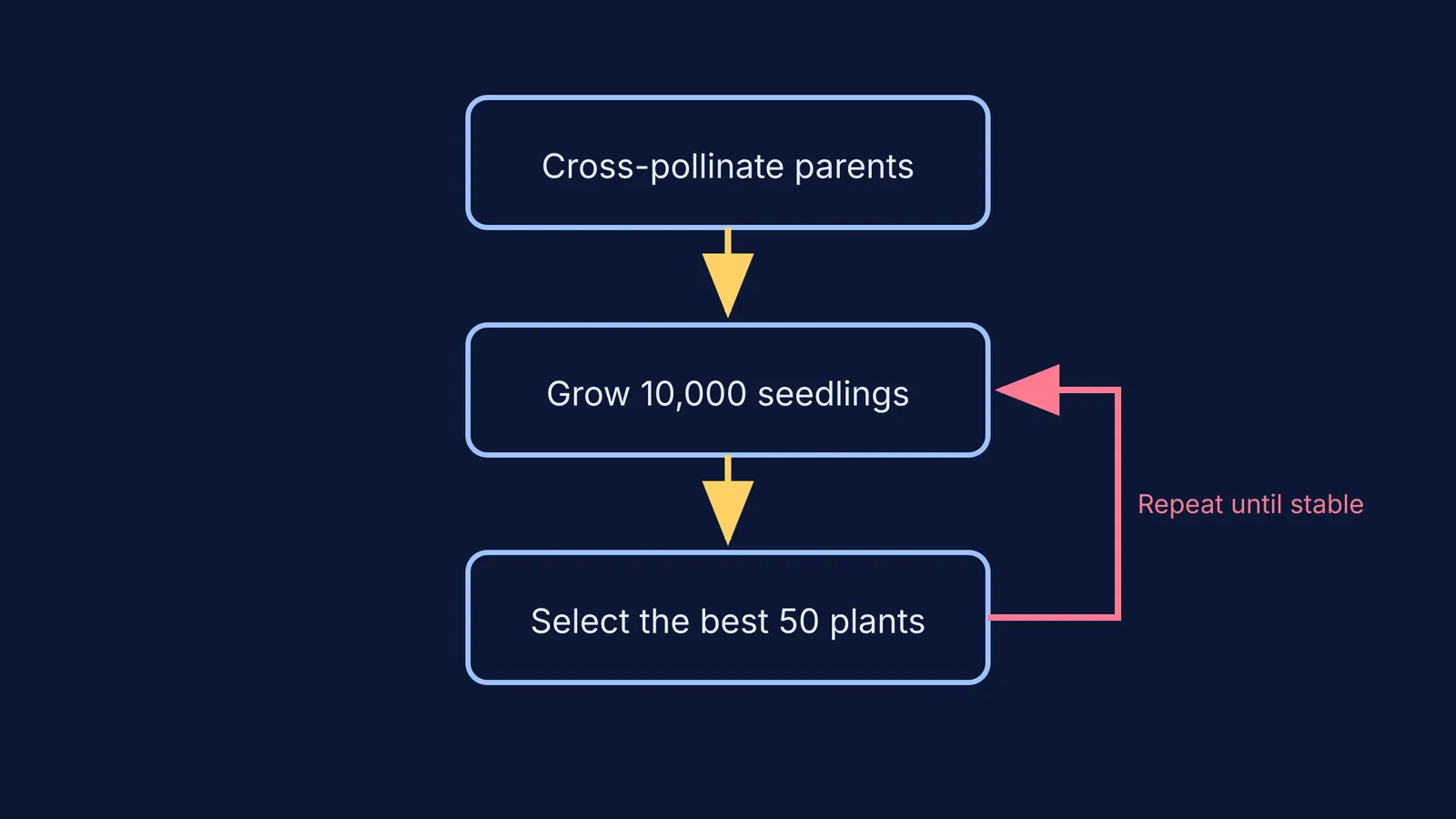
Burbank operated on a massive scale over his 55-year career. He did not rely on complex theoretical genetics; instead, his method was built on mass selection. If you want to understand how a breeder approaches a new plant, you can break Burbank's workflow down into four distinct steps:
Cross-pollinate by hand: Transfer pollen between two parent plants that have promising traits, such as size or disease resistance.
Plant at scale: Grow 10,000 or more seedlings of the resulting cross to ensure a wide variety of genetic combinations.
Select rigorously: Inspect the field and keep only the top 1 to 50 plants, destroying the rest.
Repeat the cycle: Grow another 10,000 seeds from the selected survivors until the desired trait is perfectly stable.
Using this rigorous selection, he introduced more than 800 new strains and varieties of plants. This immense output included 113 types of plums and prunes, 69 nuts, and 91 ornamentals such as the popular Shasta daisy.
This hands-on approach is similar to the controlled crosses taught in school biology. For a closer look at how modern breeders control pollination, read our guide to artificial hybridisation and emasculation.
How did scientists view Luther Burbank's work?
While Burbank was incredibly successful as a horticulturist, his relationship with the academic science of his day was complicated. He was often criticized by contemporary scientists for his lack of detailed record-keeping.
Because his goal was to create useful commercial crops quickly, he focused entirely on practical results rather than basic biological research. He did not meticulously track the lineage of every cross or publish theoretical papers on why certain traits emerged. For students learning biology today, taking careful lab notes is essential. If you are working through complex genetic problems and find yourself stuck on the theory, Fermi's AI tutor holds a line of reasoning across a whole session and teaches through it.
Despite the academic criticism, his practical output was undeniable. The sheer volume of his creations—from the spineless cactus to new varieties of berries and nuts—cemented his reputation as a master breeder.
Why did Luther Burbank inspire the Plant Patent Act?
Burbank's relentless experimentation proved that new plant varieties were valuable inventions. However, because he worked before plants could be patented, he struggled to profit from many of his creations. Unlike mechanical inventors, plant breeders had no legal framework to protect their years of investment.
His legacy ultimately helped change the law. Four years after his death, the United States passed the Plant Patent Act of 1930, making it possible for the first time to patent new varieties of plants. The inventor Thomas Edison testified before Congress in support of the bill, stating that the new law "will, I feel sure, give us many Burbanks".
Under this new legal protection, his widow, Elizabeth Waters Burbank, acted as the executrix of his estate. She partnered with Stark Bro's Nurseries to secure 16 plant patents posthumously for his fruits and flowers, including patent numbers 12, 13, and 14. Although the original act excluded tuber-propagated plants like the potato, the legislation laid the groundwork for modern agricultural intellectual property.
Understanding how dominant and recessive traits behave helps explain why fixing a trait requires so many generations and why breeders need protection for their work. To see how breeders identify hidden traits today, explore our breakdown of the test cross vs back cross.


