

On this page
Why was glycogen synthesis a biochemical puzzle?
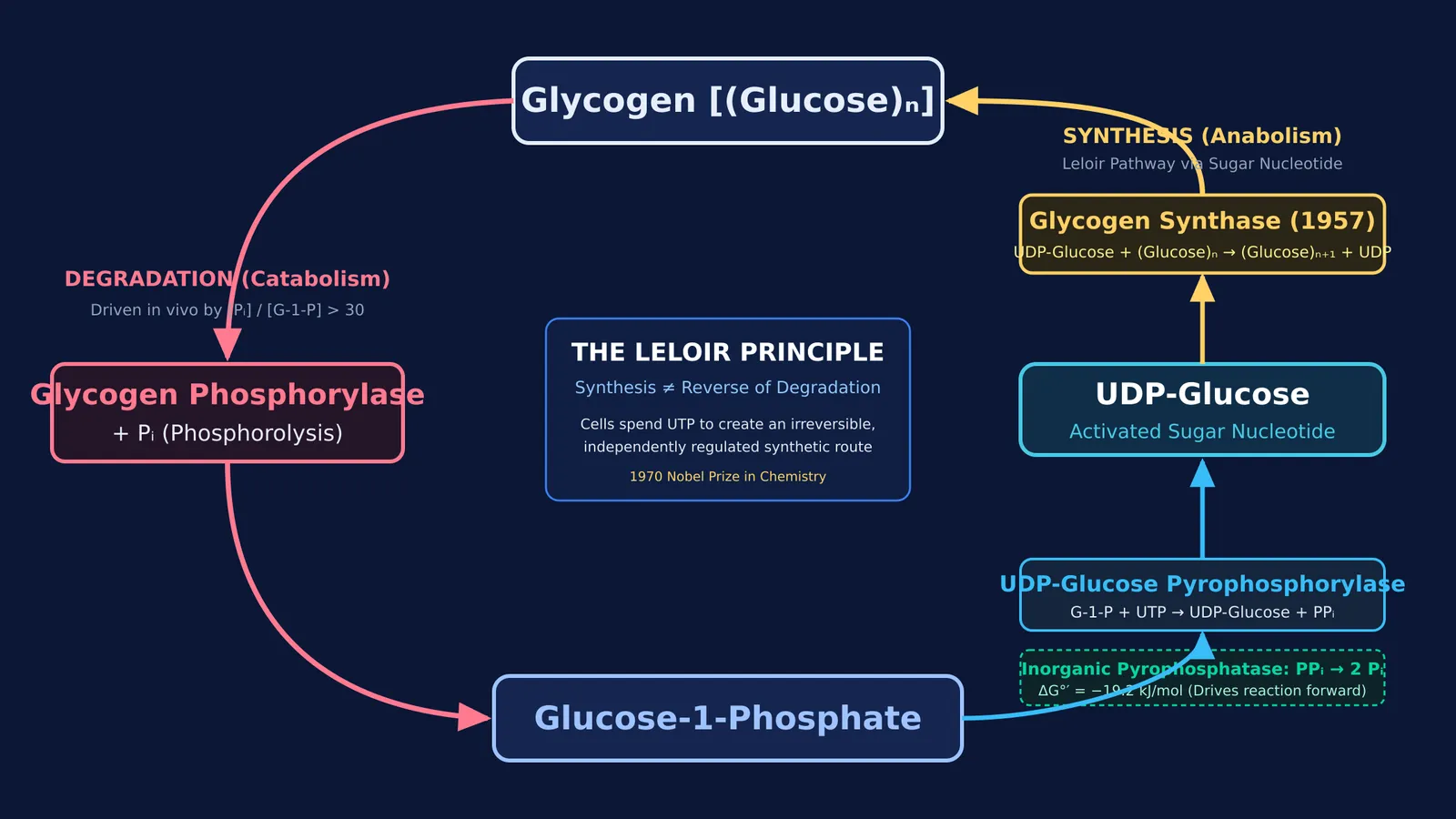
Until the late 1950s, textbooks taught that cells synthesized glycogen by reversing the reaction that breaks it down. In the 1930s and 1940s, biochemists Carl and Gerty Cori discovered glycogen phosphorylase, proving that the enzyme degrades glycogen by phosphorolysis: an inorganic phosphate cleaves an α-1,4-glycosidic bond to release glucose-1-phosphate. Because the reaction is reversible in a test tube, researchers assumed that cells simply ran phosphorylase backward to store excess sugar, as detailed in our history of Gerty and Carl Cori's work on glycogen and phosphorylase.
Thermodynamics, however, contradicted that assumption. In test-tube experiments at pH 7.0, the equilibrium ratio of inorganic phosphate to glucose-1-phosphate is approximately 3.5. Yet inside intact animal muscle and liver cells, the intracellular concentration of inorganic phosphate is typically 30 to over 100 times higher than that of glucose-1-phosphate. Under these physiological conditions, the mass-action ratio pushes glycogen phosphorylase overwhelmingly toward degradation. If cells relied solely on phosphorylase, net glycogen synthesis would be thermodynamically impossible. In addition, hormones such as adrenaline stimulate glycogen breakdown by activating phosphorylase. If synthesis shared the exact same enzyme, hormonal activation would trigger wasteful, simultaneous synthesis and destruction, as Nobel laureate Severo Ochoa highlighted in his Biographical Memoirs of Fellows of the Royal Society retrospective on Leloir.
How did Luis Leloir discover UDP-glucose in Buenos Aires?
The resolution came from an unlikely setting: a cramped, poorly funded private laboratory in Buenos Aires. Luis Federico Leloir was born in Paris to Argentine parents in 1906, completed his medical degree at the University of Buenos Aires in 1932, and trained under Nobel laureate Bernardo Houssay. After research stints with Frederick Gowland Hopkins in Cambridge and the Coris in St. Louis, Leloir returned to Argentina to direct the Instituto de Investigaciones Bioquímicas Fundación Campomar in 1947. Working in a dilapidated former residential house with a leaky roof and kerosene stoves for warmth, Leloir and his small team—Carlos Cardini, Ranwel Caputto, Raúl Trucco, and Alejandro Paladini—improvised laboratory apparatus using tin cans and recycled cardboard.
While investigating how lactose-fermenting yeast (*Saccharomyces fragilis*) converts galactose into glucose, Leloir and his team noticed that the isomerization of galactose-1-phosphate into glucose-1-phosphate required a heat-stable cofactor. In 1950, they succeeded in isolating this molecule and deduced its structure: a uridine mononucleotide joined through a second phosphate group to a molecule of glucose. They announced the discovery of uridine diphosphate glucose (UDP-glucose) in Nature in 1950 and provided full chemical characterization in the Journal of Biological Chemistry51153-x). UDP-glucose was the first identified sugar nucleotide, a hybrid of a nucleic acid building block and a carbohydrate. Understanding how these activated units function builds on the chemistry of nucleosides and nucleotides in biochemical reactions.
Why does glycogen assembly need sugar nucleotides instead of phosphorylase?
In 1957, Leloir and Cardini solved the thermodynamic paradox of glycogen synthesis. Publishing in the Journal of the American Chemical Society, they identified a previously unknown enzyme—glycogen synthase—that transfers a glucosyl residue from UDP-glucose directly to the non-reducing end of an existing glycogen chain, releasing UDP.
Using a sugar nucleotide transforms the bioenergetics of glycogen assembly. The cellular synthesis proceeds through a two-step activation sequence:
First, glucose-1-phosphate reacts with uridine triphosphate (UTP) to form UDP-glucose and inorganic pyrophosphate (PPᵢ), catalyzed by UDP-glucose pyrophosphorylase.
Second, intracellular inorganic pyrophosphatase immediately hydrolyzes pyrophosphate into two orthophosphate molecules: PPᵢ + H₂O → 2 Pᵢ.
This subsequent pyrophosphate cleavage releases approximately 19 kJ/mol of standard free energy, pulling the activation forward and making the overall pathway irreversible in vivo. As Leloir explained in his 1970 Nobel lecture, Two Decades of Research on the Biosynthesis of Saccharides, this strategy is universal. Cells synthesize glycogen, starch, sucrose, and complex glycoproteins using sugar nucleotides as activated donors, separating anabolic synthesis from catabolic breakdown.
How can students analyze glycogen metabolism pathways?
For competitive exams and advanced biology curricula, analyzing carbohydrate metabolism requires thinking in terms of thermodynamic directionality and enzyme regulation, rather than memorizing isolated reactions. When reviewing biomolecules and carbohydrate structures, you can evaluate any metabolic cycle using a four-step framework:
Identify the thermodynamic driver: Check whether an anabolic step is coupled to pyrophosphate hydrolysis (PPᵢ → 2 Pᵢ), which pulls an otherwise reversible sequence forward.
Separate opposing enzymes: Contrast the degrading enzyme (glycogen phosphorylase) with the synthesizing enzyme (glycogen synthase) rather than assuming a single reversible catalyst.
Track the nucleotide carrier: Follow the specific nucleotide base used to activate the sugar, such as UDP in animal glycogen and ADP in plant starch.
Check reciprocal regulation: Examine how signaling cascades (such as glucagon, adrenaline, and insulin) activate one pathway while simultaneously inhibiting the reverse.
Mastering these interconnected biochemical loops requires testing how small chemical changes alter overall pathway flux. For students who want to build intuition across complex metabolic networks, the Fermi Concept Library offers lessons covering every concept in physics, chemistry, biology, mathematics and computing, each with its own lesson and its place in the map. When practicing numerical free-energy calculations and equilibrium shifts, the Fermi Problem Library provides worked problems with a step-by-step solver that explains the reasoning rather than printing an answer. For visual learners seeking to explore how allosteric regulators shift enzyme states dynamically, the Fermi Simulation Lab provides interactive simulations for the ideas that are easier to see than to read.


