

On this page
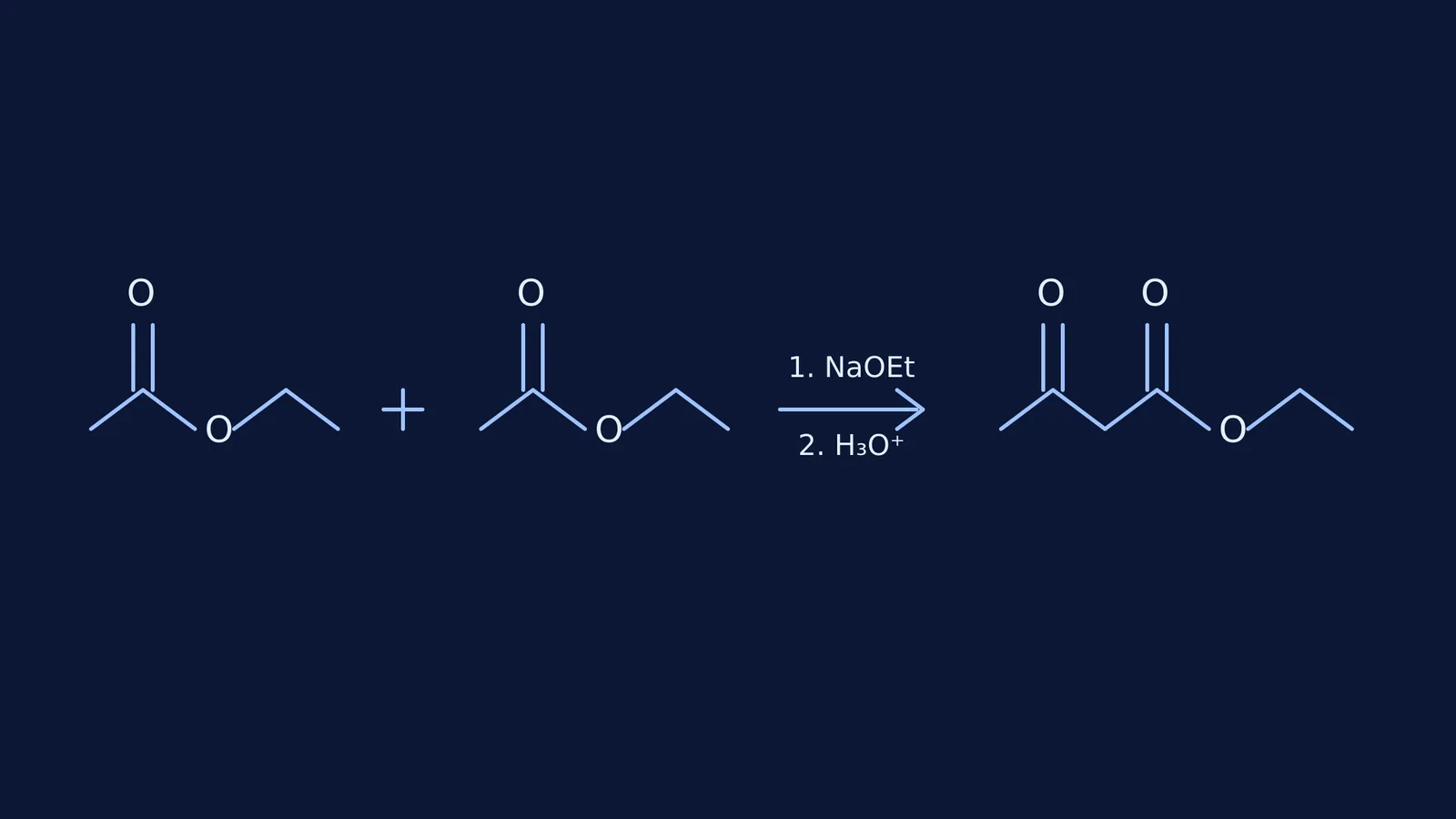
For organic chemistry students, forming new carbon-carbon bonds is the key to building complex molecules. One of the most powerful tools for this is the Claisen condensation. By linking two esters together, the reaction produces a β-keto ester, a versatile intermediate found in everything from pharmaceutical synthesis to the biological pathways that create antibiotics.
But where did this reaction come from, and why does it carry Ludwig Claisen’s name?
What is the Ludwig Claisen condensation reaction history?
The history of the Claisen condensation actually begins 24 years before Claisen published his seminal paper. In 1863, the German chemist Anton Geuther treated ethyl acetate with metallic sodium and successfully synthesised ethyl acetoacetate source. Because of this early discovery, the reaction is sometimes referred to historically as the Claisen–Geuther reaction. However, Geuther did not fully understand the mechanism or the broader synthetic potential of what he had found.
The real breakthrough came from Rainer Ludwig Claisen (1851–1930). In 1887, Claisen published a paper in *Berichte der Deutschen Chemischen Gesellschaft* that generalised the reaction source. Claisen proved that the condensation could occur between two of the same esters, or between an ester and a ketone, as long as a strong base was present. Crucially, he recognised that an alkoxide base (such as sodium ethoxide) was required to remove a proton from the α-carbon, forming the reactive enolate intermediate.
Because of his rigorous mechanistic insights, Claisen’s name became permanently attached to the reaction. The study of enolates also leads to other classic transformations; for a fascinating parallel in aldehydes, read about Alexander Borodin, the composer chemist and the aldol reaction.
How does the Claisen condensation mechanism work?
The Claisen condensation is a classic example of nucleophilic acyl substitution. To master it for your exams, you need to follow the electrons through four distinct steps. If you ever feel stuck trying to map out these electron flows, Fermi's AI tutor works out what you already know, builds a plan for the session, and teaches through it, guiding you step-by-step through the mechanism.
Enolate formation
The alkoxide base removes a mildly acidic proton from the α-carbon of one ester molecule. This creates a negatively charged enolate ion. For the reaction to work without unwanted side products, the base chosen usually matches the ester's leaving group (for example, using sodium ethoxide with an ethyl ester).
Nucleophilic attack
The enolate ion acts as a nucleophile, attacking the electrophilic carbonyl carbon of a second ester molecule. This nucleophilic attack forms a tetrahedral intermediate.
Leaving group departure
The tetrahedral intermediate collapses. The carbon-oxygen double bond reforms, kicking off the alkoxide ion as a leaving group. At this point, a β-keto ester has been formed.
The thermodynamic sink
This final step is what drives the reaction forward. The newly formed β-keto ester has highly acidic protons situated between its two carbonyl groups. The alkoxide leaving group immediately removes one of these protons, forming a stable, doubly-stabilised enolate.
Finally, adding an aqueous acid like H₃O⁺ in a separate workup step reprotonates the molecule to give the neutral β-keto ester product.
What is the crossed Claisen condensation?
Once Claisen had established the mechanism for self-condensation, organic chemists quickly realised they could expand the reaction's scope by mixing two different esters. This variation is known as the crossed Claisen condensation.
However, running a crossed condensation with two esters that both have α-hydrogens is a bad idea. It will result in a messy mixture of four different β-keto esters, which are incredibly difficult to separate. To perform a useful crossed Claisen condensation, chemists use one ester that has no α-hydrogens. Molecules like ethyl benzoate or ethyl formate cannot form an enolate, meaning they can only act as the electrophilic target. By carefully controlling the reaction conditions, you can ensure the enolate formed from the first ester exclusively attacks the second ester, yielding a single, predictable product.
How to solve Claisen condensation exam problems?
When tackling ester reactions in an exam, use this checklist to avoid common traps:
Check your base: Does the base match the ester group? If you use sodium methoxide with an ethyl ester, you risk transesterification (swapping the ester groups) rather than a pure condensation.
Understand the origin: If you need to review how esters are formed in the first place, brush up on the Fischer esterification: mechanism and how to push the equilibrium.
Count the alpha-hydrogens: A successful Claisen condensation requires an ester with at least two α-hydrogens. One is removed to form the initial enolate, and the second is removed in the thermodynamic sink step.
Watch for crossed condensations: If you are reacting two different esters, one of them must lack α-hydrogens (like ethyl benzoate or ethyl formate) to prevent a messy mixture of four different products.
By breaking the reaction down into its historical discovery, its step-by-step electron flow, and its advanced variations, you can move past rote memorisation. Understanding the underlying logic of carbon-carbon bond formation will help you predict the products of even the most complex synthetic pathways.


