

On this page
On July 25, 1909, the French aviation pioneer Louis Blériot achieved what many thought impossible: he flew a heavier-than-air aircraft across the English Channel. His journey in the Blériot XI monoplane took exactly 36 minutes and 30 seconds.
The flight brought him international fame, a £1,000 prize from the *Daily Mail*, and a place in history. But Blériot was not a natural-born pilot with a perfect record. He was an engineer who learned through relentless trial and error.
How many times did Louis Blériot crash?
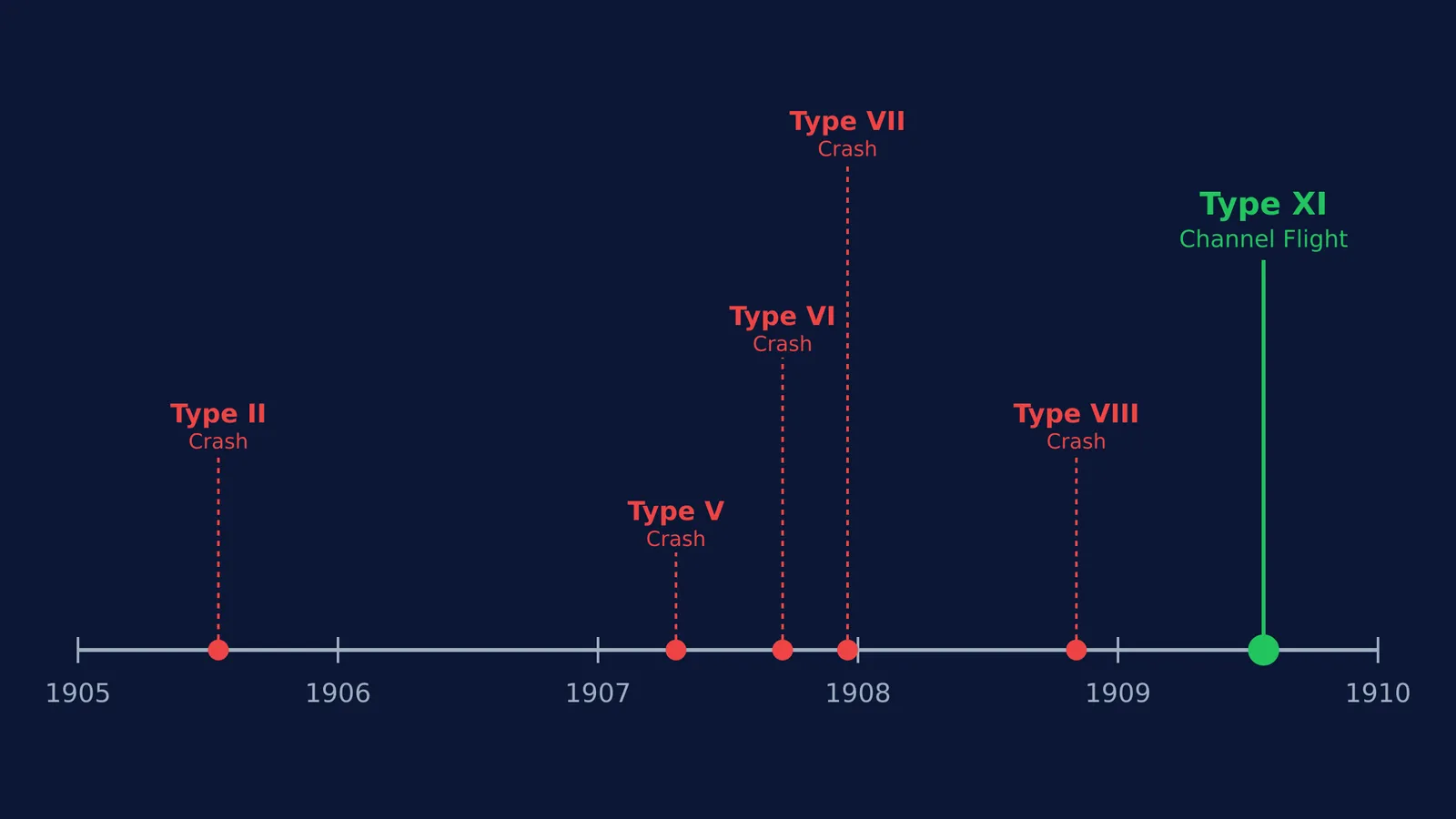
Before his triumph, Blériot was known for his frequent and spectacular accidents, earning a reputation for his incredible luck in surviving them. Between 1905 and his Channel crossing, he built ten different aircraft models—Types I through X—before designing the successful Blériot XI. Most of those early machines crashed, overturned, or collapsed during testing.
In December 1907, the undercarriage of his Type VII collapsed on the ground. In September 1907, the engine of his Type VI cut out at 25 metres in the air; Blériot only survived by throwing his body weight towards the tail to level the plane before impact. Even weeks before his famous Channel flight, a loose piece of asbestos insulation gave him third-degree burns on his foot, yet he persisted.
Every crash taught him something new. Through this physical process, he became the first aviator to combine a hand-operated joystick with a foot-operated rudder—the same control layout pilots use today.
What did Blériot's engineering process look like?
Blériot's approach to invention was deeply practical. While other inventors might spend years calculating theories before building a machine, Blériot chose to build full-sized aircraft and test them in the real world.
His Type II was a floatplane glider that plunged into the Seine river. His Type V was a tail-first monoplane that somersaulted upon landing and was completely destroyed, nearly crushing him. His Type VIII managed a successful cross-country flight before being ruined in a simple taxiing accident.
Rather than giving up, he used the profits from his successful automobile headlamp business to fund the next prototype. He systematically eliminated design flaws, refining the monoplane shape and perfecting his control system. He did not view a crashed plane as a final failure; it was simply a piece of data showing him what not to do on the next attempt.
How long did the 1909 flight take?
On July 25, 1909, Blériot took off from Les Baraques, near Calais, and pointed his monoplane towards Dover, England. He navigated the English Channel without the advanced instruments modern pilots rely on, facing intense fog and uncertainty along the way.
After 36 minutes and 30 seconds in the air, he made a successful landing on English soil. His pioneering flight proved that the monoplane design—often dismissed at the time in favour of biplanes—was a viable and stable aircraft.
Why is trial and error important in active learning?
Students preparing for tough exams often feel discouraged when they get a mathematics or physics problem wrong. It is easy to look at a successful student—or a famous inventor—and assume they never make mistakes.
But learning is a process of crashing and rebuilding. Trying a problem, getting stuck, and identifying exactly where your logic failed is how you build a better understanding. Reading a textbook passively is like looking at a diagram of an airplane; solving problems and making mistakes is like getting in the cockpit.
If you feel like you are guessing without making progress, Fermi's AI tutor can help. Instead of just giving you the answer, it works out what you already know and builds a plan for the session, guiding your trial and error so you sit down to a clear next step.
When you study kinematics and see problems about Will two projectiles collide midair? The relative motion test or a Horizontal projectile from a cliff: time, range and impact speed, remember that you will probably crash on your first attempt. Expect to make mistakes, learn from the damage, and try again. That is how you reach your destination.


