

On this page
Who was Lotfi Zadeh?
Lotfi Aliasker Zadeh was born in 1921 in Baku, Azerbaijan, to an Iranian journalist father and a Russian physician mother. In 1931, when he was ten years old, his family moved to Tehran, Iran. Zadeh attended Alborz High School, an American Presbyterian missionary school in the capital, before sitting for the national competitive examinations to enter the University of Tehran. In 1942, during the turmoil of wartime Allied occupation, he graduated from the university with a degree in electrical engineering as one of only 3 graduating students in his field that year, as documented in Tekla S. Perry's biographical profile in IEEE Spectrum.
Zadeh emigrated to the United States in 1944 to pursue graduate studies at the Massachusetts Institute of Technology, earning his master's degree in 1946. He completed his doctorate in 1949 at Columbia University, where he taught for a decade and co-developed the z-transform method that became a foundational tool of discrete-time signal processing. In 1959, he joined the faculty of the University of California, Berkeley. Serving as chair of the Department of Electrical Engineering from 1963 to 1968, he oversaw the formal integration of computer science, transforming the unit into the Department of Electrical Engineering and Computer Sciences (EECS).
Why did computers need partly true values?
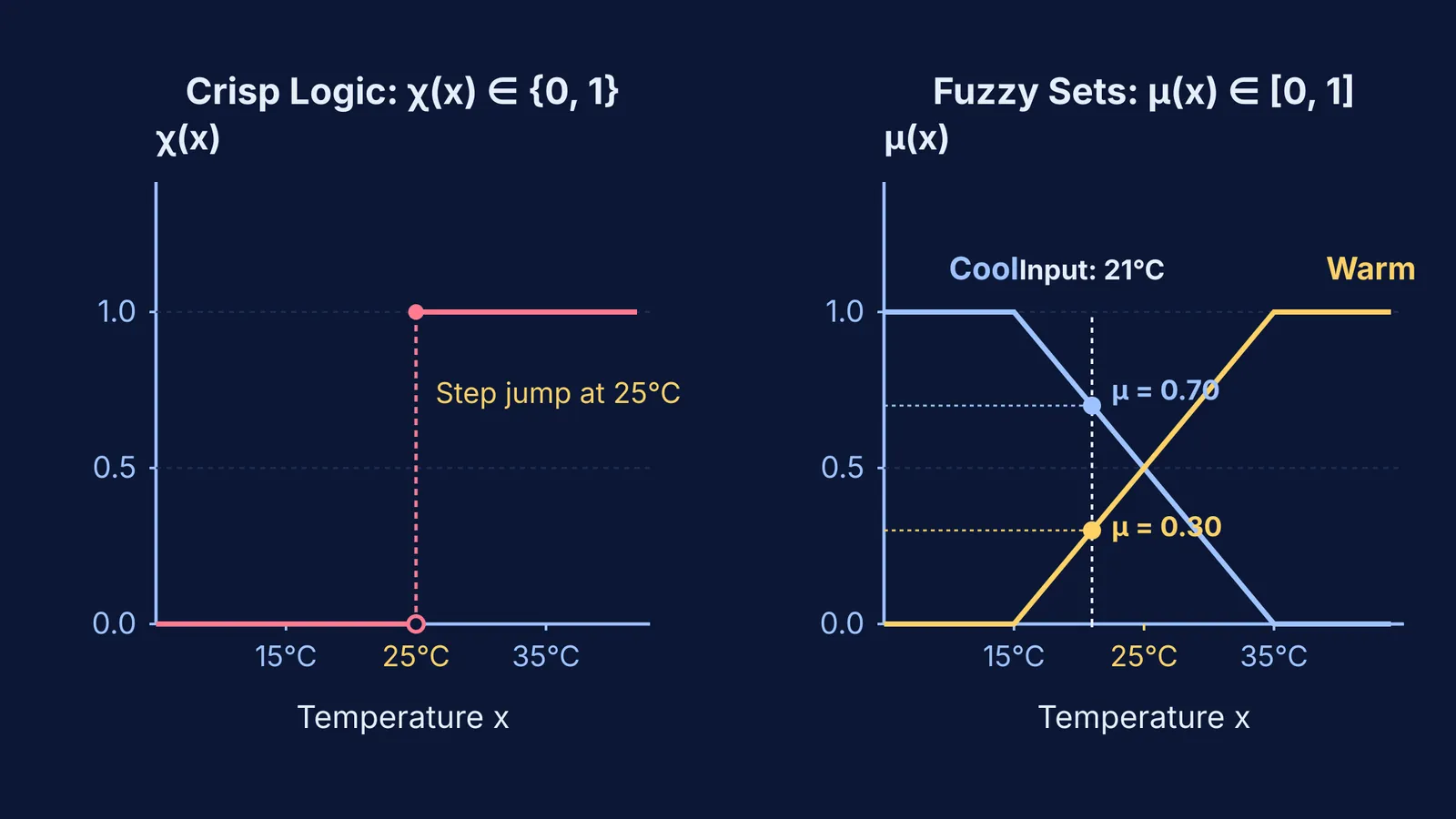
By the mid-1960s, digital computing rested on the binary framework of George Boole's algebra of logic. In classical set theory, boundaries are crisp: an item belongs to a set or it does not, evaluated strictly as 1 (true) or 0 (false). This binary model worked cleanly for mathematical proofs and digital circuit switches.
In June 1965, Zadeh published "Fuzzy sets" in the journal *Information and Control* (Zadeh, 196590241-x)), proposing continuous membership functions taking values across the closed interval [0, 1]. He recognized that real-world classes rarely follow sharp binary boundaries. If 25 °C is defined as "warm", a rigid binary test treats 24.9 °C as false and 25.0 °C as true, creating an artificial cliff edge. While early artificial intelligence focused on formal theorem provers—such as John McCarthy's early artificial intelligence research on symbolic logic—practical automation struggled with ambiguous language and noisy sensory data, challenges also seen in Raj Reddy's early speech-recognition systems.
In his 1973 paper in *IEEE Transactions on Systems, Man, and Cybernetics*, Zadeh formulated the Principle of Incompatibility: as a system's complexity increases, our ability to make precise and significant statements diminishes until precision and relevance become almost mutually exclusive (Zadeh, 1973).
How does a fuzzy set work?
In Zadeh's framework, a fuzzy set A in universe X is defined by a membership function μ_A(x) mapping each element to a real number between 0 and 1 (Zadeh, 196590241-x)). The value μ_A(x) represents the grade of membership: 0 denotes non-membership, 1 denotes complete membership, and values like 0.7 reflect strong partial truth.
Zadeh established three basic operations to manipulate these sets:
Complement (NOT): μ_A'(x) = 1 − μ_A(x)
Union (OR): μ_{A ∪ B}(x) = max(μ_A(x), μ_B(x))
Intersection (AND): μ_{A ∩ B}(x) = min(μ_A(x), μ_B(x))
Writing in *IEEE Spectrum* in 1984, Zadeh explained how these operators let computers reason with natural language words rather than brittle numbers (Zadeh, 1984). Engineers could write intuitive rules such as "IF temperature is high AND pressure is rising, THEN open valve moderately."
How does a fuzzy controller make decisions?
To see how fuzzy control operates in practice, consider an automated fan controller applying E.H. Mamdani's inference method (Mamdani and Assilian, 197580002-2)) to room temperature:
Fuzzification:
At 27 °C, we evaluate two membership functions over temperature:
"Comfortable" (1 at 22 °C, dropping linearly to 0 at 30 °C):
μ_Comfortable = (30 − 27) / (30 − 22) = 3/8 = 0.375
"Hot" (0 at 22 °C, rising linearly to 1 at 30 °C):
μ_Hot = (27 − 22) / (30 − 22) = 5/8 = 0.625
Rule evaluation:
The controller evaluates two operational rules:
Rule 1: IF Comfortable, THEN fan is Low (30% power). Rule weight = 0.375.
Rule 2: IF Hot, THEN fan is High (80% power). Rule weight = 0.625.
Defuzzification (Center of gravity):
The controller calculates crisp output power by weighted average: Fan Power = (0.375 × 30% + 0.625 × 80%) / (0.375 + 0.625) = (11.25 + 50.0) / 1.0 = 61.25%
Instead of clicking harshly on and off around 25 °C, the motor glides smoothly to 61.25% power.
Where did fuzzy logic make its mark?
While early critics in American academia dismissed fuzzy logic as unnecessary, engineers overseas recognized its power for nonlinear systems. In 1975, E.H. Mamdani and S. Assilian built the first practical fuzzy logic controller for a steam engine at Queen Mary College in London (Mamdani and Assilian, 197580002-2)).
Japanese industry soon commercialised the technology. In 1987, Hitachi deployed predictive fuzzy control on the Sendai City Subway Namboku Line, achieving roughly 10% lower power consumption than human drivers and halting trains within 10 centimetres of platform targets without passenger jolts, as documented in Perry's historical overview. Fuzzy chips soon directed washing machines, rice cookers, anti-lock brakes, and camcorders.
When you study STEM subjects, concepts can appear divided into rigid boxes. The Fermi Concept Library maps every concept in physics, chemistry, biology, mathematics and computing, revealing how fundamental logic connects to modern engineering.
Real understanding develops along a continuum. Fermi's AI tutor works out what you already know and builds a plan for the session, deciding whether to explain, ask or show rather than treating learning as an all-or-nothing test score.


