On this page
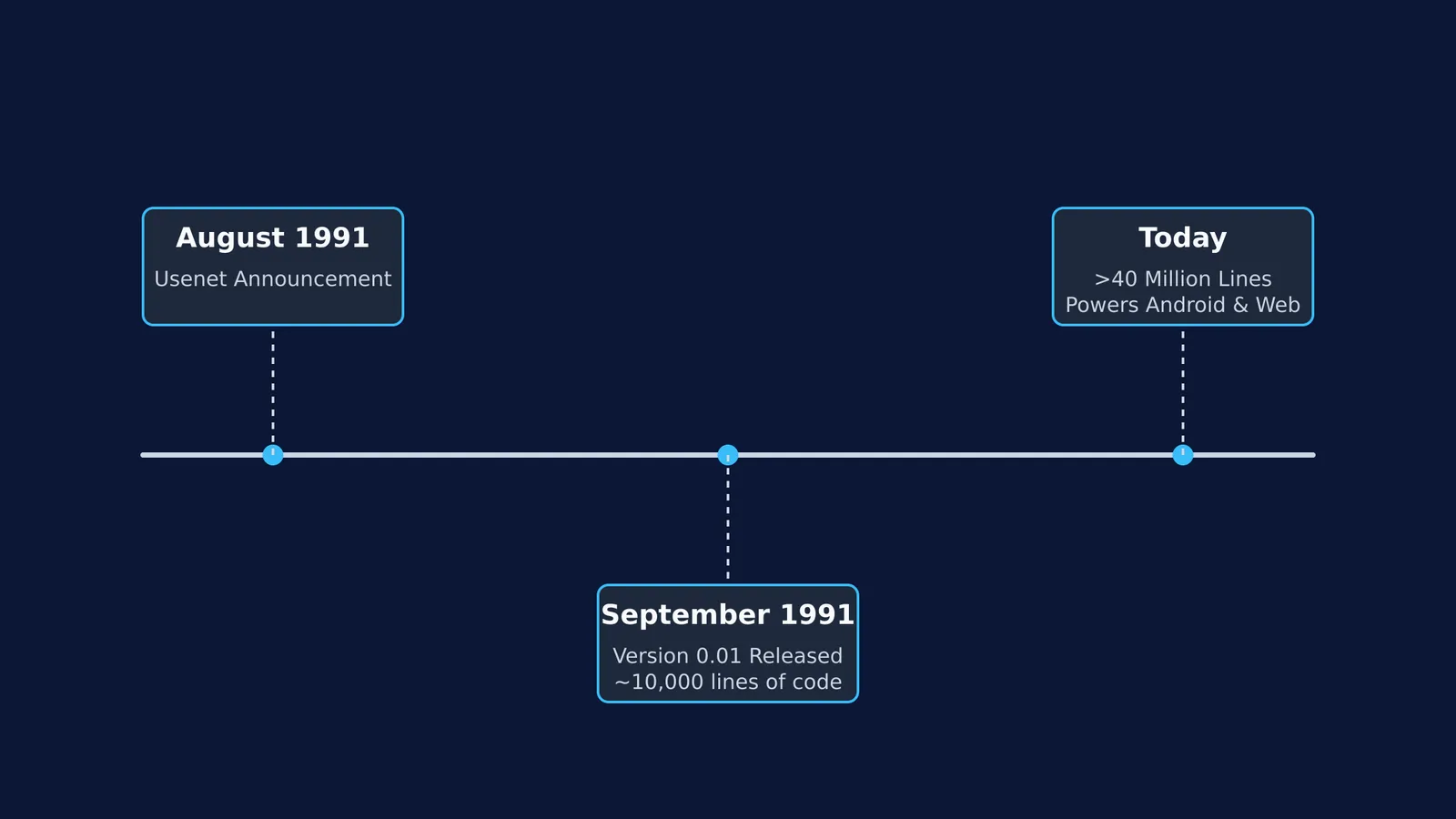
In August 1991, a 21-year-old computer science student at the University of Helsinki posted a message to the `comp.os.minix` Usenet group. Linus Torvalds (Wikipedia) was working on a personal project and wanted feedback. "I'm doing a (free) operating system (just a hobby, won't be big and professional like gnu) for 386(486) AT clones," he wrote.
That first version of the Linux kernel, released in September 1991, contained about 10,000 lines of code (Wikipedia). Today, it has grown to tens of millions of lines and is the foundation of the modern internet. It powers Android smartphones, most of the world's web servers, and the top 500 supercomputers (Wikipedia).
The story of the Linus Torvalds Linux kernel 1991 release is a powerful example for students and parents. It shows what happens when a student builds something out of genuine curiosity rather than for an exam, a grade or a resume.
What prompted the Linus Torvalds Linux kernel 1991 post?
In the early 1990s, operating systems were either expensive and proprietary, or they were educational tools with strict licensing. Torvalds wanted to understand how his new personal computer's hardware worked. He started writing terminal emulation software to connect to his university's Unix servers, and eventually realised he had written the core of an operating system—a kernel (Wikipedia).
He did not set out to change the world. He set out to solve his own immediate problem and learn how things worked under the hood. When students are given the space to tinker with their own projects, their motivation often outlasts the promise of any external reward.
If you are exploring computer science, having a place to test your understanding step by step can keep that initial curiosity alive. The Fermi Problem Library has worked problems with a step-by-step solver that explains the reasoning rather than printing an answer.
Why did Linux become so big?
Torvalds made one crucial decision early on: he released the source code for free and invited others to contribute. If someone found a bug or wanted a new feature, they could write the code themselves and send it to him.
This open, collaborative approach meant Linux improved rapidly. Programmers around the world added support for different hardware, improved its performance and fixed its flaws. Torvalds acted as the lead developer, reviewing and merging these contributions—a role he still holds today.
For parents, the Linux story is a reminder that talking about STEM careers does not have to mean a straight, predictable path into a traditional job. Some of the most impactful careers begin as unstructured side projects.
How can students learn like Linus Torvalds?
You do not need to invent a new operating system to benefit from Torvalds's approach to learning. The key is active, hands-on exploration.
Start small: Torvalds did not write a massive system on day one. He wrote small programs to test individual parts of his computer's processor. Break large subjects into manageable pieces.
Build to understand: Write code, build circuits or run experiments to see how things fail. Reading about how a system works is different from making it work yourself.
Share your work: Post your projects online or show them to friends. Feedback from others will point out flaws you missed and teach you new ways to approach a problem.
Follow your curiosity: The most powerful driver of learning is a genuine desire to know the answer.
When you hit a roadblock in your own projects, having a guide helps you move forward without losing momentum. Fermi's AI tutor works out what you already know and builds a plan for the session, so you sit down to a clear next step instead of a blank page.
The next time you open a browser on an Android phone or load a web page, you are relying on the legacy of a student who just wanted to see if he could make his computer work a little better.