

On this page
If you have ever baked a cake or cooked a meal, you know the frustration of crossing the kitchen repeatedly for ingredients, bowls and spoons. A century ago, domestic work involved a great deal of wasted movement.
It took an engineer and psychologist named Lillian Moller Gilbreth to look at a kitchen not as a collection of furniture, but as a system of human effort. By tracking every movement a person made while working, she changed kitchen design and laid the foundation for modern ergonomics—the science of designing a workspace around the person who uses it. Her approach to eliminating friction in physical work can be applied to the mental work of studying.
How did Lillian Gilbreth redesign the kitchen?
In the early 20th century, Gilbreth and her husband Frank pioneered "time and motion studies" in factories, breaking down industrial labor into 18 fundamental units of movement they called therbligs. After her husband's death, she turned this analytical lens toward the home, arguing that domestic labor was real work that deserved scientific optimization.
Gilbreth sought to reduce physical exhaustion and create what she called "happiness minutes"—time saved from drudgery that could be spent on leisure or family. To test her ideas, she analyzed the layout of the kitchen to reduce the time and effort required in the preparation of meals.
In 1929, she unveiled the "Kitchen Practical" at a Women's Exposition, developed in partnership with the Brooklyn Borough Gas Company (Wikipedia). By standardizing counter heights and placing appliances in an efficient layout, her redesign proved that careful planning could substantially cut the steps needed for everyday tasks.
What is the kitchen work triangle?
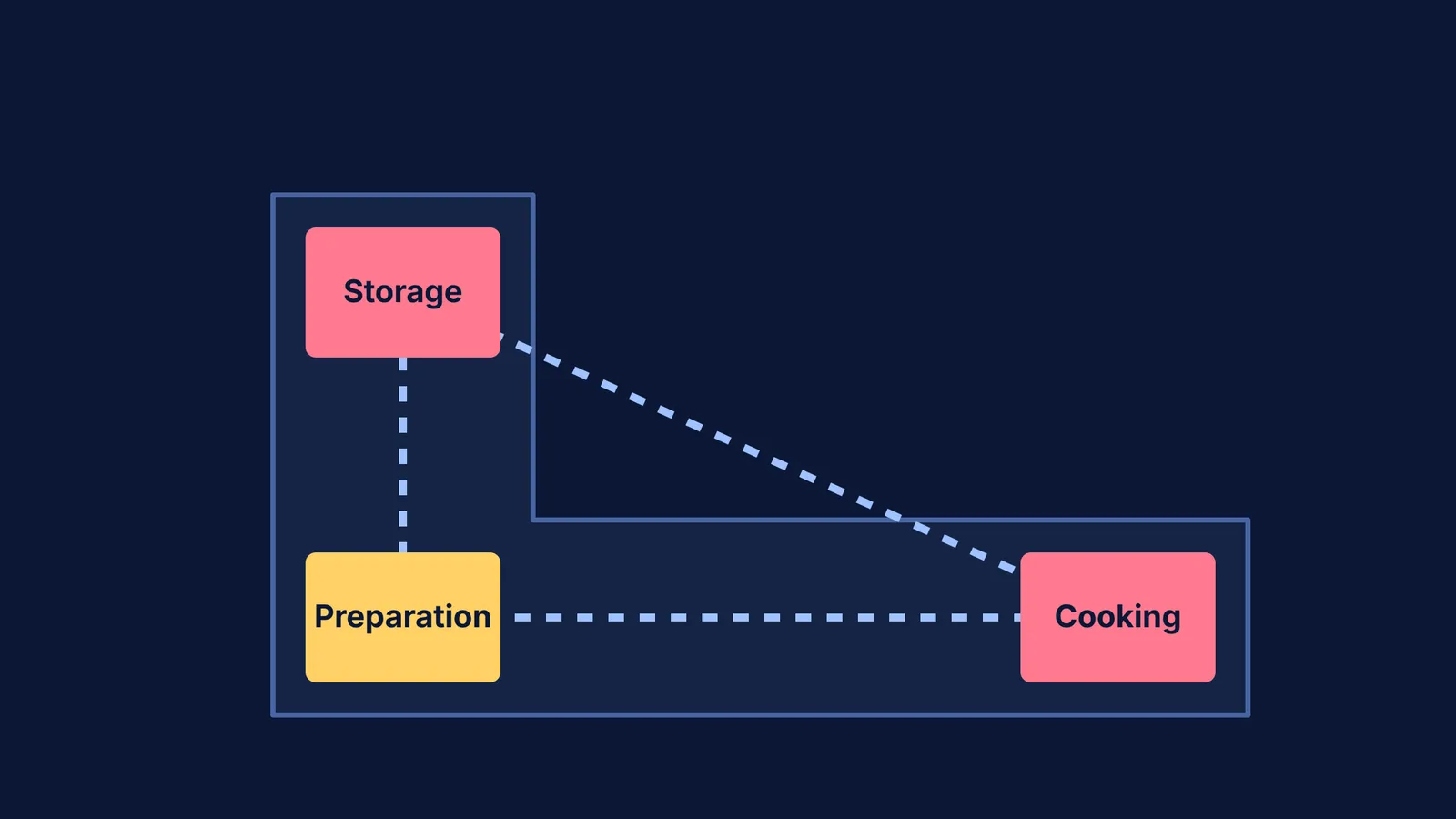
Gilbreth's most enduring legacy is the "circular routing" system, which evolved into the modern kitchen work triangle.
Instead of scattering appliances across a room, Gilbreth grouped the kitchen into three primary centers:
Storage: The refrigerator and pantry.
Preparation: The sink and counter.
Cooking: The stove and oven.
By arranging these three zones in a tight triangle, she eliminated unnecessary walking and searching. The modern guidelines dictate that the sum of the work triangle's three sides should be between 13 feet and 26 feet.
Gilbreth also invented specific tools to save motion, such as adding shelves to the inside of refrigerator doors and creating the foot-pedal trash can, which allowed a person to dispose of waste without putting down what they were holding.
How can ergonomics improve your study habits?
When you sit down to study for a high-stakes exam, your desk is your workspace. Just as Gilbreth found that a poorly laid-out kitchen drains physical energy, a scattered study routine drains cognitive energy. Every time you break focus to find a formula, search for a lost calculator, or figure out what topic to tackle next, you are wasting mental steps.
You can apply Gilbreth's principles of motion study to your own learning:
Build a study work triangle: Arrange your physical space so that your focus area (your notebook), your reference area (your textbook or screen) and your tool area (pens, calculator) are all within an arm's reach. You should not have to stand up or lean awkwardly to reach what you need.
Standardize your process: Gilbreth reduced operations by grouping ingredients and tools where they were used. When solving physics problems like the free expansion of an ideal gas, keep your formula sheet exactly where you can see it without moving. The same applies for chemistry calculations such as the work done in irreversible expansion.
Eliminate cognitive friction: The mental equivalent of pacing across a kitchen is sitting at a desk wondering where to begin. Fermi's AI tutor works out what you know and builds a plan for the session, so you sit down to a clear next step. It holds a line of reasoning across a whole session, meaning you never have to waste energy finding your place again.
By treating your study habits as a system to be optimized, you can turn wasted effort into "happiness minutes"—freeing up time to rest, recharge and actually enjoy learning.


