

On this page
In the early decades of the twentieth century, global petroleum geology rested on an immovable premise: commercial oil existed almost exclusively in marine strata. Ancient ocean floors provided the massive plankton accumulations, salt waters, and quiet sediment beds believed necessary to generate hydrocarbons. When American geologist Eliot Blackwelder surveyed East Asia in the *Transactions of the AIME* (Blackwelder, 1923), his verdict was bleak. Observing that China contained virtually no marine sedimentary rocks from the Mesozoic or Cenozoic eras and that exploratory wells in northern Shaanxi yielded barely 1 barrel of oil a day, Blackwelder concluded that the country had negligible petroleum potential.
One Chinese geologist refused to accept that empirical dead end. Li Siguang (also known as J. S. Lee), who had trained in mining and geology at the University of Birmingham, approached the problem through physics. In his foundational 1926 paper in the *Bulletin of the Geological Society of China* (Lee, 1926), he introduced geomechanics—a discipline that applies continuum mechanics and stress analysis to crustal deformation.
Why did geologists believe China had no oil?
The global consensus formed because the world's most productive oilfields—from Texas and California to Baku and the Persian Gulf—were tapped in ancient marine basins. Western geologists assumed that kerogen, the precursor to petroleum, required the specific biochemical conditions of marine algae and saline waters.
Because mainland China's interior remained elevated above sea level throughout most of the Mesozoic era, its sedimentary basins were continental—formed by freshwater lakes, river deltas, and alluvial plains. Foreign surveys assumed these freshwater sediments were either too coarse to preserve organic matter or too broken by tectonic faults to hold reservoirs. Since early drilling focused on small surface seeps in mountainous margins, Western experts declared China fundamentally barren of petroleum.
What is geomechanics, and how does it predict traps?
Li realised that rock formations are physical materials governed by mechanics. Just as Nicolaus Steno's stratigraphic laws showed that rock layers record chronological deposition and Arthur Holmes's model of mantle convection linked continental drift to thermal currents, Li sought the mechanical forces driving crustal deformation.
Rocks in the lithosphere respond to regional stress fields:
Compressive stress produces folds, reverse faults, and crustal thickening.
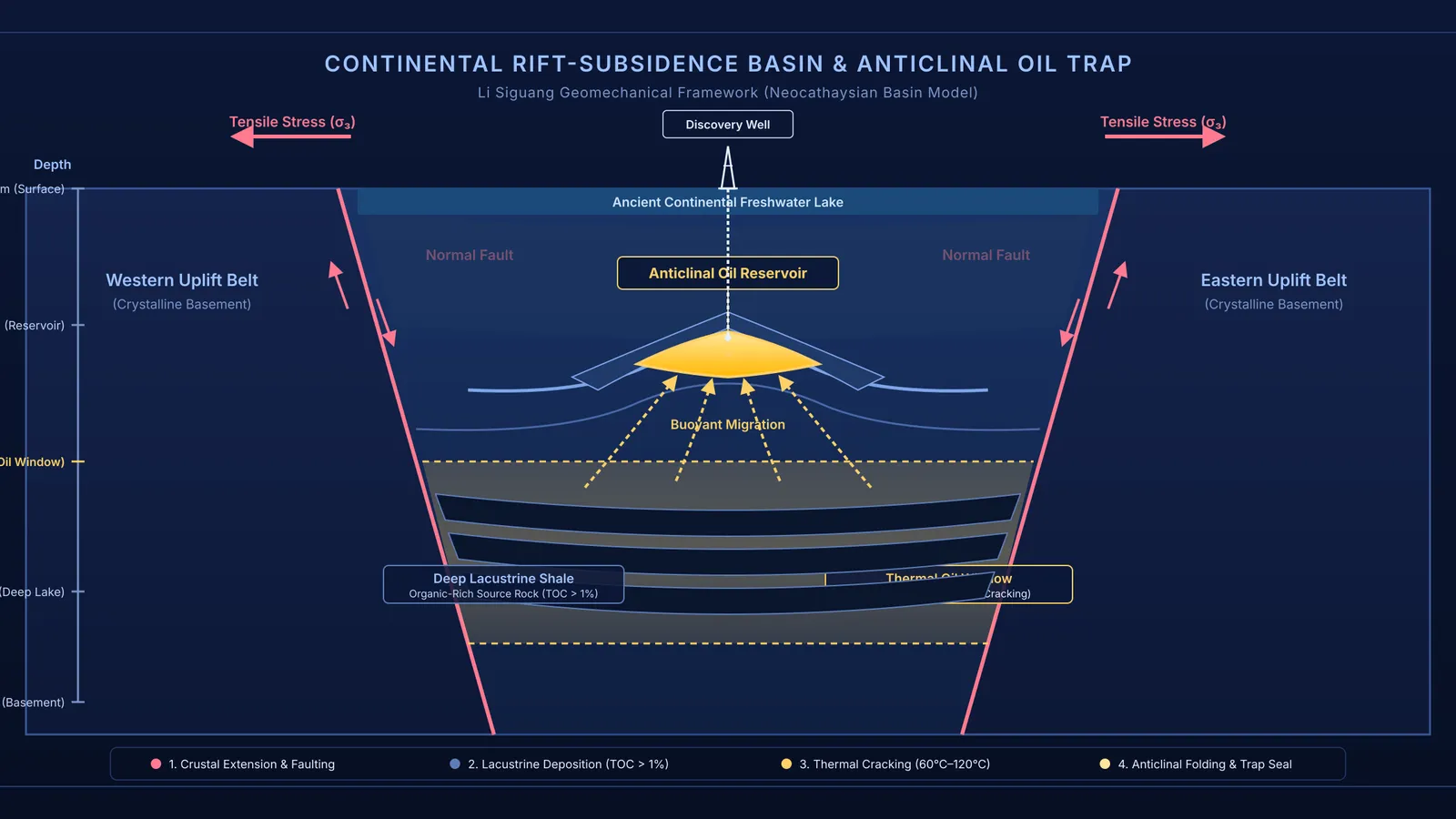
Tensile stress pulls the crust apart, creating grabens and subsiding troughs.
Shear stress creates strike-slip displacements and rotational shear patterns.
By analysing shear fracture angles and regional fold trends, Li identified coherent tectonic systems. In eastern China, he mapped the Neocathaysian tectonic system, trending north-northeast. This system consisted of three alternating uplift mountain belts and three massive subsidence depressions. Li recognised that these subsidence belts were long-term crustal sags where sediments could accumulate several kilometres deep.
How did continental basins generate the Daqing oilfield?
Li argued that petroleum formation depends on physics and organic chemistry rather than seawater. Deep, long-lived freshwater lakes produce dense blooms of algae. When tectonic subsidence pulls the lake floor downward, thick blankets of fine mud bury this organic matter in anoxic conditions, preventing oxidation.
As burial depth exceeds 2 kilometres, geothermal heat warms the sediment between 60°C and 120°C—the thermodynamic oil window—cracking organic kerogen into liquid petroleum, as detailed in USGS Open-File Report 86-502. Buoyant oil migrates upward through porous sandstones until it meets an impermeable clay seal or anticlinal fold. Earlier field observations by Pan, 1941 had noted oil generation in non-marine shales, but Li provided the structural map showing where large-scale trapping occurred.
In January 1955, Li urged the Ministry of Geology to shift drilling from western mountains to the eastern subsidence zones. On September 26, 1959, the Songji No. 3 exploration well in the Songliao Basin struck a commercial gusher at a depth of over 1,100 metres. This opened the supergiant Daqing Oilfield, which went on to produce over 50 million tonnes of crude oil annually, establishing national fuel self-sufficiency.
What is the mechanical checklist for continental basin exploration?
Synthesising structural analysis and basin thermodynamics (USGS Open-File Report 86-502), Li's framework can be structured as a four-step mechanical checklist:
Crustal subsidence: Verify sustained tensile or shear stress creating accommodation space deeper than 2 kilometres.
Lacustrine source facies: Confirm quiet, deep-water lake sediments with total organic carbon exceeding 1 percent.
Thermal maturation: Calculate burial depth and geothermal gradient to verify cooking temperatures between 60°C and 120°C.
Structural closure: Identify anticlinal folds or fault seals to trap buoyant hydrocarbons beneath impermeable caprocks.
Just as D. N. Wadia's geological surveys in the Himalaya decoded structural syntax across complex mountain bends, Li proved that mechanical principles reveal resources hidden beneath quiet plains, a framework modern geophysicists continue to apply (Huijun Li et al., 2021).
Applying first-principles thinking to modern science
When students prepare for demanding physics and chemistry curricula, they often encounter topics that seem like arbitrary rules. Li Siguang's breakthrough came from discarding conventional assumptions in favour of fundamental mechanics and material science.
Visualising complex systems: If you struggle to picture three-dimensional stress vectors or subterranean fault geometry, the Fermi Simulation Lab offers interactive simulations for ideas that are easier to see than to read.
Connecting concepts across subjects: To understand how continuum mechanics, rock stress, and thermal organic reactions connect, the Fermi Concept Library maps every concept across physics, chemistry, biology, mathematics, and computing.
Mastering step-by-step reasoning: When solving multi-step mechanics or thermodynamics problems, the Fermi Problem Library provides worked problems with a step-by-step solver that explains the reasoning rather than printing an answer.


