

On this page
In short Completed around 605 CE by Li Chun, the Zhaozhou Bridge is the world's oldest open-spandrel segmental arch bridge. By hollowing out the bridge's shoulders, Li Chun reduced the weight of the limestone structure by about 700 tons and allowed floodwaters to pass through unharmed.
Between 595 and 605 CE, a master stonemason named Li Chun built a bridge over the Jiaohe River in China's Hebei Province. Over 1,400 years later, the Zhaozhou Bridge (also known as the Anji Bridge) is still standing and in use today. It is the world's oldest open-spandrel arch bridge, and its design solved two of the greatest engineering problems of its time: how to cross a wide river without blocking floods, and how to build a massive stone structure without crushing its own foundations.
What makes a segmental arch work?
Until Li Chun's design, most stone arches were semicircular. A semicircular arch is strong, but to cross a wide river, it has to be built very high, creating a steep, impractical climb for carts and pedestrians.
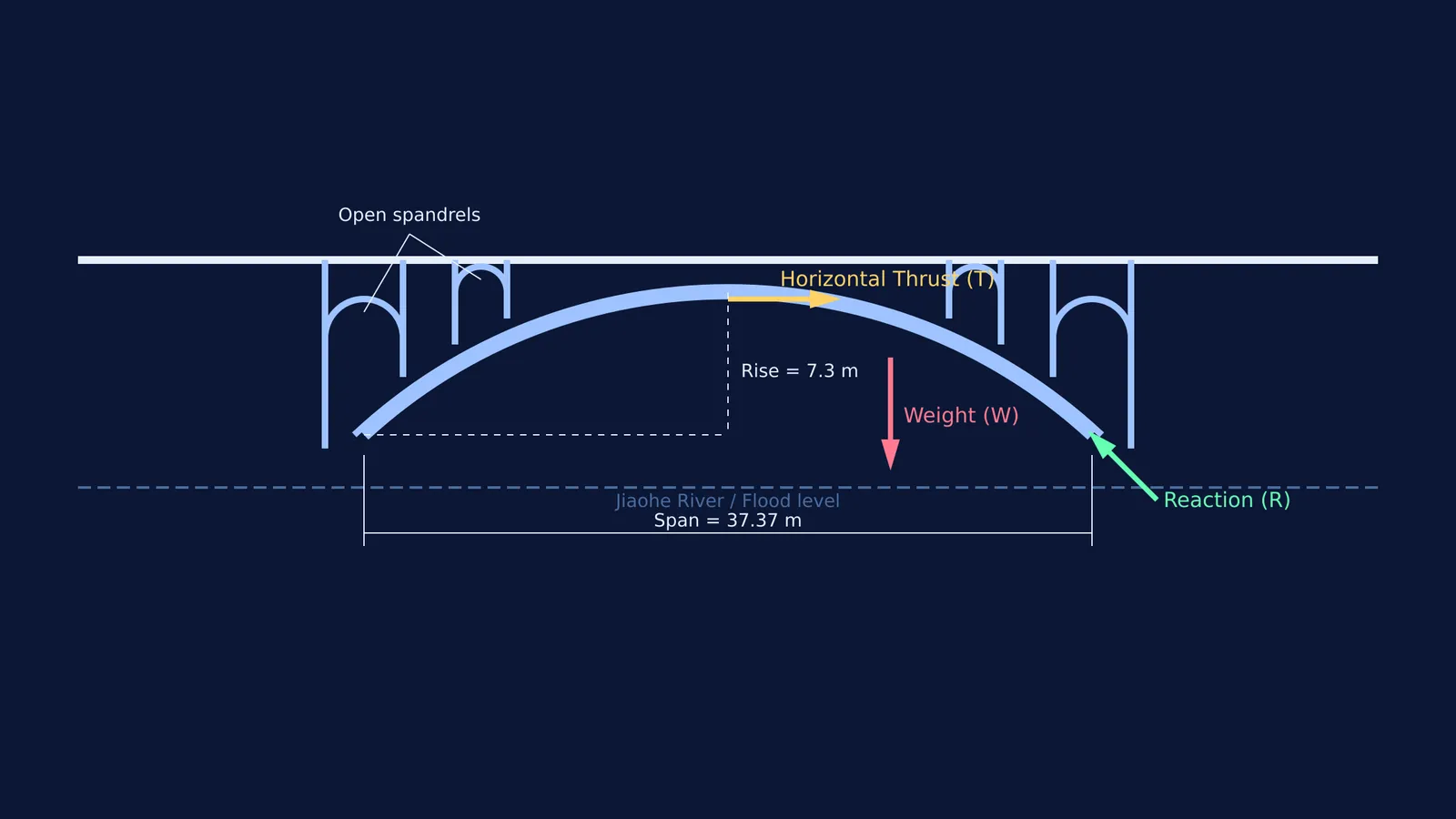
Li Chun chose a segmental arch, which forms a shallow slice of a circle. The Zhaozhou Bridge spans 37.37 metres (123 feet) but rises only 7.3 metres (24 feet). This geometry creates a low, gentle slope that is easy to cross.
However, a flat arch pushes outwards against its abutments much harder than a tall semicircular one. Just as the contact force between blocks pushed together depends on their mass distribution, the thrust of an arch depends heavily on its rise-to-span ratio. To manage this extreme outward thrust, Li Chun had to lighten the load on the stone.
What is an open spandrel arch?
The triangular wall area between the flat deck of a bridge and the curve of its arch is called the spandrel. In traditional Roman and early Chinese bridges, these spandrels were built as solid stone walls filled with earth or rubble.
Li Chun hollowed them out. He built two smaller pairs of arches on the shoulders of the main arch. This was a major engineering innovation that served two critical purposes.
First, it removed about 700 tons of dead weight (around 15.3% of the bridge's total mass), significantly easing the outward pressure on the abutments. Just like accounting for a rod stretching under its own weight, civil engineers must ensure a structure can hold itself up before it carries any traffic.
Second, it made the bridge flood-resistant. When the Jiaohe River floods, the rising water flows straight through the open spandrels instead of battering against a solid stone wall.
How does the Zhaozhou Bridge survive earthquakes?
Beyond its open spandrels, the bridge is not a single solid barrel of stone. Instead, the main arch is constructed from 28 independent, thin limestone ribs laid side by side.
These ribs are held together by iron butterfly joints, or dovetails. If the riverbed shifts or an earthquake strikes, the bridge can flex slightly to absorb the movement. If one rib cracks, the rest of the arch remains standing. This flexibility has allowed the bridge to survive numerous floods and earthquakes over its 1,400-year history.
How do you analyse the forces on an arch?
When engineering students look at a structure like the Zhaozhou Bridge, the physics comes down to resolving vectors. If you need to map out the forces on a segmental arch, follow this standard three-step framework:
Draw the free-body diagram. Treat half of the arch as a rigid body. Identify the three main forces acting on it: the downward force of gravity (its weight), the horizontal thrust from the other half of the arch at the crown, and the reaction force at the abutment.
Resolve the weight vector. Locate the centre of mass for that half of the arch. Because the spandrels are open, the centre of mass is lower and closer to the abutments than it would be in a solid bridge.
Apply rotational equilibrium. Take moments about the springing point (where the arch meets the abutment). The clockwise moment from the arch's weight must be perfectly balanced by the counter-clockwise moment from the horizontal thrust at the crown. Since the bridge's rise is very small relative to its span, the horizontal thrust must be enormous to maintain equilibrium.
This framework shows exactly why Li Chun's open spandrels were necessary: by reducing the weight vector, he proportionally reduced the massive horizontal thrust demanded by such a flat arch.
If you are studying the static mechanics of structures like this, Fermi's AI tutor works out what you already know, builds a plan for the session, and teaches through it. For the ideas that are easier to see than to read, the Fermi Simulation Lab provides interactive simulations.
The Zhaozhou Bridge earned its title as an International Historic Civil Engineering Landmark in 1991. It proves that great engineering does not just resist nature's forces, but elegantly steps out of their way.


