

On this page
In 1983, an American computer scientist named Leslie Lamport, who was working as a researcher at SRI International at the time, wanted to write a book (Wikipedia). He was using TeX, a typesetting system created by Donald Knuth, but found its commands too low-level for everyday writing. To simplify his work, Lamport wrote a set of macros that handled the formatting automatically, letting him focus on the structure of his document. That set of macros became LaTeX.
Lamport released version 2.06a of LaTeX in 1984, and the final version he personally maintained, LaTeX 2.09, in August 1985. The following year, he published *LaTeX: A Document Preparation System*, a user manual that sold hundreds of thousands of copies (Wikipedia).
What is LaTeX document preparation?
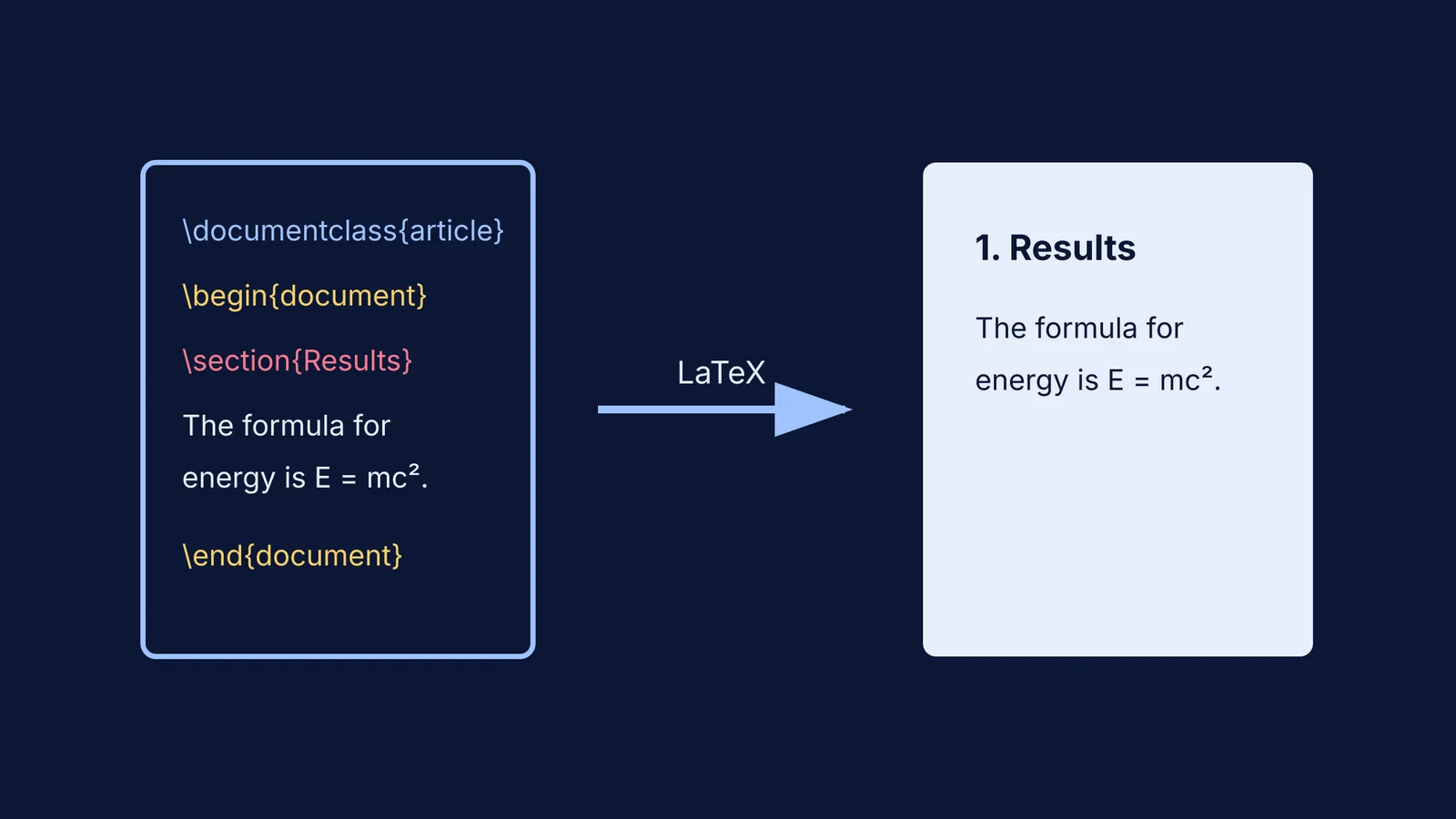
LaTeX is a document preparation system that separates content from design. In a standard word processor, which uses a "What You See Is What You Get" (WYSIWYG) interface, you see the exact formatting as you type (typetex.app). In LaTeX, you write plain text and use tags to define what that text is—a title, a section heading, or an equation.
For example, instead of highlighting text and making it bold and size 18, you type `\section{Introduction}`. When you compile the document, the LaTeX engine applies a consistent, professional design to every section heading.
Why use LaTeX over Word for a thesis or paper?
When writing a long academic document, the formatting can become harder to manage than the writing itself. Researchers use LaTeX because it solves three main problems:
Mathematical typesetting: LaTeX uses a logical syntax to render complex equations with precision (typetex.app). Once you know the commands, it is faster than clicking through equation editor menus.
Automatic numbering: If you add a new figure in chapter two of your thesis, LaTeX automatically renumbers every figure after it and updates every cross-reference in the text.
Stability: Word processors can become unstable as document length increases, but because LaTeX files are just plain text, they do not slow down or corrupt when they reach hundreds of pages.
If you are stuck on the mathematics behind your paper, the Fermi Problem Library has worked problems with a step-by-step solver that explains the reasoning rather than printing an answer.
How do you start learning LaTeX?
LaTeX has a steep learning curve because it feels more like writing code than typing an essay, much like early programming efforts that focused on letting scientists write formulas directly as code. However, mastering it early in your university degree will save you weeks of formatting panics later on.
Use a cloud editor: Sites let you write and compile LaTeX in your browser without installing anything.
Find a template: Most universities and journals provide their own LaTeX templates. Ask your department for the official thesis template.
Learn the basics: Start by learning how to make sections, insert lists, and type basic equations.
Use a reference manager: Learn to use BibTeX. It stores your sources in one plain-text file and formats your bibliography automatically.
If you need a structured plan for your study sessions, Fermi's AI tutor can work out what you already know and build a plan for the session, so you sit down to a clear next step.
What else is Leslie Lamport known for?
While students know him for his document preparation system, Lamport's most major impact is in the field of distributed systems. In 2013, he was awarded the A.M. Turing Award—often called the Nobel Prize of computing (Wikipedia). He shares this honour with computing pioneers such as John McCarthy.
He received the award for his fundamental contributions to how multiple computers communicate and reach consensus. His work on logical clocks and the Paxos algorithm forms the foundation of modern cloud computing and distributed databases. Alongside these algorithms, he also developed the TLA+ specification language to help engineers verify complex systems before building them.
If you are learning the computer science concepts behind these systems, the Fermi Concept Library contains every concept in physics, chemistry, biology, mathematics and computing, each with its own lesson and its place in the map.


