

On this page
A student opening their Class 12 mathematics textbook to the chapter on Linear Programming Problems (LPP) might wonder who first thought to graph constraints and slide an objective function line to find a maximum. The answer lies not in a classroom, but in a Soviet plywood factory just before the Second World War.
In 1939, a 26-year-old mathematics professor named Leonid Kantorovich was asked to consult for the Laboratory of the Plywood Trust. The trust faced a practical, everyday industrial problem: they needed to distribute raw materials among their machines to maximise their total plywood output without buying new equipment (Wikipedia).
What looked like a mundane factory scheduling puzzle turned out to be the birth of a new branch of mathematics. Kantorovich recognised that this was a problem of optimising a linear function subject to linear constraints. He published his findings in a 1939 booklet titled *The Mathematical Method of Production Planning and Organization* (Wikipedia).
How did Kantorovich solve the 1939 plywood challenge?
The Plywood Trust's problem was a classic resource allocation puzzle. Each machine had a different productivity rate. If the factory manager assigned the wood by trial and error, they would likely miss the optimal combination, leading to wasted time and materials.
Kantorovich formulated the problem mathematically. He defined the total output as a linear objective function that needed to be maximised, subject to the constraints of machine time and raw material availability. To solve it, he developed what he called the "method of resolving multipliers". These multipliers, known today in economics as shadow prices, represented the marginal value of a resource—how much more plywood could be produced if one more unit of a specific resource were available.
By applying his mathematical framework, the factory was able to increase its efficiency and output without adding any new machines or workers.
What is linear programming?
Today, the mathematical technique Kantorovich devised is known as linear programming. It is a method to achieve the best outcome, such as maximum profit or lowest cost, in a mathematical model whose requirements and objective are represented by linear relationships (Wikipedia).
Kantorovich’s work laid the foundation for solving such problems without the aid of modern computers. It was only later, during and after the Second World War, that the field expanded rapidly. For example, American mathematician George Dantzig independently developed the simplex method in 1947, which provided an efficient algorithm to solve linear programming problems with many variables (Wikipedia). Decades later, researchers continued to improve these techniques, such as Narendra Karmarkar and a faster algorithm for linear programming.
Why is this linked to Class 12 mathematics?
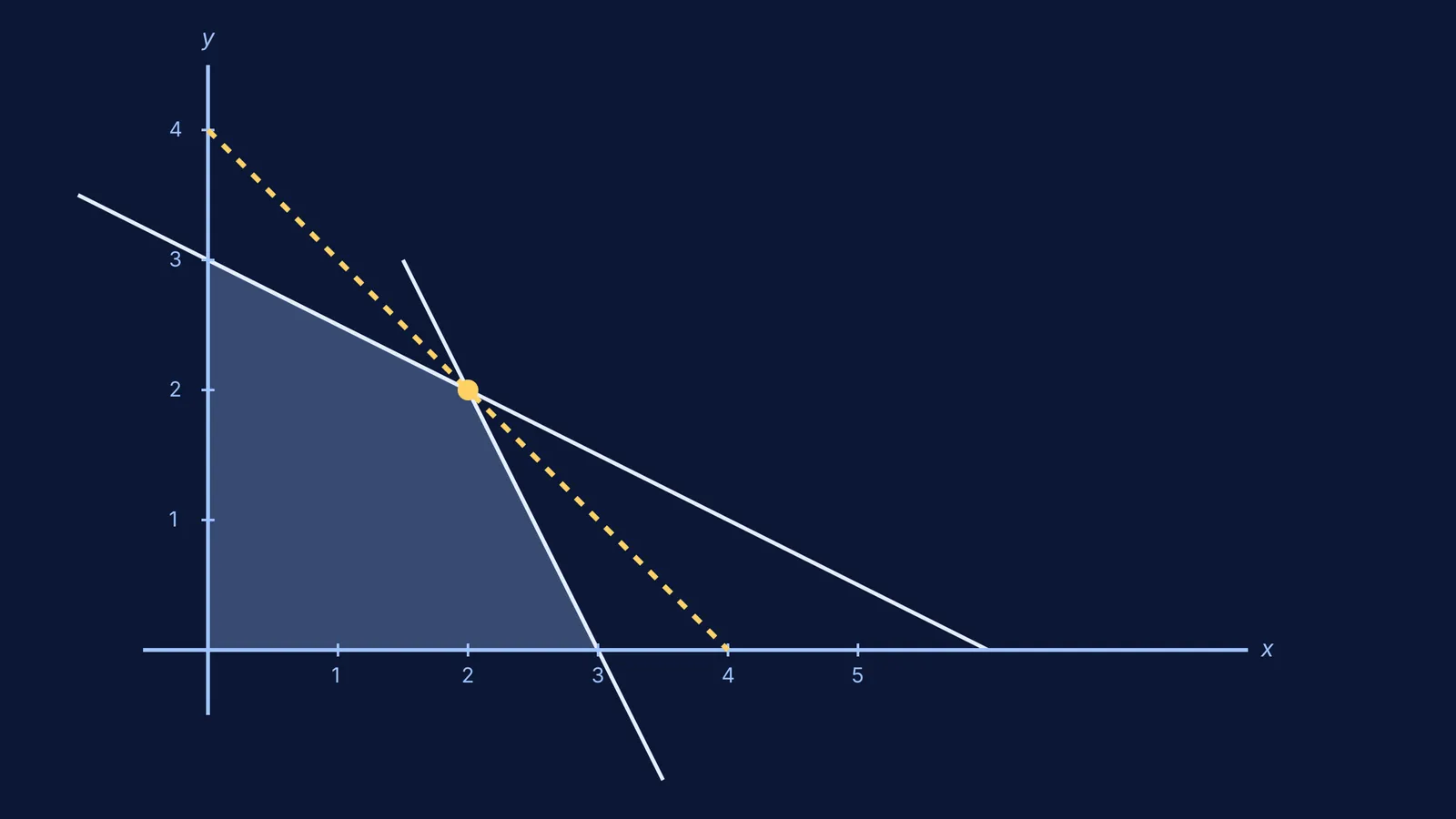
If you have studied Linear programming in CBSE Class 12: the corner point method, you will recognise the modern approach to solving the exact type of problems Kantorovich faced. The linear inequalities form a feasible region—a convex shape on a graph containing all possible solutions. The objective function is a straight line, and the optimal solution is found at one of the vertices or corner points of this feasible region.
When you encounter complex optimisation problems that are difficult to visualise, the Fermi Simulation Lab provides interactive simulations for the ideas that are easier to see than to read, helping you understand how constraints shape the feasible region.
Despite its brilliance, Kantorovich's work was initially met with resistance in the Soviet Union because his idea of shadow prices seemed to conflict with the Marxist labour theory of value. However, the power of linear programming could not be ignored. It eventually revolutionised global logistics, economics, and military planning.
For students tackling LPP questions today, Kantorovich’s story is a reminder of how abstract mathematics can solve very real problems. The equations you balance and the graphs you draw are the exact same tools that help modern industries, airlines, and economies run efficiently around the world. If you find yourself stuck on setting up the constraints for a word problem, the Fermi Problem Library has worked problems with a step-by-step solver that explains the reasoning rather than printing an answer.


