

On this page
For the first half of the 20th century, biology textbooks taught that vertebrate cells were naturally immortal. The Nobel laureate Alexis Carrel had famously kept a culture of chicken heart cells alive for 34 years—far longer than a chicken's natural lifespan of 5 to 10 years (Wikipedia). Researchers believed that if cells died in a laboratory, it was simply because the scientist had failed to feed them properly or clear out their waste.
That consensus changed in 1961. Leonard Hayflick and Paul Moorhead, working at the Wistar Institute, published a landmark paper in *Experimental Cell Research* (Crossref90192-6)). They demonstrated that normal human fetal cells possess a finite capacity for replication. The cells would grow rapidly for a period, but after about 50 divisions, they inevitably slowed down and stopped.
What is the Hayflick limit?
The Hayflick limit is the number of times a normal human cell population will divide before cell division stops. For human fetal fibroblasts, this number is typically between 40 and 60 times (Wikipedia).
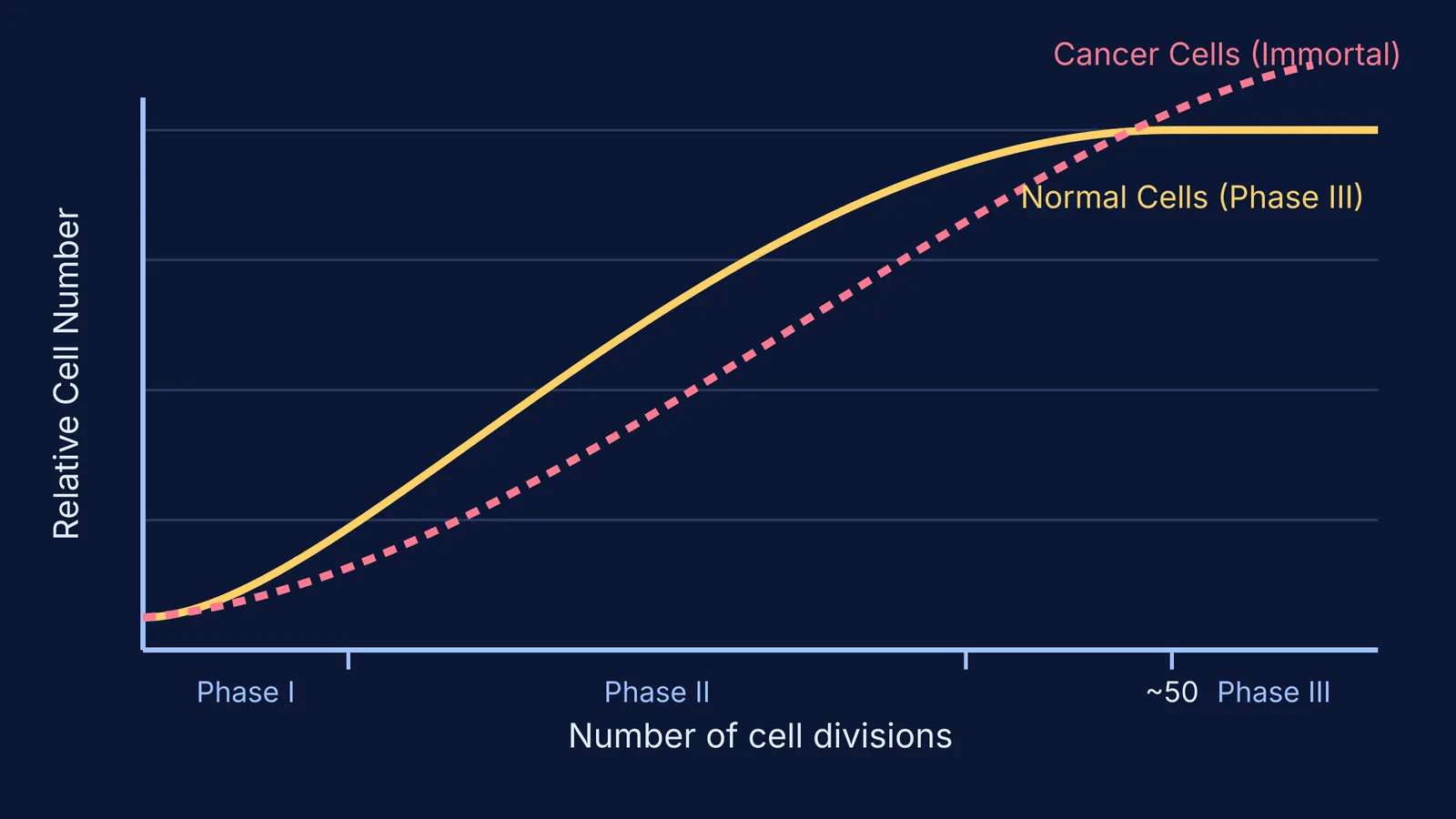
Hayflick divided the life of cultured cells into three distinct phases:
Phase I: The initial primary culture, where cells are freshly isolated from tissue and begin to settle.
Phase II: A period of "luxuriant growth" where cells double rapidly and consistently, filling the culture vessel.
Phase III: The final stage, now known as cellular senescence, where the replication rate slows drastically and permanently stops.
To prove the limit was a built-in cellular clock rather than a result of poor lab conditions, Hayflick designed an elegant experiment. He mixed "old" male cells that had already divided 40 times with "young" female cells that had divided only 15 times. When the control male cells stopped dividing, the male cells in the mixed culture also stopped, leaving only the young female cells to continue multiplying. The stop signal was entirely inside the cell itself.
(We now know that Carrel's supposedly immortal chicken cells survived because fresh embryonic cells were accidentally added to the culture along with their daily nutrient extract.)
Why do cells stop dividing?
The countdown mechanism that Hayflick observed is driven by telomeres. Telomeres are protective caps of repetitive DNA at the ends of linear chromosomes. Every time a cell divides and copies its DNA, the replication machinery cannot reach the very end of the strand—a fundamental constraint known as the end-replication problem.
With each division, a small piece of the telomere is lost. When the telomeres become critically short, the cell interprets the exposed chromosome ends as dangerously damaged DNA. To prevent harmful mutations from being copied, the cell permanently halts its cycle and enters senescence.
To trace how DNA polymerase works, the Fermi Concept Library maps out every concept in genetics, each with its own lesson. For a more interactive view of the end-replication problem, which is easier to see than to read, you can explore the Fermi Simulation Lab to watch molecules interact in real time.
Can cells bypass the Hayflick limit?
Yes, but normal somatic (body) cells generally do not. Stem cells and germ cells—which must keep dividing to maintain the body's tissues and reproduce—produce a specialised enzyme called telomerase. Telomerase actively rebuilds the lost telomere sequences, effectively resetting the biological clock and allowing these cells to exceed the Hayflick limit indefinitely.
Cancer cells also hijack this telomerase mechanism. In fact, Hayflick was the first to state that "only cancer cells are immortal" (Wikipedia). Most malignant tumours activate telomerase to keep their telomeres long, which is exactly what allows them to divide relentlessly.
How do different cell types handle the limit?
When studying the cell cycle, you can group cells by how they handle the Hayflick limit:
Somatic cells (normal body cells): Obey the limit (40–60 divisions) (Wikipedia). They have no active telomerase. They eventually age and enter Phase III senescence.
Stem and germ cells: Bypass the limit. They use active telomerase to maintain chromosome length for essential lifelong growth and reproduction.
Cancer cells: Break the rule. They pathologically reactivate telomerase to become immortal, allowing for uncontrolled tumour growth.
Hayflick's discovery fundamentally shifted the study of aging from the whole organism down to the cellular level. It paved the way for decades of research into genetics, including the mechanics of Okazaki fragments and DNA replication and the original isolation of nuclein by Friedrich Miescher. By proving that our cells carry their own mortality, Hayflick completely rewrote the rules of biology.


