

On this page
In the mid-1990s, search engines ranked web pages largely by counting how many times a keyword appeared on them. This made search results vulnerable to manipulation and often unhelpful. Two university students found a mathematical way out by treating the internet as a massive network of citations.
How did Larry Page and Sergey Brin meet?
Larry Page and Sergey Brin met in 1995 at Stanford University. Brin, who was already a PhD student, was assigned to show Page around the campus during a summer orientation. Although they reportedly disagreed on almost everything during their first meeting, they soon united over a shared interest in the mathematical structure of the World Wide Web.
By 1996, Page started a dissertation project nicknamed "BackRub". He wanted to explore the link structure of the web as a graph, reasoning that a link to a page was essentially a citation, and thus a signal of its value. Brin joined the project, and together they built their first web crawler and search engine using spare parts from inexpensive computers in Page's dormitory room.
What is the PageRank algorithm?
The PageRank algorithm, named after Larry Page, ranks the importance of web pages by looking at their backlinks. The core assumption is that a page is important if many other important pages link to it, treating each link as a vote of support.
In September 1998, after their search engine was already processing 10,000 searches a day, they incorporated Google, Inc. to commercialize the algorithm. They received a $100,000 cheque from Sun Microsystems co-founder Andy Bechtolsheim and famously set up their first office in a garage in Menlo Park, California.
How does PageRank use Markov chains?
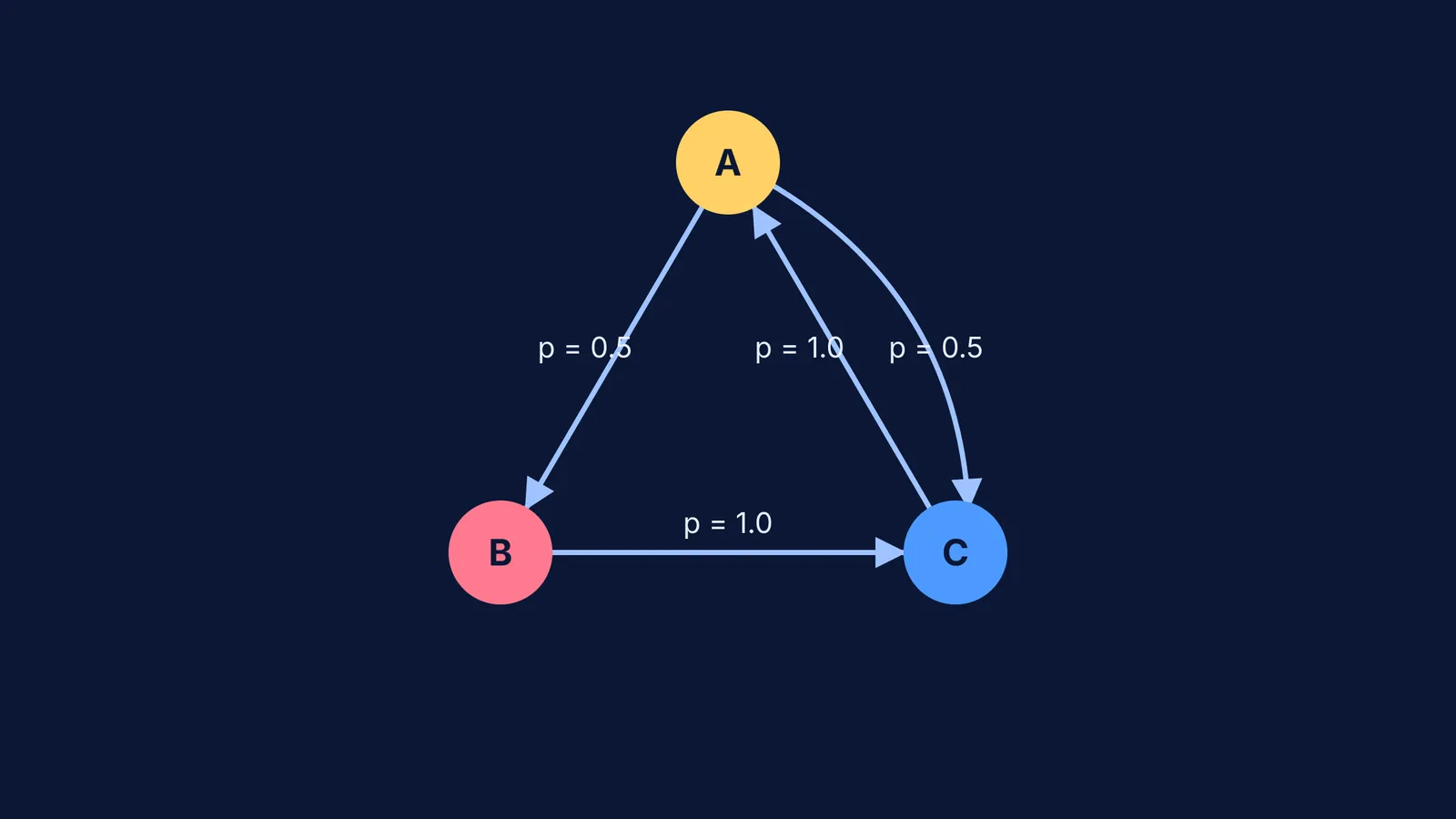
PageRank relies on the "random surfer model", which represents the internet as a Markov chain. In this model, the states are web pages and the transitions are the hyperlinks between them. The algorithm calculates the probability that a person randomly clicking on links will arrive at any particular page.
Mathematically, the PageRank of a page is the probability of being on that page after a large number of clicks. This corresponds to finding the stationary distribution of the Markov chain. Students tackling problems in Andrey Markov and the chains that link random events or Probability distributions for JEE: mean and variance worked out will recognise this as a matrix of transition probabilities converging on a stable limit.
What is the PageRank formula?
The PageRank of a page A, written as PR(A), is calculated by gathering the rank of every page that links to it. The formula is:
PR(A) = (1 − d)/N + d × [ PR(B)/L(B) + PR(C)/L(C) + ... ]
Here, d is the damping factor (0.85), N is the total number of pages in the network, and L(B) is the total number of outbound links leaving page B. The rank of page B is divided by its outbound links, meaning a page spreads its "votes" equally among all the links it points to.
This iterative formula acts as the principal eigenvector of the network's modified adjacency matrix. In their original 1998 paper, Page and Brin proved that this system converges rapidly. They reported that the algorithm took about 52 iterations to converge for a network of 322 million links, proving it could scale to the entire internet.
If you are learning the matrix algebra behind Markov chains, the Fermi Concept Library maps out every concept in mathematics with its own lesson. When a textbook explanation of eigenvectors or Andrey Kolmogorov and the three axioms behind every probability leaves you stuck, Fermi's AI tutor works out what you already know, builds a plan for the session, and teaches through the steps on a whiteboard.


