

On this page
In September 1989, three back-to-back papers in the journal *Science* announced a discovery that changed human genetics. A collaborative research team led by Lap-Chee Tsui and John Riordan at the Hospital for Sick Children in Toronto, alongside Francis Collins at the University of Michigan, had found the gene responsible for cystic fibrosis.
Before this major collaborative effort, the disease was a medical mystery. Doctors and researchers knew it ran in families and caused severe lung infections and digestive blockages, but the underlying cellular defect was completely hidden. By tracking the chemistry of DNA across affected families, the team managed to pinpoint the exact location of the gene without knowing what the associated protein looked like in advance. This approach, known as positional cloning, was a major achievement at the time.
What is an autosomal recessive disorder?
Cystic fibrosis is inherited in an autosomal recessive pattern (NIH). This means that a person must inherit two mutated copies of the gene—one from each parent—in order to develop the disease.
Because the condition is "autosomal," the gene sits on a numbered chromosome rather than an X or Y sex chromosome, meaning it affects males and females equally. A person who carries just one mutated copy is called a carrier. They do not show any symptoms of the disease, but they can silently pass the genetic mutation on to their children.
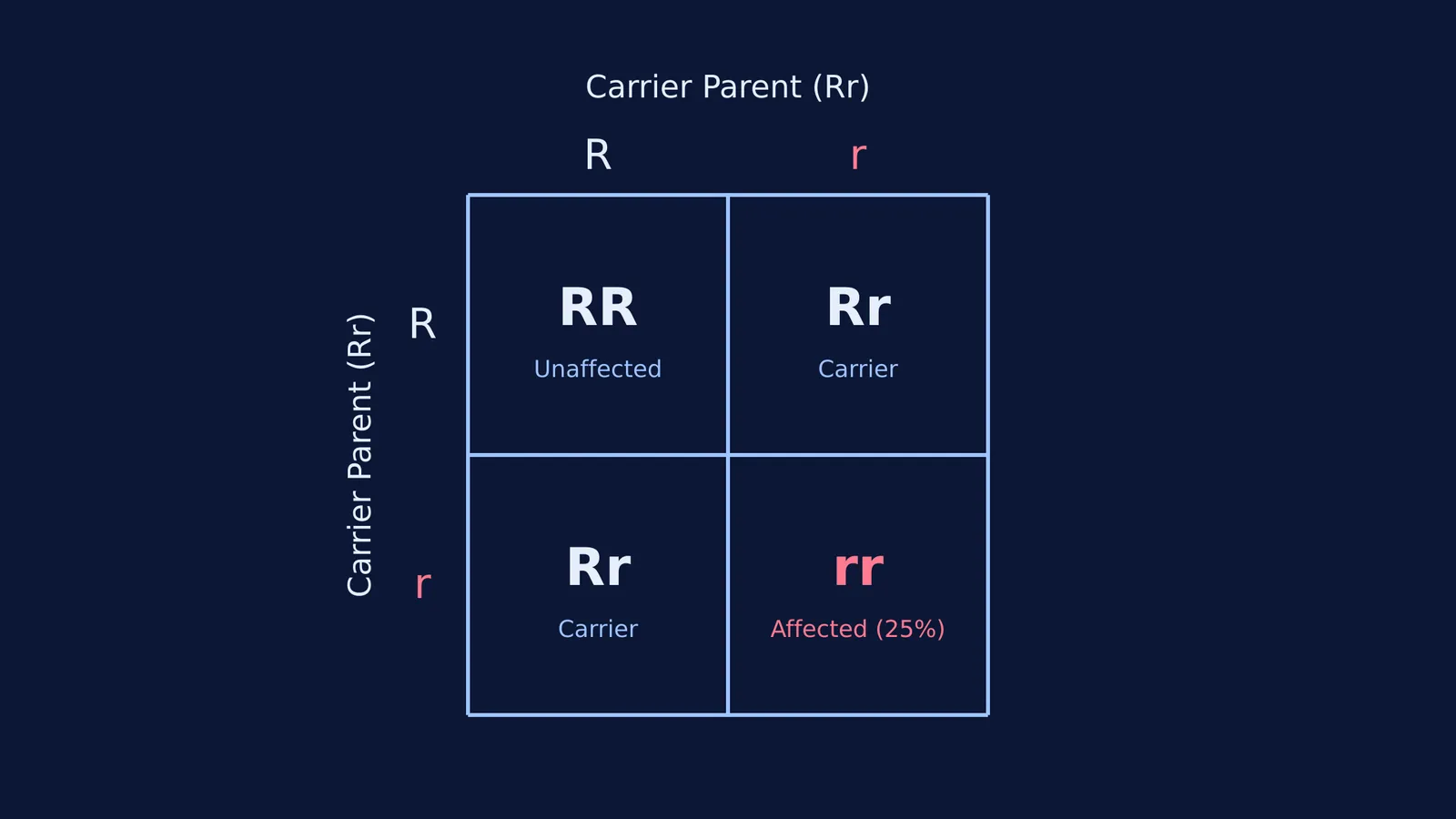
Similar to other Mendelian disorders like sickle-cell anaemia and PKU, when two carriers have a child together, the NIH notes the genetic probabilities follow a strict, predictable mathematical rule:
There is a 25% chance the child will have the disease (inheriting both mutated copies).
There is a 50% chance the child will be a carrier (inheriting one mutated and one normal copy).
There is a 25% chance the child will inherit two normal genes and be completely unaffected.
If you have concept gaps around setting up the grid to find these probabilities, the Fermi Concept Library explains Mendelian inheritance so you can see exactly where the 1:2:1 ratios come from.
How did chromosome walking find the CFTR gene?
Finding the specific gene responsible for the disease was a challenging task in the era before the Human Genome Project. Tsui, Collins and Riordan used genetic mapping techniques called "chromosome walking" and "chromosome jumping" to carefully navigate through 500,000 base pairs of DNA (10.1126/science.2772657).
Chromosome walking involves taking a known piece of DNA, finding an overlapping segment next to it, and slowly moving down the chromosome. Because this was too slow, Francis Collins introduced "chromosome jumping," which allowed the researchers to vault over long stretches of uninteresting DNA and speed up the search. They eventually isolated the responsible gene on the long arm of human chromosome 7.
The team named the newly discovered gene the Cystic Fibrosis Transmembrane Conductance Regulator (CFTR). Its job is to provide the instructions for a protein channel that moves chloride ions in and out of cells. When this channel fails or is missing, cells cannot regulate water movement properly. This leads to the buildup of the thick, sticky mucus that damages the lungs and blocks the pancreas.
What is the ΔF508 mutation?
By analysing the genetics of various patients, the research team found that the most common mutation—accounting for approximately 70% of cases at the time—was a tiny three-base-pair deletion (10.1126/science.2570460). This microscopic error results in the loss of a single amino acid, phenylalanine, at position 508 of the final protein. This specific genetic deletion is widely known as ΔF508.
How can you explain genetic inheritance?
The 1989 discovery of the CFTR gene paved the way for modern genetic testing and fingerprinting, eventually shifting cystic fibrosis from an untreatable childhood illness into a condition managed with targeted modulator drugs.
If you need to explain how autosomal recessive inheritance works for a biology assignment or to a friend, you can use this simple framework:
Start with the pairs: Explain that humans carry two copies of most genes—one inherited from the mother, and one inherited from the father.
Define a carrier: Clarify that a "carrier" has one working copy of the gene and one mutated copy. Because the working copy still does the job, the person is completely healthy.
Trace the combinations: Draw a 2 × 2 Punnett square on a piece of paper. Show that each parent passes down one of their two copies entirely at random.
Show the 25% rule: As the NIH explains, point to the single square out of the four where the child inherits the mutated copy from both parents, explaining that this is the only biological way an autosomal recessive disease appears.
Understanding these inherited patterns is the important first step in seeing how a single missing amino acid can alter an entire biological system.


