

On this page
In early 1963 the gas lasers of the day gave out a few tens of milliwatts, and many physicists had decided they would never do better. By mid-1964, Kumar Patel at Bell Labs had a gas laser giving out a hundred watts, continuously. This post tells how he did it, and works through the photon arithmetic from your Class 12 physics that shows why his carbon dioxide (CO2) laser was so much more efficient.
Who is Kumar Patel?
C. Kumar N. Patel was born on 2 July 1938, according to the National Inventors Hall of Fame, which inducted him in 2012 for the CO2 laser. The introduction to his IEEE oral history records that he took a B.E. in telecommunications from the College of Engineering in Poona in 1958, then a master's degree in 1959 and a PhD in 1961 at Stanford.
In the interview he says he went to Stanford as a stopgap. He had planned to join the foreign service, but he was too young to sit the entrance exam. He joined Bell Labs in 1961 and told his interviewer that he wanted to do laser spectroscopy. Asked what he knew about lasers, he answered: "Nothing."
Why were early gas lasers so weak?
By early 1963, Patel recalls in the same interview, he and others had found thousands of laser transitions in gases, but every system gave "in the region of ten to fifty milliwatts". Many researchers had concluded that gas lasers would never give much power.
Patel spent about six months asking why. In atomic gases, as he explained to APS Physics, the levels involved in laser action sit high above the ground state, so the energy needed to pump an atom up is much larger than the energy of the photon that comes out. Molecules have vibrational levels much closer to the ground state, so a larger share of the pumping energy can leave as light. "I wanted high power and high efficiencies," he told the magazine.
What did he find in carbon dioxide?
In Physical Review in 1964, Patel reported continuous laser action on vibrational-rotational transitions of CO2 around 10.4 and 9.4 micrometres. The strongest line was at 10.6324 micrometres, and the continuous output was about 1 milliwatt. The abstract on the APS page says so plainly.
The jump came from a second idea. Nitrogen molecules excited in an electric discharge store energy for a long time, and their first vibrational level almost matches the upper laser level of CO2. Patel's Physical Review Letters paper on the N2-CO2 mixture appeared in November 1964. In the oral history he says that adding nitrogen gave "the first laser producing power greater than a watt", and that by about mid-1964 he had a laser giving a hundred watts of continuous output.
Worked example: why CO2 wastes less energy
Use hc = 1240 eV nm, and the vibrational data from NIST's CCCBDB entry for CO2 (asymmetric stretch at 2349 cm⁻¹) and for N2 (2330 cm⁻¹).
Photon energy. λ = 10.6 µm = 10,600 nm, so E = 1240 / 10,600 = 0.117 eV.
Energy of the upper laser level. A wavenumber of 2349 cm⁻¹ corresponds to λ = 1/2349 cm = 4.257 µm, so E = 1240 / 4257 = 0.291 eV.
Fraction that can leave as light. 0.117 / 0.291 = 0.40. At most about 40 per cent of the energy stored in the upper level comes out as the laser photon; the rest stays in the molecule as vibration and ends up as heat.
Why nitrogen helps. Nitrogen's level at 2330 cm⁻¹ gives 0.289 eV. The gap to CO2 is 0.002 eV, while kT at 300 K is 8.62 × 10⁻⁵ × 300 = 0.026 eV. Collisions easily make up a gap that small, so excited nitrogen hands its energy to CO2.
Photons per second. At 100 W: 0.117 eV = 0.117 × 1.602 × 10⁻¹⁹ = 1.87 × 10⁻²⁰ J, so the beam carries 100 / 1.87 × 10⁻²⁰ = 5.3 × 10²¹ photons every second.
Which mistakes does this help you avoid?
Mixing up wavelength units. 10.6 µm is 10,600 nm, not 1060 nm. Write the conversion before you divide.
Treating wavenumber as wavelength. 2349 cm⁻¹ means 2349 waves per centimetre; invert it to get the wavelength.
Thinking more power means more energetic photons. A 100 W CO2 laser has low-energy infrared photons. Its power comes from the huge number of them.
What happened to the CO2 laser?
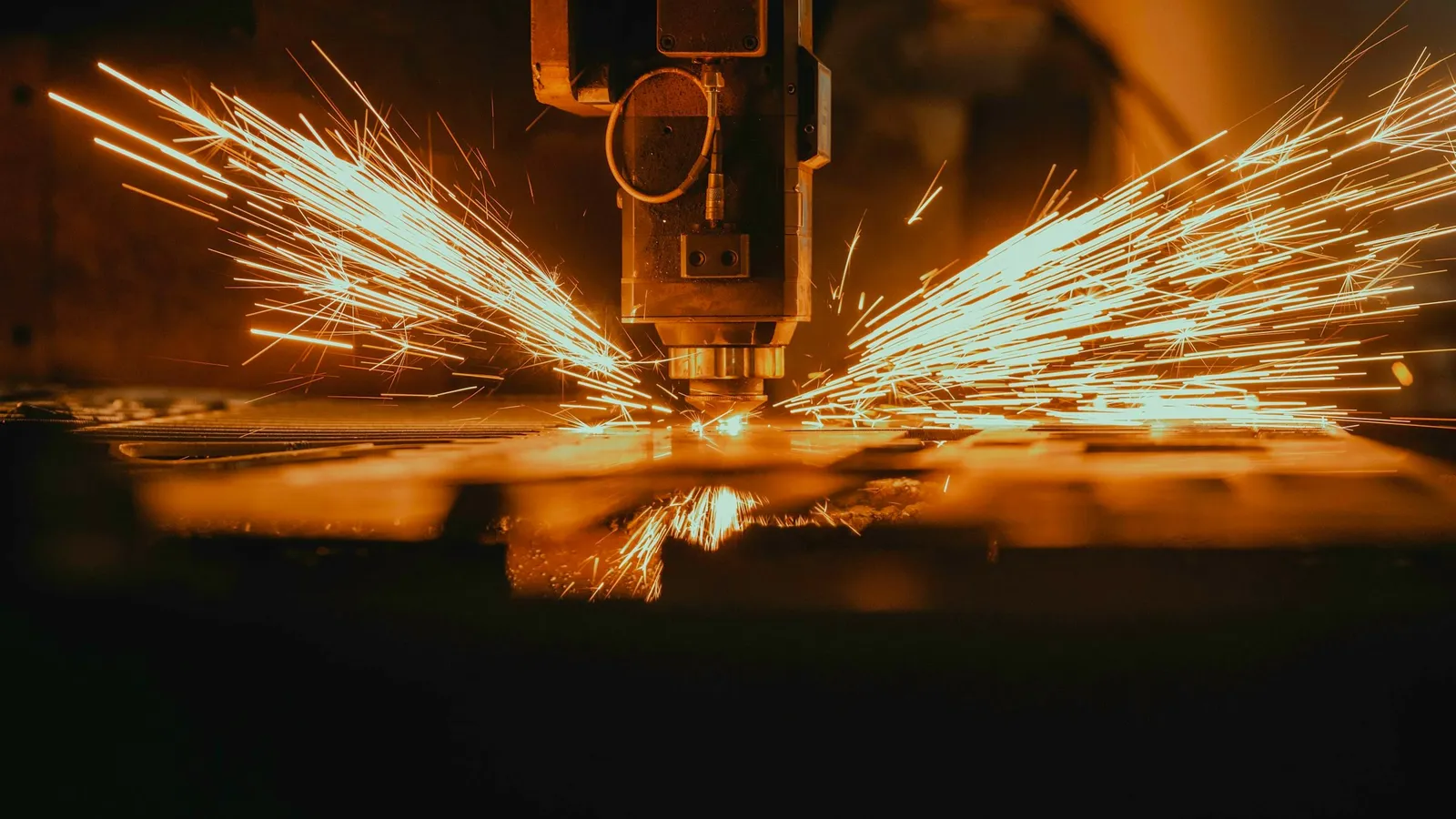
The 1996 National Medal of Science citation honours "his fundamental contributions to quantum electronics and invention of the carbon dioxide laser". The Hall of Fame page lists its uses: cutting, welding, engraving and drilling in industry, and laser scalpels and skin treatments in medicine. After 32 years at Bell Labs, Patel became Vice Chancellor for Research at UCLA, and in 2000 he started a company, Pranalytica, making mid-infrared lasers and gas sensors.
The laser grew from the maser; our post on Charles Townes and the road to the laser covers that earlier step.
What can a student learn from how Patel worked?
He did not accept "gas lasers are dead" as an answer. He asked why the power was capped, traced the cause to where the energy levels sat, and chose a new system on that basis. "It came about because I refused to believe that gas lasers were dead!" he said in the oral history. The habit is useful in any problem: before trying harder, find out what is limiting you.
Energy levels and photon emission are easier to understand when you can see them change. The Fermi Simulation Lab has interactive simulations for ideas that are easier to see than read, which helps when level diagrams feel abstract.
Try it now: find the photon energy of a 632.8 nm helium-neon laser and compare it with the 0.117 eV CO2 photon.


