

On this page
Shrinivas Kulkarni, a professor of astronomy and planetary science at the California Institute of Technology (Caltech), has spent his career hunting for the universe's most elusive events. As a young graduate researcher at the University of California, Berkeley, he made a groundbreaking discovery: the first millisecond pulsar, designated PSR B1937+21 [[1]](https://en.wikipedia.org/wiki/Shrinivas_Kulkarni). By 2024, his pioneering work in "time-domain astrophysics" earned him the prestigious Shaw Prize in Astronomy. Instead of treating the night sky as a static map, Kulkarni studied the things that change—exploding stars, variable stars, and fleeting cosmic flashes. To catch these short-lived events, Kulkarni led the development of a fully automated survey that watched the sky every night and processed the data immediately.
What is the Palomar Transient Factory?
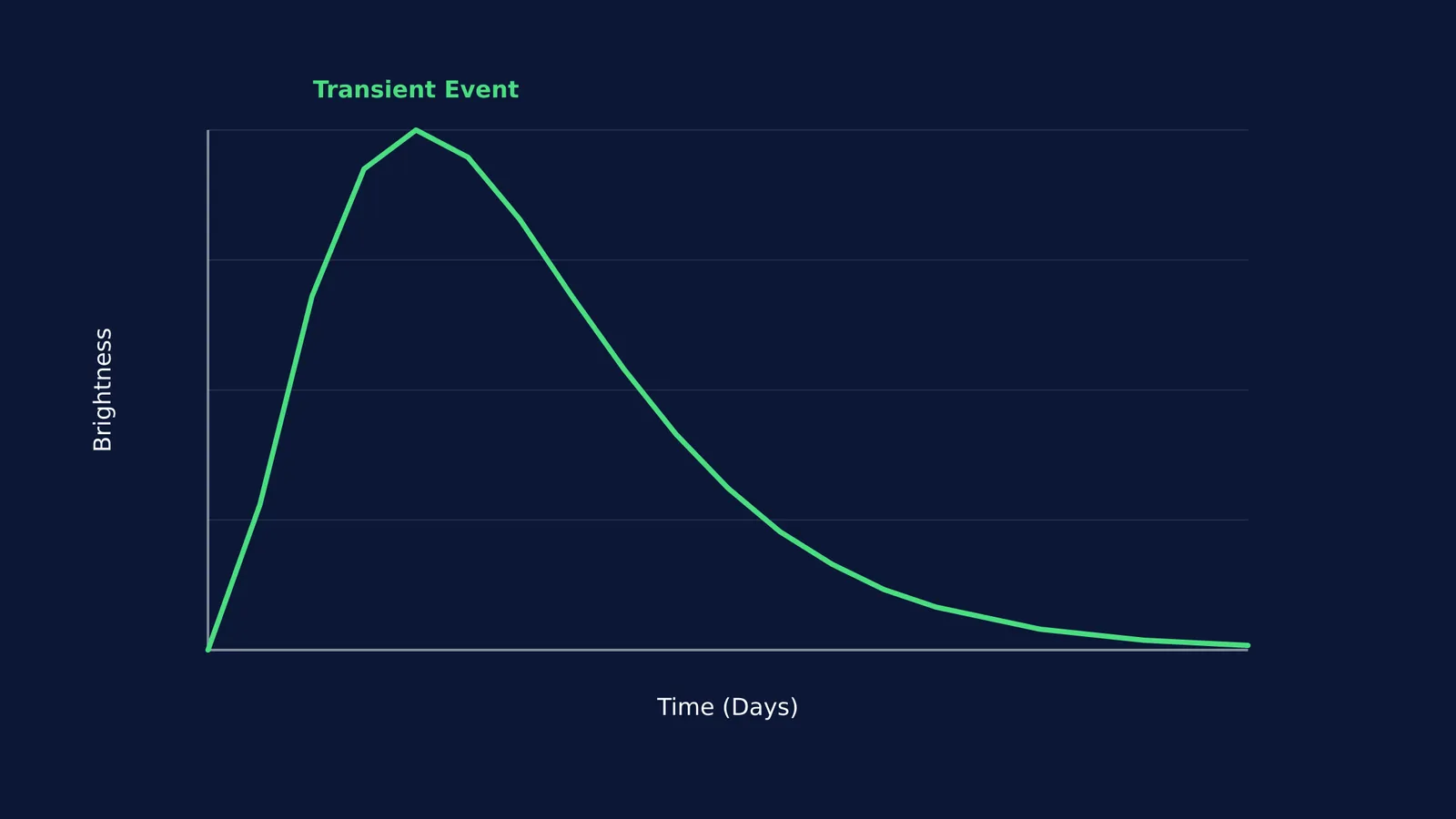
The Palomar Transient Factory (PTF) was a major astronomical survey designed to find transient objects that change in brightness over short periods. It used a re-engineered 96-megapixel camera on the 1.2-metre Samuel Oschin Telescope at the Palomar Observatory in California [[2]](https://en.wikipedia.org/wiki/Palomar_Transient_Factory). Before the PTF, astronomers often had to manually search through images or rely on slower, uncoordinated processes to spot a new supernova. Kulkarni's project changed this by building an end-to-end automated pipeline. The system systematically photographed the sky, automatically compared the new images to older reference photos using advanced image subtraction at the Lawrence Berkeley National Laboratory, and flagged any new flashes of light within minutes [[2]](https://en.wikipedia.org/wiki/Palomar_Transient_Factory).
During its main operational run from 2009 to 2012, the PTF accumulated precise light curves for approximately 500 million objects. By continuously watching the same patches of sky, it discovered many new cosmic events and filled significant gaps in astronomical knowledge. This included entirely new phenomena, such as rare superluminous supernovae and unique calcium-rich supernovae [[2]](https://en.wikipedia.org/wiki/Palomar_Transient_Factory).
How did automation change astronomy?
The PTF proved that speed and automation could yield entirely new science. When the software detected a flash, it triggered immediate automated photometric follow-up observations by other telescopes—including the Palomar 1.5-meter telescope—while the event was still happening. This allowed astronomers to study the earliest stages of a star's explosion, a critical observational window that was previously almost impossible to catch [[2]](https://en.wikipedia.org/wiki/Palomar_Transient_Factory). His bold approach relied on the core idea that observing large areas of the sky frequently will naturally lead to unexpected discoveries. The success of the PTF laid the essential groundwork for even larger and faster automated surveys, such as the Zwicky Transient Facility, which continues scanning the sky today [[2]](https://en.wikipedia.org/wiki/Palomar_Transient_Factory).
How does the time-domain approach apply to learning?
There is a striking parallel between Kulkarni's automated sky survey and how students can approach studying physics, chemistry, or mathematics. Many students treat a science syllabus as a static map. They read the textbook, highlight key paragraphs, memorise the core formulas, and simply hope the knowledge stays put until the final exam. But learning is deeply dynamic. Your understanding changes from minute to minute as you try to solve new problems and encounter unexpected challenges. If you often find yourself stuck in this frustrating gap—knowing the rules but failing to apply them in practice—you might be wondering why you understand physics theory but still fail numericals.
Instead of waiting for a term mock exam to find out what you missed, you can set up your own personal system of continuous monitoring and real-time feedback. This active, survey-like approach catches small errors before they grow into large conceptual gaps:
Test yourself frequently. Just as the PTF scanned the sky frequently rather than once a year, you should test your recall regularly. Small, frequent tests show you exactly what facts or methods you have forgotten.
Follow up immediately. When the PTF software spotted a transient, it flagged the coordinates for immediate follow-up by other telescopes around the world. When you make a mistake in a practice problem, do not just read the correct answer and move on. Stop and investigate why you made the error. If you are struggling to review your errors effectively, read our step-by-step guide on how to analyse a mock test.
Use real-time feedback. An automated pipeline spots patterns faster than manual checking ever could. Fermi's AI tutor works in a similar way for your study sessions. Most learning tools answer questions. Fermi teaches — it holds a line of reasoning across a whole session, notices where a student is stuck, and decides whether to explain, ask, or show. If you know the theory but struggle to apply it, try working through the step-by-step solver in the Fermi Problem Library.
When you sit down to study, look for the changes, the mistakes, and the flashes of confusion in your own work, and follow up on them immediately.


