

On this page
In 1985, a young electrical engineer named Koichi Tanaka accidentally mixed glycerin instead of acetone into his metal powder matrix 1. Rather than throwing away the expensive cobalt powder, he decided to test the "ruined" sample. That mistake revealed a way to lift intact proteins into a mass spectrometer, a breakthrough that earned him the 2002 Nobel Prize in Chemistry.
What makes weighing proteins so difficult?
Francis Aston's mass spectrograph proved early on that mass spectrometry is a powerful way to measure atoms and small molecules. A mass spectrometer works by giving a molecule an electric charge (ionizing it) and vaporizing it into a vacuum. The machine then measures how the ion's path bends in a magnetic or electric field, which reveals its exact mass.
This works perfectly for small, robust molecules. However, proteins are enormous and delicate. When scientists like James Sumner proved that enzymes are proteins, they revealed complex biological structures made of thousands of atoms folded into precise shapes. If you hit a large protein with enough laser energy to vaporize it directly, the molecule simply shatters or burns before it can be measured. The thermal energy breaks the chemical bonds that hold the protein together. For decades, it was thought impossible to analyze large biomolecules intact using mass spectrometry.
How did an accidental mixture change mass spectrometry?
Koichi Tanaka was an engineer with a bachelor's degree working at the Shimadzu Corporation in Japan. He was experimenting with a technique called laser desorption, trying to find a chemical "matrix" that could absorb the laser's energy and transfer it to the protein without breaking the fragile molecule.
His monumental blunder happened when he mistakenly used glycerin instead of acetone to suspend his ultra-fine cobalt metal powder. Because the cobalt was an expensive material, he decided not to discard the mixture and tested it anyway. He placed the protein sample into this matrix and fired the nitrogen laser.
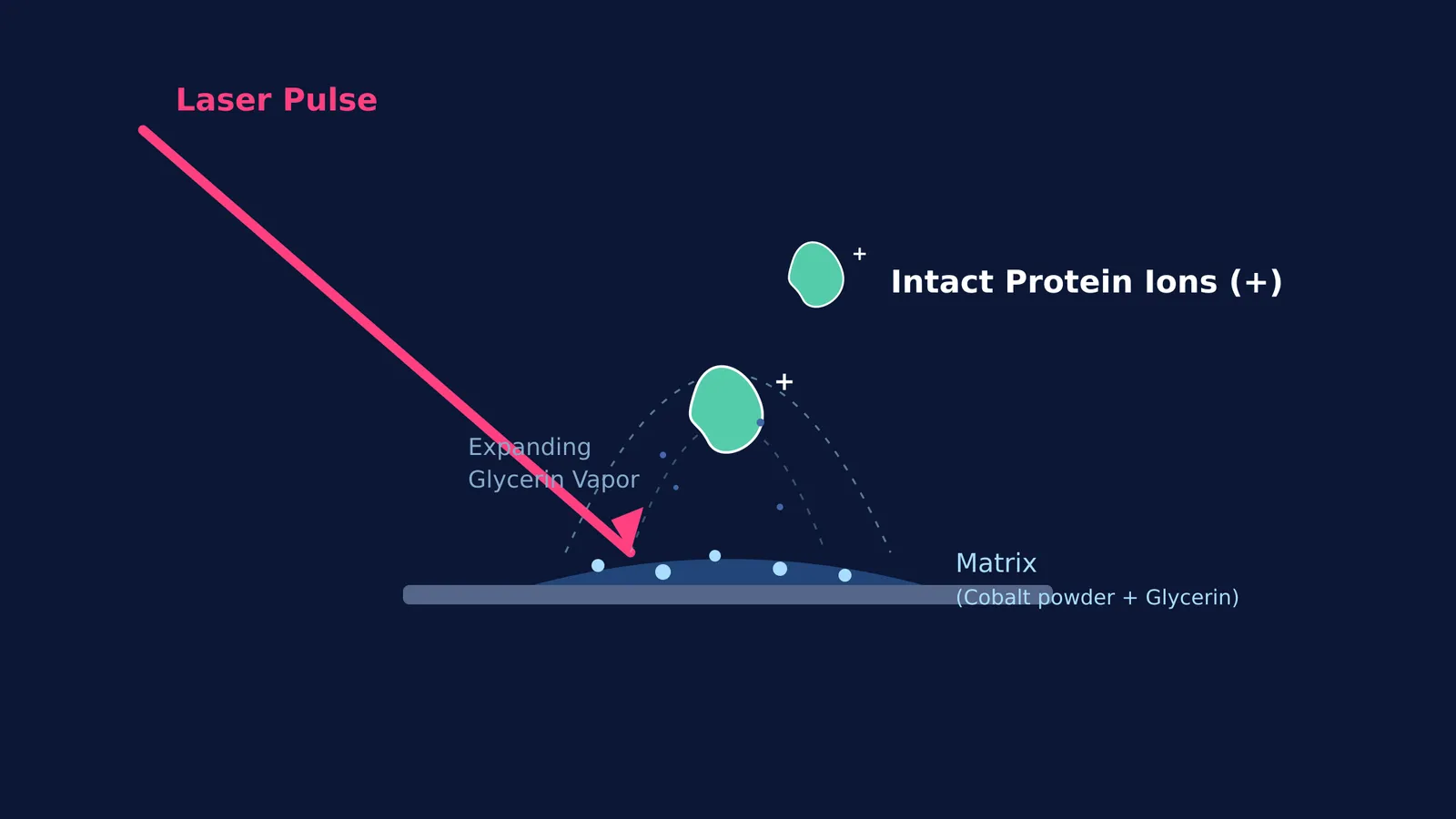
When the laser hit the sample, the cobalt powder absorbed the heat, causing the glycerin to rapidly evaporate. This expanding vapor softly carried the intact protein molecules into the gas phase without breaking them apart. Soft laser desorption (SLD) is a technique that uses a matrix to absorb laser energy and lift intact large molecules into the gas phase for mass spectrometry 1.
Using this method, Tanaka successfully ionized Carboxypeptidase-A, an enzyme with a mass of approximately 35,000 Daltons 1. By 1987, he had observed lysozyme cluster ions with masses exceeding 100,000 Daltons 1.
What does soft laser desorption allow us to do?
Tanaka's discovery, alongside the similar MALDI (Matrix-Assisted Laser Desorption/Ionization) technique developed by researchers in Germany around the same time, transformed the field of proteomics. Because scientists could now measure the exact mass of whole proteins and their fragments, they could rapidly sequence them and compare them against a protein sequence database.
Today, MALDI-TOF (Time-of-Flight) mass spectrometers are used globally in medical and research laboratories. They allow pharmaceutical companies to verify the exact structure of protein-based drugs, researchers to discover new disease biomarkers, and doctors to rapidly identify bacteria from clinical samples.
Tanaka shared the 2002 Nobel Prize in Chemistry for his discovery. He became one of the few laureates in the modern era to win the science prize without a PhD or a formal academic research background, proving that careful observation is just as important as formal credentials.
How can you learn from a laboratory mistake?
Tanaka's story shows that an anomaly in the lab is often more valuable than a perfectly executed experiment. When an experiment goes wrong, use this framework before washing the glassware:
Document the exact deviation: What exactly did you mix, drop, or heat differently? Write down the "wrong" conditions immediately while your memory is fresh.
Observe the result: Did the experiment fail completely, or did it fail in a specific, measurable way?
Ask why it happened: What physical or chemical mechanism could possibly explain the unexpected result?
Test the anomaly: If the mistake produced something new, can you repeat the mistake intentionally to confirm the mechanism?
Learning from mistakes is how science moves forward, and it is how students learn best. If you are struggling with a concept and making consistent errors, Fermi's AI tutor works out what you already know and builds a plan for the session. Rather than just printing an answer when you get stuck, the Fermi Problem Library has worked problems with a step-by-step solver that explains the reasoning. This helps you identify exactly where your logic went off track, turning a simple mistake into a clear next step.


