

On this page
The Standard Model of particle physics often advances not when an equation works perfectly, but when it breaks. Our mathematical framework relies on symmetries, and understanding how they break explains why we exist. For decades, physicists assumed the universe treated matter and antimatter as perfect mirror images. The reality, as revealed through careful experimentation and the bold theoretical work of Makoto Kobayashi and Toshihide Maskawa, turned out to be far more complex and interesting.
What is CP violation in quarks?
In 1964, James Cronin and Val Fitch found that the neutral kaon (K₂⁰) decayed in a way that violated a fundamental rule of nature called CP symmetry (Physical Review Letters). CP symmetry states that the laws of physics should remain unchanged if you swap a particle with its antiparticle (charge conjugation) and simultaneously invert its spatial coordinates like a mirror (parity). The discovery that nature has a slight preference for matter over antimatter sent shockwaves through the physics community, challenging the foundational assumptions of quantum mechanics.
This breakage was not a disaster; it was a profound necessity for our very existence. In 1967, physicist Andrei Sakharov showed that CP violation is one of the three critical conditions required for the early universe to contain matter (Wikipedia). Without this slight asymmetry, the Big Bang would have produced exactly equal amounts of matter and antimatter. As the universe expanded, these particles and antiparticles would have annihilated each other completely, leaving nothing behind but a bath of light. CP violation was the crack in the mirror that allowed the stars, planets, and human beings to exist.
Why did Kobayashi and Maskawa predict a third generation?
By the early 1970s, physicists knew of three quarks: up, down and strange. Theory strongly suggested a fourth, the charm quark, completing two "generations" of particles. Many believed this four-quark model was complete.
However, Kobayashi and Maskawa began to analyse exactly how these quarks transform into one another through the weak interaction. They found that in a theoretical model restricted to only four quarks, any complex phase in the mixing matrix—the mathematical machinery that describes the likelihood of one quark transforming into another—could simply be rotated away by redefining the fields of the quarks themselves.
Without an irreducible complex phase in the matrix, the mathematical theory could not produce any CP violation at all. The mathematics of four quarks forced matter and antimatter to behave identically, directly contradicting the experimental results from 1964.
To save the theory and explain the broken symmetry, they made a bold leap. In their 1973 paper, "CP-Violation in the Renormalizable Theory of Weak Interaction" (Progress of Theoretical Physics), they demonstrated that if a third generation of quarks existed, the resulting 3 × 3 mixing matrix (now known universally as the Cabibbo-Kobayashi-Maskawa or CKM matrix) would necessarily contain at least one complex phase that could not be mathematically rotated away. This irreducible phase provided the exact mechanism needed for CP violation.
What are the three generations of quarks?
This strict mathematical requirement meant there had to be two entirely new, undiscovered quarks. The prediction was remarkably bold for its time, but it proved correct. The bottom quark was discovered at Fermilab in 1977, and the extraordinarily massive top quark was finally observed in 1995, completing the set. The prediction earned Kobayashi and Maskawa a share of the 2008 Nobel Prize in Physics for "the discovery of the origin of the broken symmetry which predicts the existence of at least three families of quarks in nature" (NobelPrize.org).
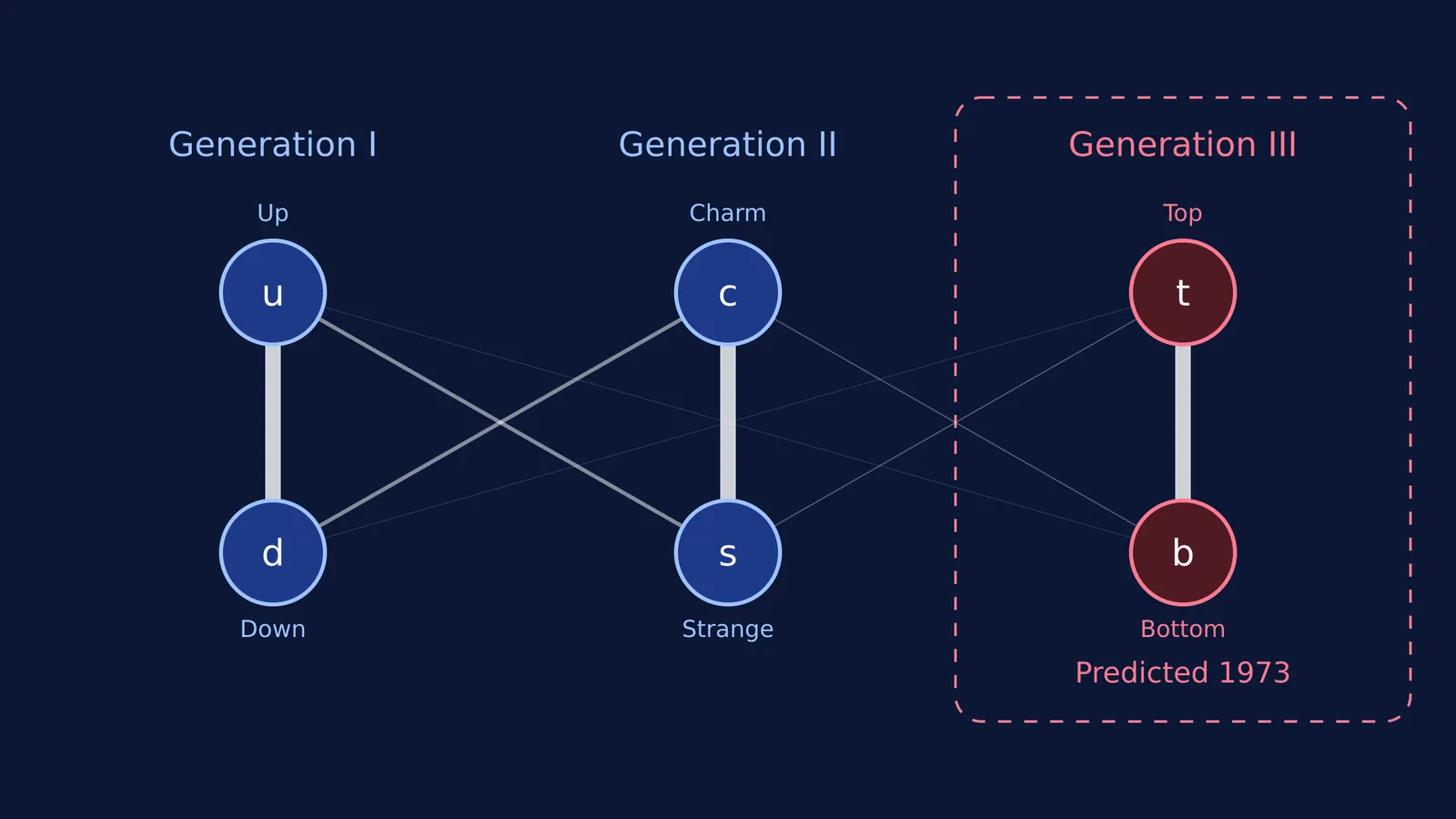
Today, the six quarks are understood as the fundamental building blocks of matter, divided cleanly into three families. As you move to higher generations, the mass increases dramatically, which is why the heavier quarks are rarely seen outside of particle accelerators:
Generation I (Up and Down): The lightest and most stable quarks. They make up the protons and neutrons that form the nuclei of everyday matter.
Generation II (Charm and Strange): Considerably heavier quarks. They are produced in high-energy interactions, such as cosmic rays striking the atmosphere, but decay very quickly.
Generation III (Top and Bottom): The heaviest quarks. The top quark is so massive that it decays almost instantly after being created in high-energy collisions, before it can even form hadrons.
Studying the CKM matrix and the symmetries of the Standard Model can be challenging. Fermi's AI tutor can work out what you already know and build a plan for the session, so you sit down to a clear next step. To check conservation laws or quark properties, the Fermi Concept Library holds every concept in physics, chemistry, biology, mathematics and computing, each with its own lesson and its place in the map.
Understanding the strange behaviour of quarks also connects to other great discoveries in particle physics, from how fundamental particles change their identity—like Takaaki Kajita and the neutrinos that change flavour in flight—to the foundational properties of matter, such as Uhlenbeck, Goudsmit and the spin of the electron.


