

On this page
When we look at the weather, it seems impossible to predict whether it will rain on a Tuesday next month. If meteorologists struggle with short-term forecasts, how can climate scientists confidently predict what the Earth will be like in fifty years?
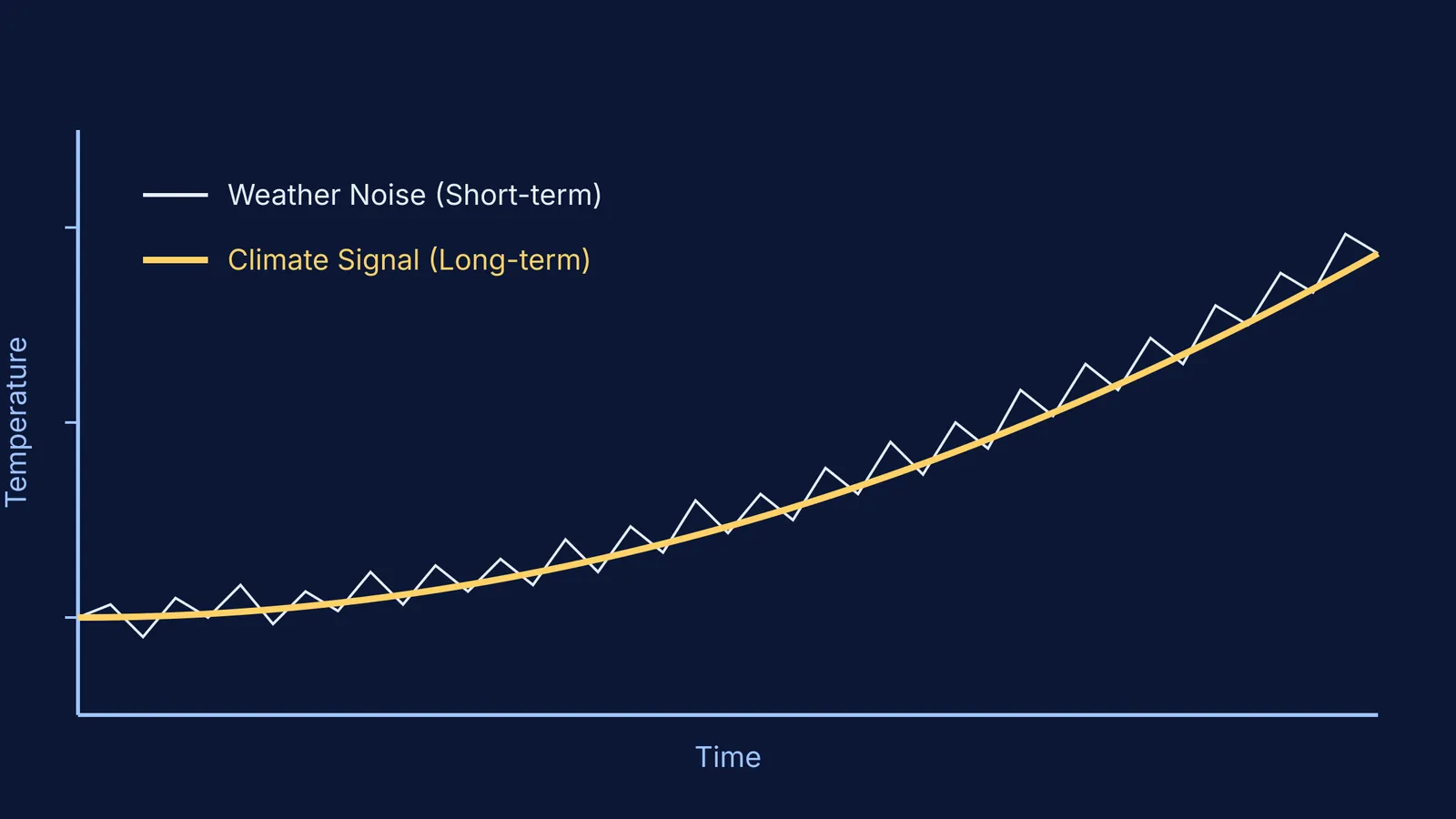
Klaus Hasselmann answered this question by proving that the chaotic noise of daily weather is exactly what drives long-term climate models. In 2021, he shared the Nobel Prize in Physics for his work on understanding complex physical systems and reliably predicting global warming (source).
How can chaotic weather produce a climate signal?
In 1976, Hasselmann published "Stochastic climate models: Part I. Theory" in the journal *Tellus* (source). To explain his model, we can look at a classic problem in physics: Brownian motion.
In 1827, botanist Robert Brown noticed that pollen grains suspended in water jittered randomly under his microscope. Albert Einstein later proved this happened because tiny, fast-moving water molecules were constantly colliding with the pollen. Over time, those chaotic, invisible hits cause the large pollen grain to drift slowly in a measurable direction—a process called a random walk.
Hasselmann realised that the Earth's climate works the same way. The fast, unpredictable changes in the atmosphere—what we experience as daily weather—act like the rapidly moving water molecules. The ocean, which holds immense amounts of heat and changes very slowly, acts like the heavy pollen grain. Building on the early computer climate models of Syukuro Manabe, Hasselmann proved that the continuous, random "hits" of weather noise integrate into slow, mathematically predictable changes in the climate. The noise does not ruin the model; it is the engine of the long-term shift.
What are optimal fingerprints?
Once Hasselmann proved that the climate naturally wanders because of weather noise, another problem arose: if the climate changes on its own, how can we prove that human emissions are causing it to warm faster?
In 1993, he solved this by publishing the "optimal fingerprint" method in the *Journal of Climate* (source006%3C1957:offtdo%3E2.0.co;2)). Different factors leave different patterns on the Earth's atmosphere. For example, changes in the Sun warm the entire atmosphere, while greenhouse gases warm the lower atmosphere but cool the upper layers.
By applying rigorous statistics to separate the background noise of natural weather from these specific spatial and temporal patterns, Hasselmann gave researchers the tools to cleanly isolate the human fingerprint on global warming. His method showed exactly how much of the temperature rise was due to natural variability and how much was driven by human activity. This finally proved what early pioneers like Guy Callendar had suspected about carbon dioxide warming decades earlier.
How can you find the signal in your own noise?
Students often feel the same frustration as early climate scientists trying to see the trend through the weather. One week, a physics test goes perfectly; the next, you feel entirely stuck on a new topic. When your daily performance fluctuates wildly, it is easy to think you are making no progress.
Here is how to apply this thinking to your own study habits:
Expect weather noise: A single bad quiz score or a tough evening of studying is just a daily fluctuation. It does not mean your long-term trend has reversed or that you are fundamentally bad at the subject.
Focus on the ocean: The ocean changes slowly because it has immense thermal mass. Your "climate" is the foundation of concepts you have truly mastered. When you struggle, use the Fermi Concept Library to strengthen that foundation rather than cramming blindly for the next test.
Look for your fingerprints: If your ability to solve complex problems is slowly rising, look for the cause. Did you change how you study? Fermi's AI tutor builds a plan for your session and checks understanding as it goes, acting as the steady force that pushes your learning forward despite the day-to-day noise.
Zoom out to see the trend: Just like a climate scientist plots temperature over decades rather than days, look at your progress over a whole term. A concept that felt impossible in August might be second nature by November. Track your mastery of broad topics, not just your daily marks.
Just as the early equations of weather forecasting eventually gave way to robust climate models, learning to ignore your daily noise will help you see the long-term signal of your own academic progress.


