

On this page
In 1969, Ken Thompson created Unix at Bell Labs alongside Dennis Ritchie (Wikipedia). They needed a simpler, more elegant environment than the massive mainframe systems of the era, leading to an operating system that fundamentally changed software development.
Who created Unix at Bell Labs?
In the late 1960s, researchers at Bell Labs were stepping back from an overly complex operating system project named Multics. Ken Thompson wanted a simpler environment to work in. He found a little-used PDP-7 minicomputer at the lab, and over a few weeks in 1969, he wrote the very first version of what would become the Unix operating system.
It is easy to get stuck when learning computing history, because the names and acronyms pile up quickly. When you use Fermi's AI tutor, it works out what you already know and builds a plan for the session, so you sit down to a clear next step rather than a confusing timeline.
How did a game called Space Travel lead to Unix?
Before Unix existed, Thompson had written a video game called *Space Travel*, which simulated the movement of planets and moons in the solar system (Wikipedia)). The game ran poorly and expensively on the larger mainframe computers Bell Labs was using.
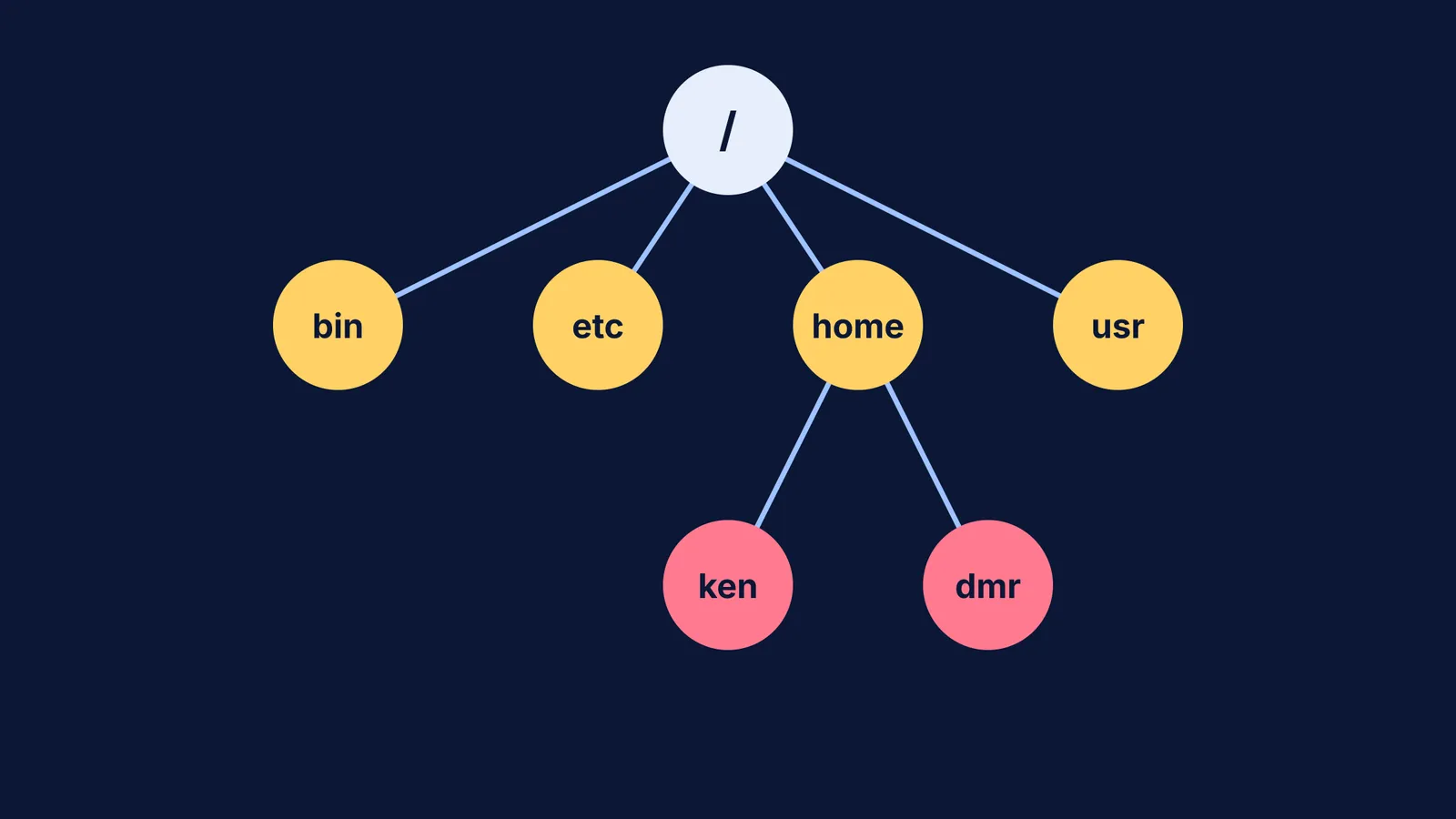
To play the game smoothly, Thompson ported it to the PDP-7. However, the machine lacked a functioning operating system, so he and Dennis Ritchie had to build everything from scratch. They designed a hierarchical file system, a process management structure, and a command-line interface. The foundations of Unix were laid down just so a developer could simulate orbits on a screen.
Why does the Unix philosophy still matter?
Unix was designed around a simple, powerful philosophy: write programs that do one thing and do it well, and write programs to work together. Instead of building massive applications that tried to do everything, Unix provided small tools that could be chained together.
If you are trying to understand how these early computing concepts fit into modern computer science, the Concept Library contains every concept in computing, each with its own lesson and its place in the map.
Does Unix run inside Android and macOS?
The ideas born at Bell Labs never faded away; they simply evolved. Apple's macOS is a certified UNIX operating system, carrying forward the architecture built by Thompson and Ritchie (Wikipedia).
Meanwhile, the mobile device in your pocket likely relies on the exact same heritage. Google's Android is built on the Linux kernel, which is a Unix-like system designed to behave like the original Unix (Wikipedia)). The file structures and permission systems on modern smartphones trace their lineage straight back to that Bell Labs laboratory in 1969.
Just as earlier engineers designed Colossus (Tommy Flowers and Colossus, the codebreaking computer) to crack specific codes, Thompson and Ritchie built Unix to make general computing manageable. This modular foundation empowered later computer scientists to focus entirely on logic, much like the detailed approaches seen in early algorithm design (Donald Knuth and the analysis of algorithms, with a worked example).
How to apply the Unix philosophy to your studies
You do not need to be a software engineer to use the Unix philosophy. It is a highly effective way to manage your schoolwork or university exam preparation:
Do one thing well: Instead of studying broad subjects all evening, break your work down. Spend a single session only on mastering vector addition.
Chain your tools together: Use your textbook to learn the theory, write notes in your own words, and finally test yourself with past papers. Let the output of one step become the input of the next.
Keep it simple: Do not clutter your desk or digital workspace with endless applications. Find simple, reliable methods that you can combine as needed.
By breaking large, intimidating tasks into small, functional pieces, you build a robust system for learning—just as Ken Thompson built an operating system that still runs the world today.


