

On this page
Fourier's name appears on two things every science student meets. In Class 11 physics, the rate of heat flow through a rod is proportional to the temperature difference and the area, and inversely proportional to the length. In higher mathematics, Fourier series let you build almost any repeating shape out of sine waves. Both come from one man's work on heat. This post tells Fourier's story from reliable sources and works through both ideas with numbers.
Who was Joseph Fourier?
The MacTutor biography records that Fourier was born in Auxerre on 21 March 1768, the ninth of twelve children of a tailor's second marriage, and died in Paris on 16 May 1830. His mother died when he was nine and his father the following year. By 14 he had worked through the six volumes of Bezout's mathematics course.
He trained for the priesthood but did not take his vows. During the Revolution he joined the local committee of the Revolution, was arrested in 1794 and feared the guillotine, and was released after Robespierre fell. He then studied at the new Ecole Normale under Lagrange, Laplace and Monge, and in 1797 succeeded Lagrange in the chair of analysis and mechanics at the Ecole Polytechnique.
In 1798 he went with Napoleon's expedition to Egypt as a scientific adviser and became secretary of the Cairo Institute. On his return Napoleon made him Prefect of Isere, based in Grenoble, where he drained swamps and oversaw a new road to Turin. It was there, from about 1804, that he did his work on heat.
What did Fourier discover about heat?
MacTutor records that by 1807 Fourier had completed his memoir On the Propagation of Heat in Solid Bodies, read to the Paris Institute on 21 December 1807. It set out the equation for how temperature spreads through a solid and solved it by writing temperatures as infinite sums of trigonometric functions.
The committee was not convinced. Lagrange and Laplace objected in 1808 to his expansions of functions as trigonometric series, and Biot to his derivation of the heat equations. Fourier entered the 1811 prize on the same subject and won, but the judges' report still complained about rigour. He became Secretary of the Academie des Sciences in 1822, and shortly afterwards the Academie published the prize essay as Theorie analytique de la chaleur.
Worked example 1: heat flow through a copper rod
The NCERT Class 11 chapter on thermal properties of matter gives the steady-state law as H = KA(T₁ − T₂)/L, where H is the heat current, K the thermal conductivity, A the cross-section and L the length. Its table lists K for copper as 385 W m⁻¹ K⁻¹.
A copper rod 0.5 m long with a cross-section of 1 cm² has one end in boiling water (100 °C) and one in ice (0 °C).
Convert the area. 1 cm² = 1 × 10⁻⁴ m².
Substitute. H = 385 × (1 × 10⁻⁴) × (100 − 0) / 0.5.
Calculate. 385 × 10⁻⁴ = 0.0385; × 100 = 3.85; ÷ 0.5 = 7.7 W.
Common mistakes: leaving the area in cm² (which gives an answer 10⁴ times too big), using the rod's length in cm, and confusing steady-state flow with the heating-up stage, where this formula does not apply. Our guide to heat conduction and thermal resistance covers rods in series and parallel.
Worked example 2: building a square wave from sines
A square wave equal to 1 between 0 and π and −1 between −π and 0 has the Fourier series
f(x) = (4/π)(sin x + sin 3x/3 + sin 5x/5 + …).
At x = π/2, f = 1 and sin x, sin 3x, sin 5x… become 1, −1, 1…. So 1 = (4/π)(1 − 1/3 + 1/5 − 1/7 + …), which gives π/4 = 1 − 1/3 + 1/5 − 1/7 + …. Check the partial sums of (4/π)(1 − 1/3 + 1/5 − …):
1 term: 1.273
3 terms: 1.104
5 terms: 1.063
100 terms: 0.997
The sums overshoot and undershoot, closing in on 1 slowly. The same series for π/4 was found centuries earlier in Kerala, as our post on Madhava and infinite series explains.
What can a student take from Fourier's way of working?
Trust a method that works, then tighten it. He kept his series in the face of the two leading mathematicians in France.
Let a real problem lead. A question about how solids cool produced a new branch of mathematics.
Keep working in a busy life. He did his main research while running a French department.
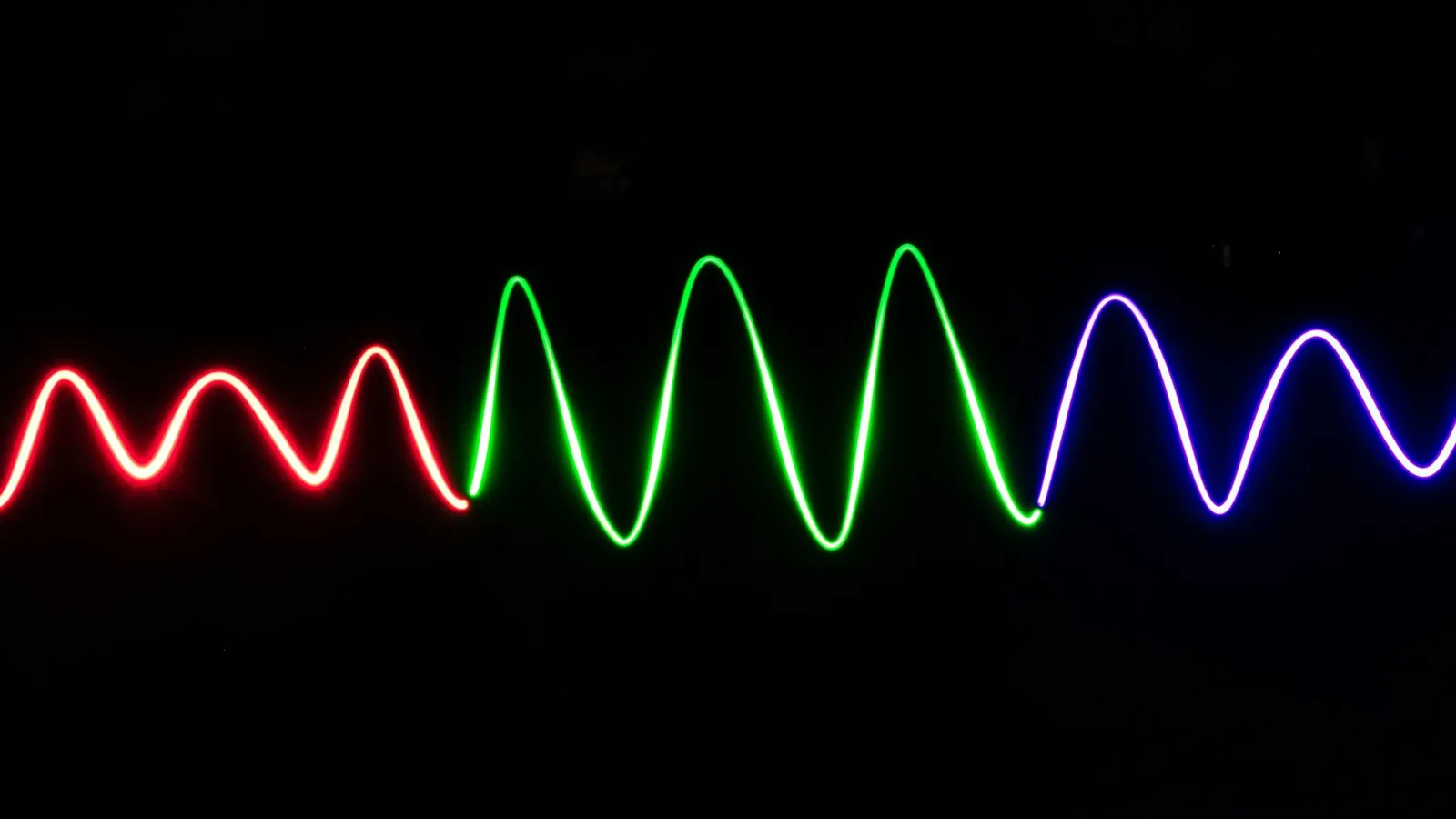
Sine waves adding up to a square wave is easier to see than read, and the Fermi Simulation Lab has interactive simulations for ideas like this one.
Redo example 1 for a steel rod (K = 50.2 W m⁻¹ K⁻¹ in the NCERT table) with the same size and temperatures, and compare the heat current with copper's.


