

On this page
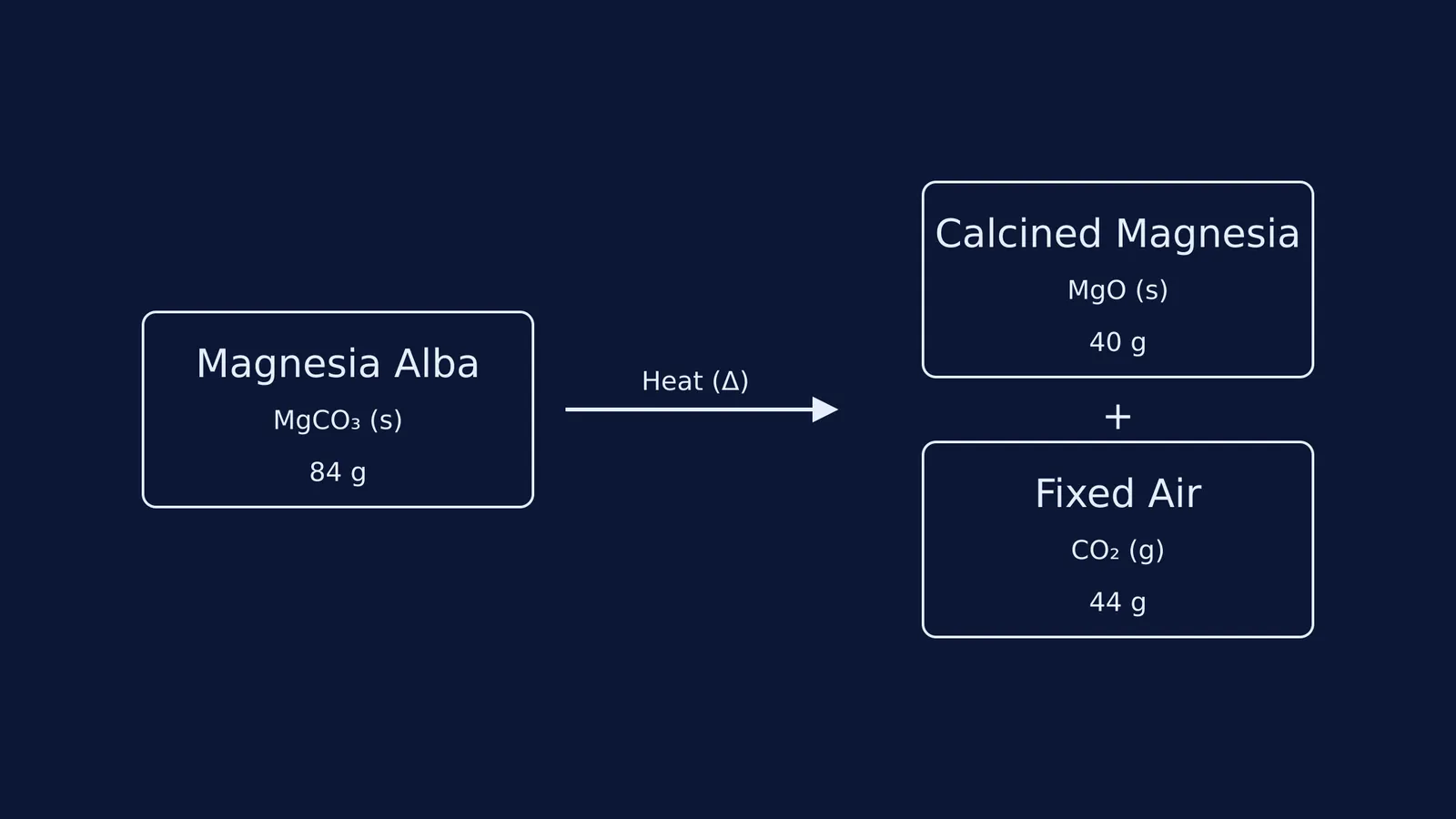
Before 1754 (Wikipedia), scientists believed that air was a single, indivisible element. That changed when a Scottish researcher named Joseph Black started weighing his chemicals. By heating a common compound called magnesia alba (magnesium carbonate), Black proved that a solid could trap and release a distinct, heavy gas. This gas was carbon dioxide, and his experiment marked the birth of quantitative chemistry.
What was the magnesia alba experiment?
At the University of Edinburgh, Joseph Black was investigating alkaline treatments for kidney stones. He focused on magnesia alba, a mild white powder. When he heated it strongly, the powder turned into calcined magnesia (magnesium oxide) and lost a significant portion of its initial mass (Britannica).
Black was meticulous. He used a precise analytical balance to measure the powder before and after heating. Instead of assuming the lost mass had simply vanished in the fire, he deduced that a gas had been driven off by the heat. This reliance on exact measurement anticipated later breakthroughs in chemistry, such as Mikhail Lomonosov and the sealed-flask test of conserved mass.
How did Joseph Black discover carbon dioxide?
Black did not just stop at noting the weight loss; he captured the escaping gas and tested its physical and chemical properties. He observed that it was denser than ordinary air and did not support either flame or animal life (Wikipedia).
Because of these properties, this new gas behaved differently from the air we breathe. It would extinguish a lit candle instantly. Furthermore, when he bubbled it through lime water, the clear liquid turned milky due to the precipitation of calcium carbonate. This remains the standard test for carbon dioxide taught in schools today. When you are studying these standard chemical tests, Fermi teaches rather than answers, holding a line of reasoning across a session to ensure you understand the underlying reactions.
Why did he call it "fixed air"?
Black named his newly isolated gas "fixed air" because it had been "fixed" or trapped within the solid matrix of the magnesia alba (Linda Hall Library). To prove that the gas was a true chemical component of the solid, he performed the reaction in reverse.
By treating the calcined magnesia with a solution of potash containing dissolved fixed air, he was able to restore the powder to its original weight and chemical state. This reversibility was groundbreaking. It proved that a gas could combine chemically with a solid and later be released, retaining its unique properties throughout the cycle. If you find it hard to picture how atoms rearrange themselves between solid and gas phases, the Simulation Lab provides interactive simulations for the ideas that are easier to see than to read.
What did this mean for the four elements theory?
For centuries, natural philosophy had been dominated by the idea that there were only four elements: earth, water, air, and fire. Air was considered a monolithic, unchangeable substance.
Black’s discovery of fixed air broke this ancient rule. He proved that atmospheric air was not a single entity, but rather a mixture that could contain different, distinct gases with their own chemical identities. This revelation triggered the Chemical Revolution, paving the way for the later discoveries of oxygen, nitrogen, and hydrogen. Decades later, scientists would continue to explore the unique properties of Black's gas, leading to breakthroughs like Thomas Andrews and the critical temperature of carbon dioxide.
How can you learn from Joseph Black's method?
Black’s breakthrough was not due to complex machinery, but rather his strict adherence to quantitative measurement and conservation of mass. You can apply his empirical approach to your own study of chemistry.
Here is a checklist for studying chemical reactions:
Track the mass: Always balance the equation and confirm that the total mass of the reactants equals the total mass of the products.
Identify the states: Note which substances are solids (s), liquids (l), or gases (g). Gas evolution often explains unexpected weight changes in open containers.
Test the products: Learn the standard laboratory tests for common gases, such as lime water for carbon dioxide or a glowing splint for oxygen.
Look for reversibility: Ask yourself if the reaction can be driven backwards by changing the conditions, just as Black reversed his magnesia experiment.


