

On this page
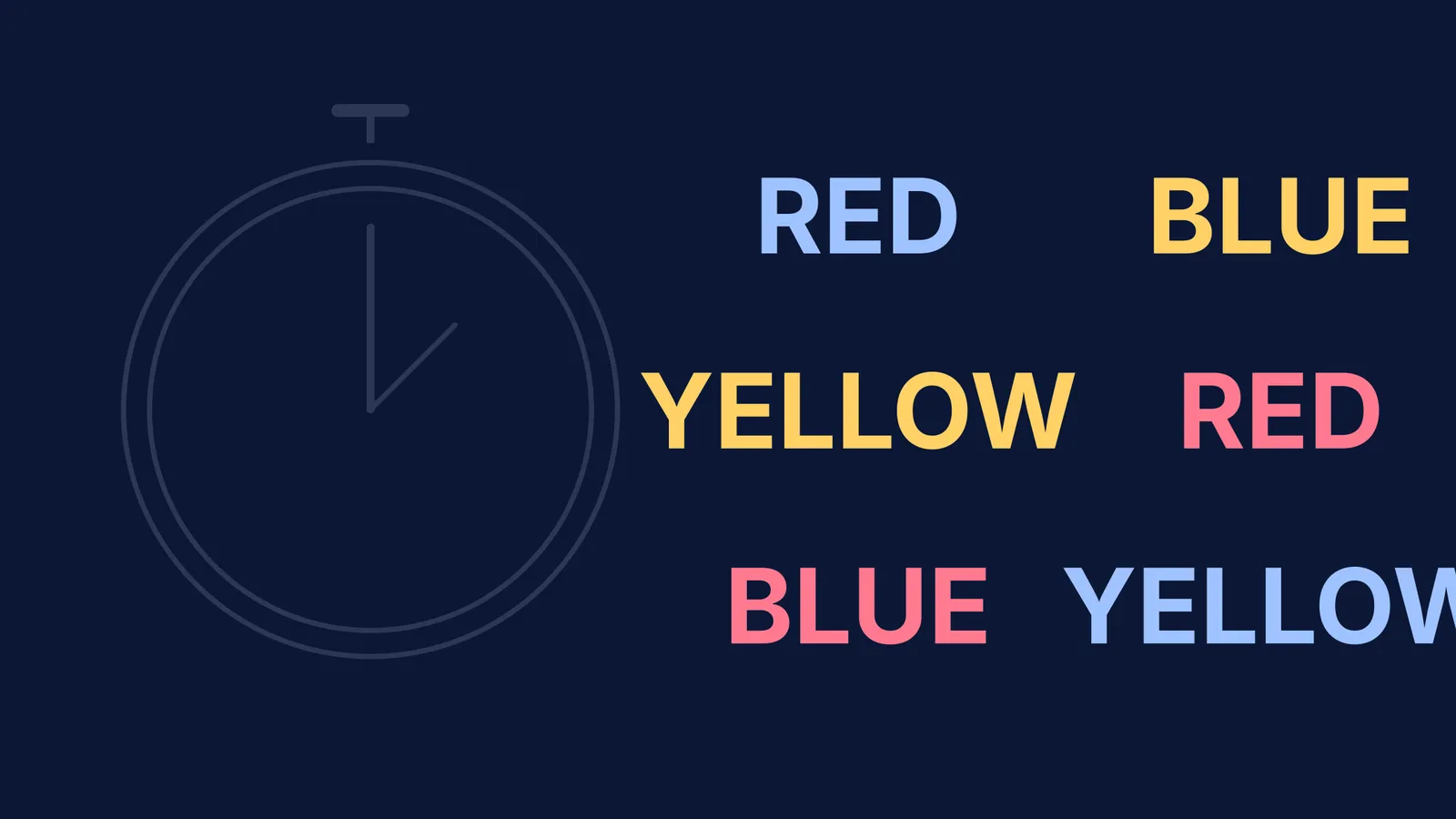
If you see the word "RED" printed in blue ink, what colour do you say? This simple question is the basis of one of the most famous demonstrations in cognitive psychology. When your eyes take in conflicting information, your brain has to fight its own automatic habits to give the correct answer.
What is the Stroop effect experiment?
The Stroop effect experiment is a classic test of cognitive interference. In a standard setup, you are asked to name the ink colour of a printed word as quickly as possible. When the word and the ink colour match (for example, the word "BLUE" printed in blue ink), the task is effortless.
However, when the word and the ink colour conflict—like the word "GREEN" printed in red ink—you will naturally stumble and hesitate. Your brain wants to read the text automatically, and you must consciously suppress that powerful urge to name the colour of the ink instead. This measurable delay in your reaction time is known as the Stroop effect.
How did John Ridley Stroop test this?
The American psychologist John Ridley Stroop formally described this phenomenon in a 1935 paper titled *Studies of interference in serial verbal reactions*. To measure the exact cost of this interference, he ran a carefully controlled experiment with 100 college students, dividing the task into two distinct parts.
First, he asked the students to name the colours of 100 solid squares printed on a page. This control task took 63.3 seconds on average. Next, he handed them 100 conflicting colour words and asked them to name the ink colour of each word. The average time shot up to 110.3 seconds. Participants took 74.3% longer to name the ink colour of conflicting words compared to solid squares.
Interestingly, the reverse was not true. When asked to simply *read* the conflicting words and ignore the ink colour, the students were barely slowed down at all. Stroop found that reading conflicting words was only 5.6% slower than reading words in plain black ink. This asymmetry proved a crucial point: some cognitive processes are so highly practiced that they dominate our attention, while others require continuous, conscious effort.
Why does the brain struggle with conflicting information?
The massive 74.3% delay happens because of a concept called automaticity. By the time you are a young adult, reading is a deeply ingrained, automatic habit. Your brain decodes letters into meaning instantly, without any conscious effort. Naming colours, while simple, is a less practiced skill that requires slightly more deliberate processing.
When you look at a conflicting word, your brain's fast, automatic system reads the text instantly. Your slower, conscious system then has to step in, suppress the incorrect word, and fetch the name of the ink colour. This internal tug-of-war takes time and mental energy. It is a perfect example of Kahneman's fast and slow thinking, where a rapid intuitive response must be forcefully overridden by careful analysis.
Stroop also tested if practice could eliminate this interference. In his third experiment, participants practiced the colour-naming task for eight days. The delay caused by interference dropped by 33.9%, but the effect never disappeared completely. No matter how much they practiced, their automatic reading habit still forced a slight delay.
How can you use the Stroop effect to improve focus?
The Stroop effect reveals how easily attention is derailed by competing signals. When studying or taking an exam, your brain constantly filters out distractors. If you struggle with multitasking while studying, you are likely forcing your brain to resolve conflicts between your textbook and background distractions, draining the mental energy needed to learn.
Examiners frequently use cognitive interference to test your true understanding. Assertion-reason questions or tricky multiple-choice options are specifically designed to look familiar. The examiner wants your automatic "fast" system to recognize a keyword and jump to a conclusion before your "slow" system notices a subtle trap.
Consider a physics problem about a ball thrown upwards. If an option says "acceleration is zero at the highest point", your automatic system might recognise the pattern "highest point = zero velocity" and quickly assume acceleration is zero. Your brain substitutes a familiar pattern for the harder analytical task of remembering that gravity acts constantly.
To beat this, you have to build habits that break your automaticity. When a question seems too obvious, force yourself to physically underline the keywords, draw a quick diagram, and write down the formula before looking at the options.
When a concept is tricky and you keep falling for cognitive traps, step out of automatic patterns. This is where Fermi's AI tutor helps; instead of just answering questions, it holds a line of reasoning across a whole session, notices where a student is stuck, and asks questions that force deliberate, step-by-step thinking.
By understanding the Stroop effect, you can stop fighting your brain's tendencies. Remove conflicting distractions, and learn to slow down when your automatic habits try to rush you through complex problems.


