

On this page
In 1842, the astronomer and polymath Sir John Herschel needed a cheap, reliable way to copy his complex mathematical and astronomical notes. While his peers Louis Daguerre and Henry Fox Talbot were inventing photography using expensive silver compounds, Herschel turned to iron. The result was the cyanotype, a photographic process that produced deep blue images using only iron salts, sunlight and water.
Herschel published his findings in an 1842 paper for the Philosophical Transactions of the Royal Society of London. Because the process was so stable and required no darkroom, architects and engineers adopted it to duplicate technical drawings, giving the world the original blueprint.
What is the cyanotype process?
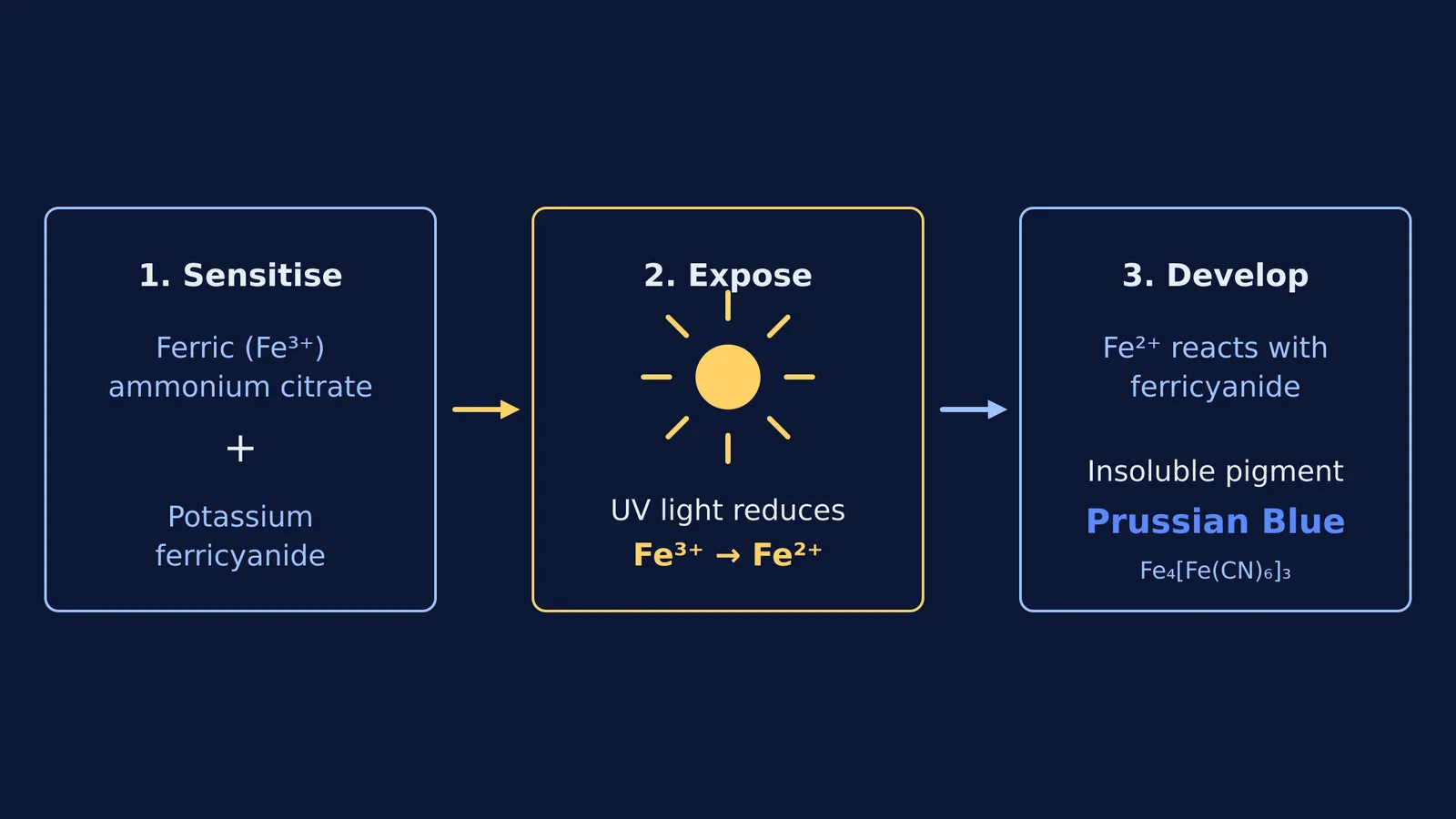
The cyanotype relies on the light sensitivity of two specific iron salts: ferric ammonium citrate and potassium ferricyanide. When mixed in equal parts, these chemicals form a yellowish-green, photosensitive solution.
You brush this solution onto paper and let it dry in the dark. To make a print, you place an object—like a leaf, or an engineering drawing on translucent tracing paper—directly onto the coated paper and expose it to ultraviolet (UV) light, usually from the Sun. The areas blocked from the light remain yellowish, while the exposed areas react to the UV rays. Finally, washing the paper in plain water dissolves the unreacted chemicals, leaving a permanent blue image behind.
Shortly after Herschel invented the method, the English botanist Anna Atkins realised its potential for scientific illustration. In October 1843, she used cyanotypes to publish *Photographs of British Algae*, widely considered the first book illustrated with photographs.
How does the chemistry of a cyanotype work?
The cyanotype relies on a photochemical redox reaction. The process begins with the ferric (Fe³⁺) ions in the ferric ammonium citrate.
When UV light hits the paper, it provides the energy to transfer an electron from the citrate to the iron, reducing the Fe³⁺ ions to ferrous (Fe²⁺) ions.
These newly formed Fe²⁺ ions immediately react with the other chemical on the paper, potassium ferricyanide (K₃[Fe(CN)₆]). This reaction yields a complex, insoluble blue coordination compound called Prussian blue—chemically known as ferric ferrocyanide, or Fe₄[Fe(CN)₆]₃.
Because Prussian blue is completely insoluble in water, you do not need any special fixing chemicals. Rinsing the paper in water washes away the water-soluble unreacted salts from the unexposed areas, revealing the white paper underneath. As the print dries in the air, the Prussian blue oxidises slightly, deepening into its signature rich, dark hue.
How do you study coordination compounds?
The cyanotype is a perfect real-world example of transition metal chemistry. The deep blue colour of Prussian blue comes from the transfer of electrons between the Fe²⁺ and Fe³⁺ ions through the cyanide ligands, absorbing red and yellow light while reflecting blue.
If you want to see how these d-orbital interactions work, the Fermi Concept Library maps out the chemistry of coordination compounds and ligand field theory. When you need to practice balancing complex redox equations or calculating oxidation states, Fermi's AI tutor can work through the problem alongside you, writing on a board and checking your understanding as it goes.
Just as learning about the dispersion of white light by a glass prism helps you understand how different wavelengths behave, seeing the cyanotype in action brings photochemistry to life. And while electron dot structures of covalent molecules show how simple bonds form, complexes like Prussian blue show what happens when transition metals share electrons in large, stable structures.
Try making your own sun print
You do not need a laboratory to try Herschel's chemistry. Sun print kits (which use pre-coated cyanotype paper) are cheap and widely available.
Prepare: Find a flat object, like a fern, a feather, or a stencil.
Expose: Place the object on the cyanotype paper and leave it in direct sunlight. Watch as the paper turns silvery-grey as the UV light reduces the iron.
Develop: Rinse the paper under cold water. The unexposed shadow will wash away to white, and the sunlit areas will turn deep blue.


