

On this page
Mass spectrometry is one of the most powerful tools in chemistry. It identifies molecules by measuring their mass, allowing scientists to see exactly what is in a sample. But for decades, it had a glaring blind spot: it could not weigh large biological molecules like proteins.
John B. Fenn solved this problem in 1988. He found a way to make massive proteins "fly" through a mass spectrometer without breaking apart. His technique, called electrospray ionisation (ESI), transformed the study of biology and earned him a share of the 2002 Nobel Prize in Chemistry.
What is the "molecular elephant" problem?
A mass spectrometer does not measure mass directly. Instead, it measures a molecule's mass-to-charge ratio (m/z). To do this, the machine must first turn the sample into a gas and strip away or add electrons to give it an electric charge.
This worked perfectly for small molecules, but proteins are massive. A typical mass spectrometer in the 1980s could only detect an m/z up to about 3,000, a limit Fenn noted in his Nobel Lecture. If a protein with a mass of 130,000 daltons (Da)—the upper range Fenn demonstrated in his 1989 paper in *Science*—picked up a single positive charge (z = 1), its m/z would be 130,000, completely off the scale.
Worse, getting these heavy molecules into a gas phase usually required heating them. But proteins are fragile. Heating them simply cooked and shattered them before they could be measured. Scientists needed a "soft" ionisation method that could lift these heavy molecules into the gas phase gently.
How does electrospray ionisation give proteins wings?
Fenn did not invent electrospray from scratch; in the 1960s, a chemist named Malcolm Dole had attempted to spray synthetic polymers, but lacked the equipment to prove his ions were intact. Two decades later, Fenn revived the idea.
Instead of boiling the sample, he dissolved the proteins in a liquid and passed it through a fine needle held at a high voltage. The strong electric field rips the liquid into a fine mist of highly charged droplets. As the solvent evaporates in the vacuum chamber, the droplets shrink.
Crucially, Fenn discovered that electrospray ionisation does not just add one charge. A single large protein molecule will pick up dozens of protons (H⁺).
This multiple charging is the secret to the technique. If a 130,000 Da protein picks up 100 protons, its charge z is 100. Its mass-to-charge ratio becomes 130,000 / 100 = 1,300, which falls perfectly into the 3,000 m/z limit of standard instruments.
In his Nobel Lecture, Fenn called these massive proteins "molecular elephants," and described his multiple-charging technique as giving them "electrospray wings".
How do the proteins actually leave the droplet?
While Fenn proved that ESI worked, chemists debated exactly how the proteins escaped the liquid droplet. Today, there are two main models that explain this transition.
The Charge Residue Model (CRM) suggests that the droplet continues to evaporate and shrink until it contains only one single protein molecule. When the very last solvent molecules evaporate away, all the positive charges that were on the droplet's surface simply settle onto the dry protein.
The Ion Evaporation Model (IEM) suggests that as the droplet shrinks, the charges get so crowded that their mutual repulsion creates an immense electric field at the surface. Before the droplet can dry out completely, this field becomes strong enough to violently eject or "evaporate" the charged protein directly from the liquid surface into the surrounding gas.
Current research suggests that large, folded proteins typically follow the Charge Residue Model, while small molecules tend to be ejected via the Ion Evaporation Model.
How do you calculate protein mass from an m/z envelope?
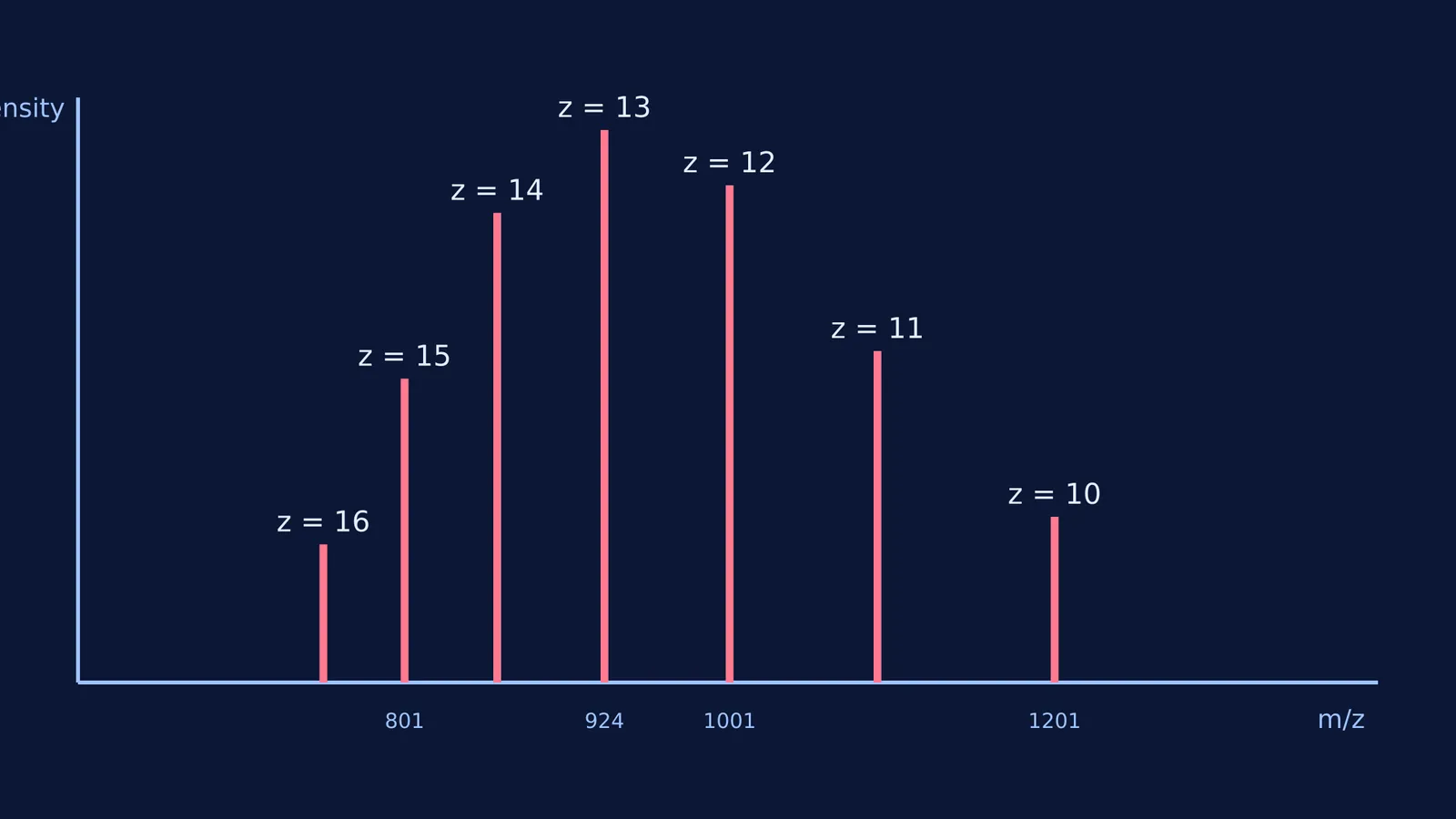
Because a population of identical proteins will pick up different numbers of protons, an electrospray mass spectrum does not show just one peak. It shows a "charge state envelope"—a series of adjacent peaks representing the exact same molecule with z, z+1, and z+2 charges.
You can use the spacing between any two adjacent peaks to calculate the exact mass of the original protein. Let the heavier peak be m₁ (which has charge z) and the lighter peak be m₂ (which has charge z+1).
The formula for the charge z of the first peak is: z = (m₂ - 1) / (m₁ - m₂)
And the original mass M is: M = z × (m₁ - 1)
If you are studying analytical techniques for your exams and get stuck on the algebra of adjacent peaks, the Fermi Problem Library has worked problems with a step-by-step solver that explains the reasoning rather than printing an answer.
Why is electrospray the foundation of modern proteomics?
Before Fenn's work, studying proteins relied heavily on slower methods, or breaking the proteins down into tiny pieces first. Today, researchers can look at large, intact proteins directly.
In a modern laboratory, scientists first separate complex mixtures—building on the legacy of Martin, Synge and partition chromatography and Arne Tiselius and separating proteins by electrophoresis—and then feed them directly into an ESI mass spectrometer. This combination is known as Liquid Chromatography-Mass Spectrometry (LC-MS).
By giving wings to molecular elephants, Fenn made it possible to identify thousands of proteins in a single drop of blood. This capability paved the way for modern drug discovery, disease diagnosis, and the entire field of proteomics.


